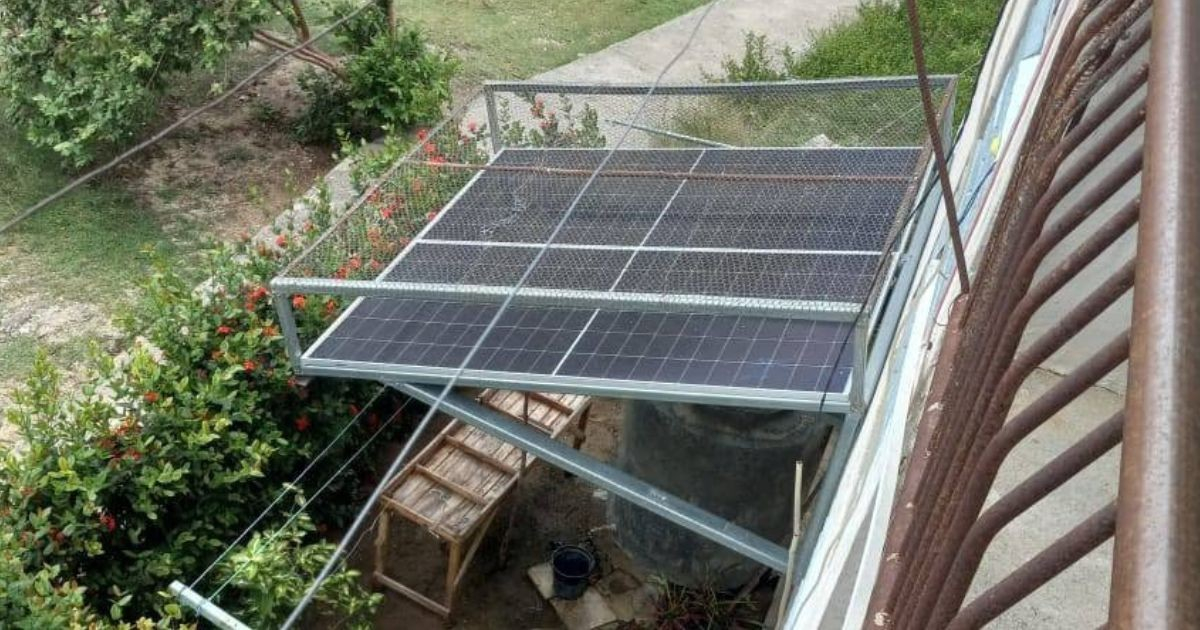
A Cuban resident named Yunier Batista Gonzalez has taken to Facebook to showcase his innovative approach to safeguarding residential solar panels in Holguín. He humorously dubbed his setup, which involves using chicken wire mesh, as an "Anti-Riot and Meteorite or Mistaken Stone Drop from Space" system.
The images, captured from an elevated vantage point, reveal the photovoltaic panels mounted on a galvanized metal framework, likely situated in a communal area of a multi-family residential complex. This metal mesh serves as a physical barrier against potential damage or theft.
Humor with a Serious Undertone
The playful title of the post subtly alludes to both the social unrest that Cuba has experienced in recent years and the inadvertent physical impacts from vandalism. Batista himself elaborates with the phrase "mistaken stone drop from space."
This homemade solution highlights a genuine and growing concern among Cubans who have invested in solar energy: the need to protect these high-value systems amid a surge in thefts, affecting both state-owned and private installations.
Escalating Threats to Solar Installations
In May 2026, a theft attempt was thwarted at the Las Nereidas Solar Park in Ciego de Ávila when two thieves tried to dismantle modules in the early morning hours of May 20. Following this incident, the plant enhanced its security with cold welding, coordinated nighttime patrols with local police, and reinforced perimeter fencing.
Such thefts are not limited to state facilities. By March 2026, Cubans had already been sharing methods to safeguard residential solar panels, including welded metal structures and reinforced enclosures. In one case, a solar park worker in Santiago de Cuba received a five-year prison sentence for stealing metal structures from the site.
Crisis-Driven Ingenuity
The backdrop to these homemade solutions is the most severe energy crisis Cuba has faced in recent years. Projected deficits reached up to 1,985 MW in May 2026, with blackouts lasting between 12 and 20 hours daily in many areas.
In response, the regime has accelerated the construction of photovoltaic solar parks — funded and equipped by China — achieving 49 parks connected to the grid with between 900 and 1,000 MW installed by March 2026, up from 34 parks at the end of 2025. Concurrently, many Cubans have privately acquired solar panels to mitigate power outages, making these systems valuable assets that require protection.
The use of chicken wire over solar panels exemplifies Cuban resourcefulness in the face of crisis, a well-documented trend that includes innovations like fans made from recycled batteries, almond leaf stoves, and other homemade inventions to endure blackouts.
The regime's official plan aims for 92 solar parks and 2,000 MW of installed capacity by 2028, a goal that does little to ease the immediate reality for millions of Cubans who, in the meantime, rely on chicken wire to safeguard their limited possessions.
Understanding Solar Panel Protection in Cuba
Why are Cubans using chicken wire to protect solar panels?
Cubans are using chicken wire as a cost-effective solution to protect solar panels from theft and potential damage. This method acts as a physical barrier, deterring thieves and preventing accidental or intentional impacts.
What prompted the increased theft of solar panels in Cuba?
The rise in solar panel thefts in Cuba is largely driven by the country's severe energy crisis, making solar panels a valuable commodity. Economic hardships and frequent blackouts have increased the demand for alternative energy sources, prompting some individuals to target these installations for profit.
How has the Cuban government responded to the energy crisis?
In response to the energy crisis, the Cuban government has accelerated the development of solar parks with the help of Chinese funding and equipment. By March 2026, 49 solar parks were connected to the grid, providing between 900 and 1,000 MW of power, with plans to expand further by 2028.