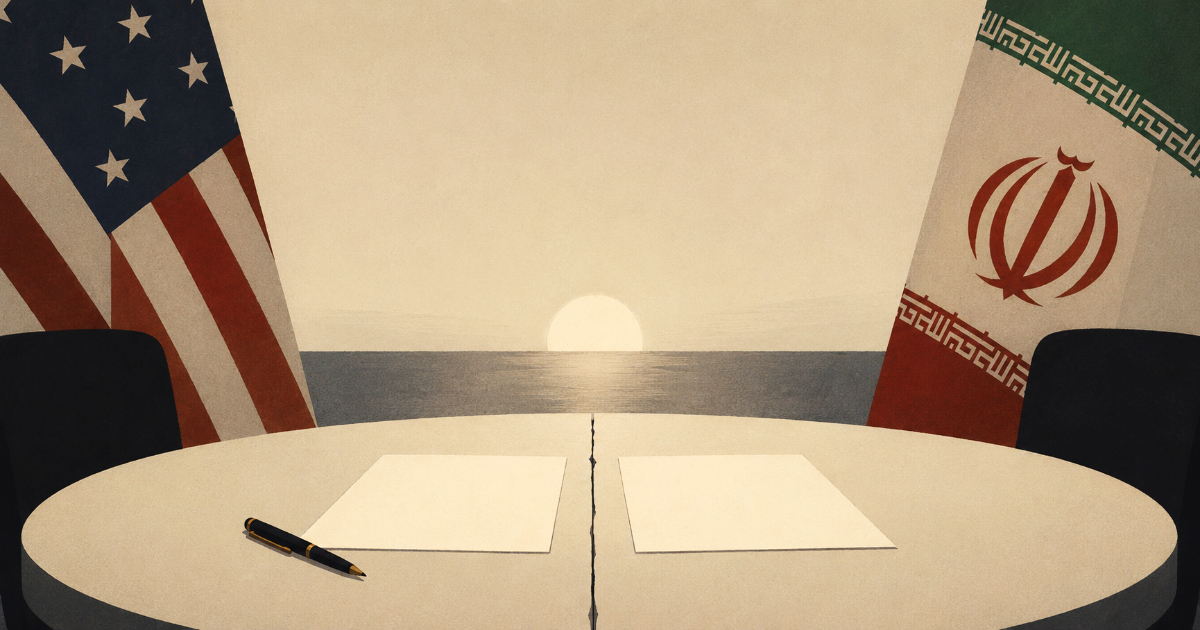
On Sunday, Pakistan's Prime Minister Shehbaz Sharif announced a "peace agreement" between the United States and Iran, a claim that former President Donald Trump echoed on Truth Social, declaring the deal "sealed" with the phrase "Let the oil flow!"
However, the truth behind the announcement is less solid than it appears on the surface.
Fragile Foundations of the Agreement
On Monday, analyst Nacho Montes de Oca cautioned that there is no definitive text yet, and the versions circulating from both sides do not align. He detailed the precarious state of negotiations in a comprehensive thread on X.
The official signing is set for Friday, the 19th in Switzerland, but the key hurdle is that Ayatollah Mojtaba Jamenei has not given formal approval to any document.
In reality, what's on the table is not a treaty but a preliminary memorandum of understanding that calls for a 60-day moratorium to continue discussions on the more contentious issues.
Key Issues and Unresolved Points
Trump announced the lifting of the naval blockade over the Strait of Hormuz, but Iran has yet to formalize the reopening.
A critical unresolved issue is Iran's nuclear program. Washington demanded a 20-year moratorium on uranium enrichment, while Tehran suggested a period between five and 15 years.
Iran currently holds about 440-450 kg of uranium enriched to 60%, a quantity technically close to the threshold needed for weaponization. "It's unclear how the U.S. plans to enforce the handover of enriched uranium," Montes de Oca pointed out.
Another issue is Lebanon. Iranian support for Hezbollah was omitted from the original agreement text, complicating any ceasefire, given Israel's refusal to accept conditions on its offensive and its exclusion from the memorandum.
Israeli Prime Minister Benjamin Netanyahu stated that his forces would not withdraw from southern Lebanon, a stance echoed by Defense Minister Israel Katz. "Israel has to give up something but gets nothing in return," the analyst summarized.
Economic Implications and Global Reactions
Unverified rumors suggest immediate economic compensation to Iran, in addition to access to approximately $24 billion in frozen assets and sanctions relief within 60 days post-signing.
The announcement did have a tangible effect: Brent oil prices fell to $81 per barrel amid expectations of reduced conflict, a relief for the global economy partly supported by the Gulf oil monarchies backing the negotiations.
Political Backlash and Historical Context
The agreement starkly contrasts with Trump's promises to the Iranian people on February 28, 2026, during the launch of Operation Epic Fury alongside Israel: "When we're finished, take control of your government. It will be yours for the taking."
Trump even mentioned "regime change," yet the current deal leaves the ayatollahs' regime in power, militarily weakened but politically intact.
Criticism within the Republican camp has been fierce. Former Secretary of State Mike Pompeo branded the agreement as "anything but America First" on May 24, likening it to the 2015 accord negotiated by Barack Obama.
Former National Security Advisor John Bolton was more blunt: warning that "the ayatollahs will have scored a significant victory" and that Iran would be "back on the path to nuclear arms."
The paradox is striking: the same hawks who backed Trump’s 2018 withdrawal from Obama's nuclear deal now criticize the new pact for being too similar, with the distinction that in 2026, Iran's nuclear program is significantly more advanced.
"Ultimately, what we have is a declaration without certainty of practical implementation," concluded Montes de Oca, summarizing what betting platform Polymarket estimated as a 57% probability of a nuclear agreement being finalized before June 30.
Understanding the U.S.-Iran Agreement: Key Questions Answered
What is the current status of the U.S.-Iran agreement?
The agreement is currently a preliminary memorandum of understanding with a 60-day moratorium to negotiate further. A formal treaty has not been signed yet.
What are the main unresolved issues in the agreement?
Key unresolved issues include Iran's nuclear program, the lifting of the naval blockade over the Strait of Hormuz, and the omission of Iranian support for Hezbollah in Lebanon.
How has the agreement announcement affected global markets?
The announcement led to a decrease in Brent oil prices to $81 per barrel, reflecting expectations of reduced conflict and economic relief partly supported by Gulf oil monarchies.