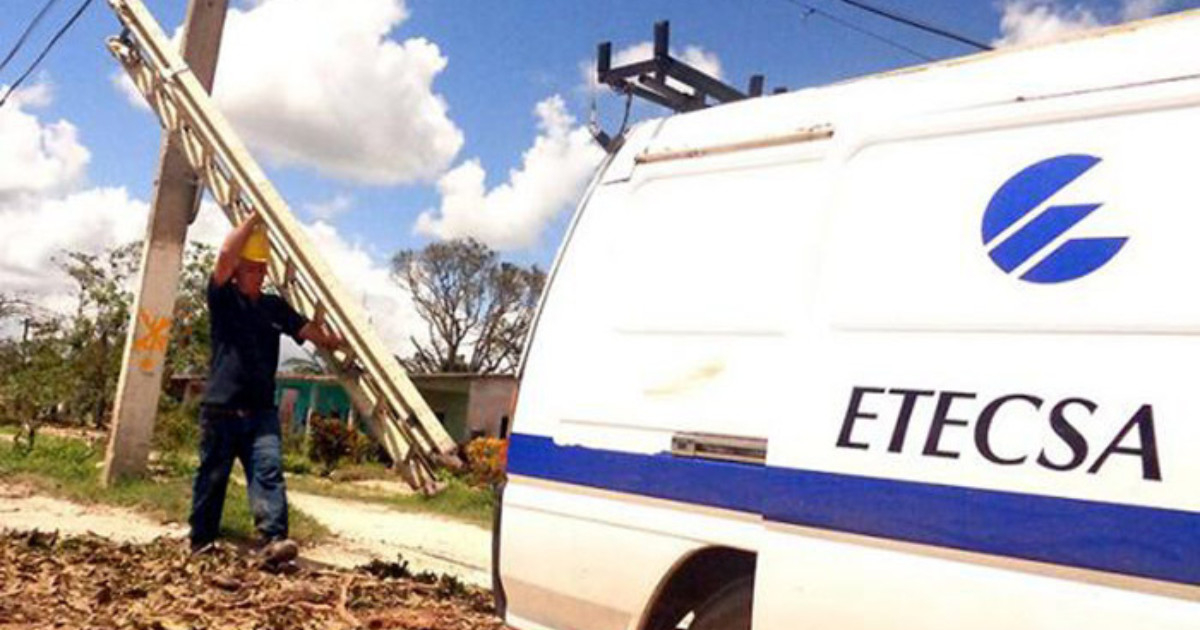
Renowned Cuban film critic and historian, Juan Antonio García Borrero, voiced his frustration this Sunday over being without a landline and Nauta Hogar service for two weeks in Camagüey, following a lightning strike. The sole telecom provider in Cuba, the state-run Empresa de Telecomunicaciones de Cuba S.A. (Etecsa), has failed to fix the issue, reportedly due to a missing "ladder-equipped vehicle" that has yet to arrive, according to their technicians.
García shared his plight on Facebook, narrating how Etecsa initially promised to resolve the problem within 72 hours—a commitment that remains unfulfilled without repercussions.
"After reporting the fault, Etecsa informed me they had up to 72 hours for the fix, but that hasn't been honored. Someone came to my house, but claimed they needed to send a vehicle with a ladder," the Camagüeyan intellectual recounted.
On Saturday, García Borrero spotted an Etecsa vehicle in the Los Coquitos neighborhood and hoped it was finally for his case.
"When I asked, they said they had no report for this area," he noted, highlighting that the issue wasn't even logged in the company's system.
Challenges and Contradictions in Cuba's Telecom Monopoly
García Borrero took this opportunity to point out a contradiction he had previously noticed when the government-controlled telecom monopoly imposed its controversial price hike in May 2025, emphasizing that the lack of competition removes any incentive to improve service quality.
"Without competition, they know we're forced to stick with them," he wrote, dismissing the official narrative blaming the embargo for these inefficiencies.
"Beyond the blockade they usually cite as the root of all their troubles, there are issues like these that have nothing to do with external factors," he stressed.
With a sense of resignation, the film critic lamented, "I'll remain disconnected, or barely able to interact, until Etecsa decides otherwise."
Echoes of Discontent: Unanswered Questions on Service Improvement
The question posed by the intellectual encapsulates the growing frustration among millions of Cubans: "Months after the price hike, we still don't know how, if at all, Etecsa's service has improved following the increase."
Comedian Ulises Toirac echoed this sentiment days earlier with a scathing critique of the millions collected without visible enhancements: "Where's all that money gone?"
The statistics support their concerns. A year after President Miguel Díaz-Canel's government enacted the price hike, Prime Minister Manuel Marrero Cruz admitted to the National Assembly that Etecsa had amassed over $24.8 million, averaging $540,000 daily.
Despite this, Cuba ranks last in Latin America with a mere 7.21 Mbps internet speed, according to the May Speedtest Global Index.
Ironically, amidst this backdrop, Etecsa recently celebrated an international award from the International Telecommunication Union for its online service portal, while an intellectual in Camagüey waits for someone to locate a ladder.
Etecsa's Service and Pricing: Key Questions Answered
Why is Etecsa unable to repair the service in Camagüey?
Etecsa has cited the need for a "ladder-equipped vehicle" as the reason for the delay in repairing the service disruption in Camagüey, which has yet to arrive.
What has been the impact of Etecsa's price increase?
Despite significant revenue from the price hike, there has been no noticeable improvement in Etecsa's service, leading to widespread dissatisfaction among users.
How does Cuba's internet speed compare regionally?
Cuba ranks last in Latin America for internet speed, with an average speed of just 7.21 Mbps, according to the Speedtest Global Index.