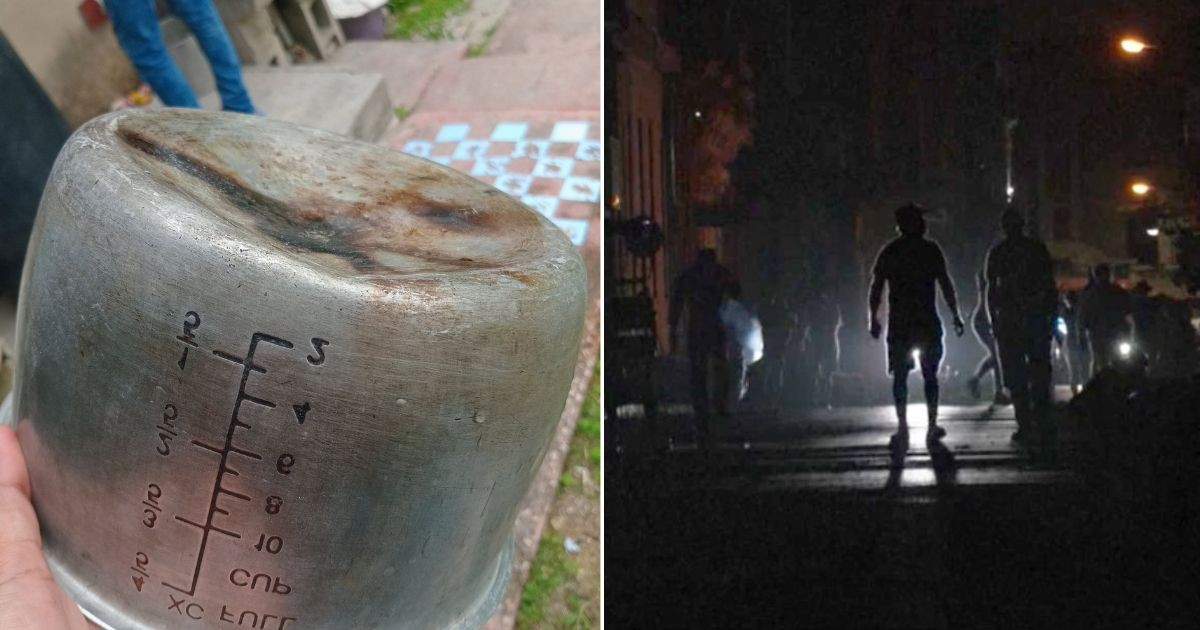
Jessica Castaño, a 28-year-old resident of Havana, shared a revealing post on Facebook that captures the exhaustion felt by millions. She posted a photo of the battered bottom of her pot—used during the noise-making protests known as "cacerolazos"—along with a post titled "Tutorial for Leaving a Pot Like This," detailing the harsh conditions that have driven her to the edge.
"Step 1: Have the electricity cut off for more than 24 hours and then restored for only five to 20 minutes," Castaño wrote, clearly outlining each linked deprivation. Without power, water can't be pumped, the refrigerator becomes "a foul-smelling display case where the food you worked hard to get spoils," liquefied gas is sold in dollars "apparently to collect currency that doesn't seem to be invested in anything here because there's NOTHING," and the price of charcoal skyrockets during the rainy season due to higher demand.
The toll isn't just physical. "When you're about to turn 28 but feel like you're 50 because we're aging at lightning speed, the physical and mental exhaustion is overwhelming," she lamented.
Castaño also shared a poignant moment with her eight-year-old daughter, who asked when the power outages would end, and she had no answer for her.
Her post concludes with a sentence that encapsulates the sentiments of an entire generation: "Nobody here is enduring, nobody wants to endure, give away the country or sell it to someone who cares, because nobody wants to spend the rest of their life enduring."
Castaño's post is part of a wave of heartbreaking stories about power outages shared by Cubans on social media.
In provinces like Granma and Holguín, blackouts have lasted up to 45 and 48 consecutive hours.
Researcher Jorge Piñón warned that the blackout situation in Cuba is likely to worsen, noting that around 60% of the thermoelectric plants—about 10 or 11 out of 19 units—were out of service as of June.
The battered pot has become a dual symbol: it's the tool used in protest and a testament to the forced use of charcoal or wood for cooking due to the lack of gas and electricity.
Protests against the blackouts, characterized by banging pots, have erupted in several neighborhoods across Havana and other cities since March, with the Cuban Conflict Observatory documenting 1,245 protests that month and 1,133 in April.
The mental health impact is significant. A study published in 2026 in the journal Social Science & Medicine, based on surveys of 415 Cuban adults conducted between July and November 2025, found that 55.4% reported extremely severe depression, 66% severe anxiety, and 65.8% extreme stress.
The youngest adults were found to be the most vulnerable group, precisely the generation to which Castaño belongs.
Other Cuban women have shared similar accounts in recent days: Lia Benítez spoke about more than 35 hours without electricity and experiencing an anxiety crisis, while Mileydis González discussed depression caused by the blackouts, both on Saturday.
"So it's all excuses and no solutions, as life slips away in this suffering. I'm exhausted," Castaño concluded, with a sentiment the regime has yet to address.
Understanding Cuba's Energy Crisis and its Impact
What are "cacerolazos" in Cuba?
"Cacerolazos" are protests where people bang pots and pans to express discontent, often associated with expressing frustration over issues like power outages.
How severe is the power outage problem in Cuba?
Power outages in Cuba can last up to 48 consecutive hours in some provinces, severely impacting daily life and contributing to mental health issues among the population.
What are the mental health impacts of these power outages?
A study reported that a significant portion of the Cuban population experiences extremely severe depression, severe anxiety, and extreme stress, largely due to the ongoing energy crisis.