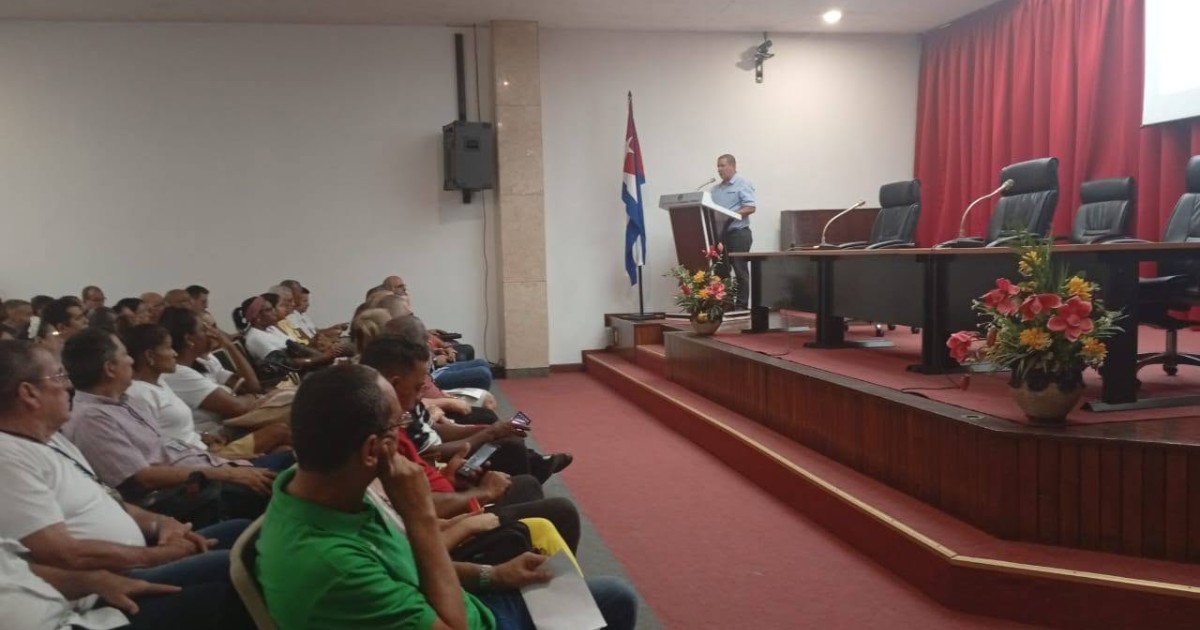
On Sunday, employees from Cuba's state oil company, Unión Cuba-Petróleo (CUPET), gathered in large assemblies to denounce the sanctions imposed by the U.S. Treasury Department. The event, shared by CUPET on its official social media platforms, comes as the island faces its most severe energy crisis in decades.
In photos shared by CUPET, auditoriums filled with 100 to 200 workers are seen assembled beneath the Cuban national flag and the company's banner. CUPET described the gathering as a collective response to measures announced by Secretary of State Marco Rubio last Thursday.
"We, the workers of Unión Cuba-Petróleo, raise our voices to denounce the unjust and arbitrary sanctions recently announced by the U.S. Treasury Department against our organization," CUPET stated in its official release.
The company also reaffirmed its "commitment to serve Cuba with responsibility and discipline, and with the unity and dedication of our workforce as our greatest strength."
The sanctions, announced on June 11 under President Trump's Executive Order 14404, freeze all assets and interests of the oil company within U.S. jurisdiction and prohibit any transactions with the entity by U.S. individuals or businesses.
Rubio accused CUPET of being a tool used by the regime to finance repression, claiming, "The regime has stolen and hoarded available fuel, using it for Castro's private plane, the security forces employed to suppress the Cuban people, to keep empty tourist hotels lit, and to transport people for fake protests."
The Secretary of State also highlighted that "Cuban communist elites have weaponized energy as a tool of social control and kleptocratic profit," while the Cuban populace endured blackouts and faced long waits to fill their car tanks.
The sanctions hit Cuba during its worst energy crisis in decades. In May, Cuba's Energy Minister, Vicente de la O Levy, acknowledged that the island had "absolutely no fuel, no diesel, only accompanying gas," with the electric deficit reaching a record 2,174 MW on May 14, causing blackouts lasting up to 22 hours a day.
The measure also definitively ended a deal between Coral Gables, Florida-based Vanguard Energy and a Cuban import agency to ship over 250,000 barrels of gasoline and diesel per trip — valued at $34.3 million — which would have been the largest U.S. fuel shipment to Cuba since the Eisenhower era. Following the sanctions, Miami-Dade revoked Vanguard Energy's license.
This action against CUPET marks the second major move under Executive Order 14404 in less than five weeks, following sanctions against GAESA announced by Rubio on May 7.
Rubio warned that "the Trump Administration will continue to target Cuba's ability to use energy trade to further its corrupt agenda and repressive security apparatus."
Implications of U.S. Sanctions on Cuba's Energy Sector
What are the main reasons for the U.S. sanctions against CUPET?
The U.S. sanctions against CUPET are based on accusations that the company is used by the Cuban regime to finance repression and support its corrupt agenda, including the misuse of energy resources for oppressive purposes.
How do the sanctions affect Cuba's energy crisis?
The sanctions exacerbate Cuba's energy crisis by freezing assets and prohibiting transactions, thus cutting off potential fuel supplies and hindering the country's ability to alleviate its severe energy shortages.
What impact do these sanctions have on U.S.-Cuba relations?
The sanctions further strain U.S.-Cuba relations by escalating tensions and reducing the avenues for diplomatic engagement, especially regarding energy trade and economic cooperation.