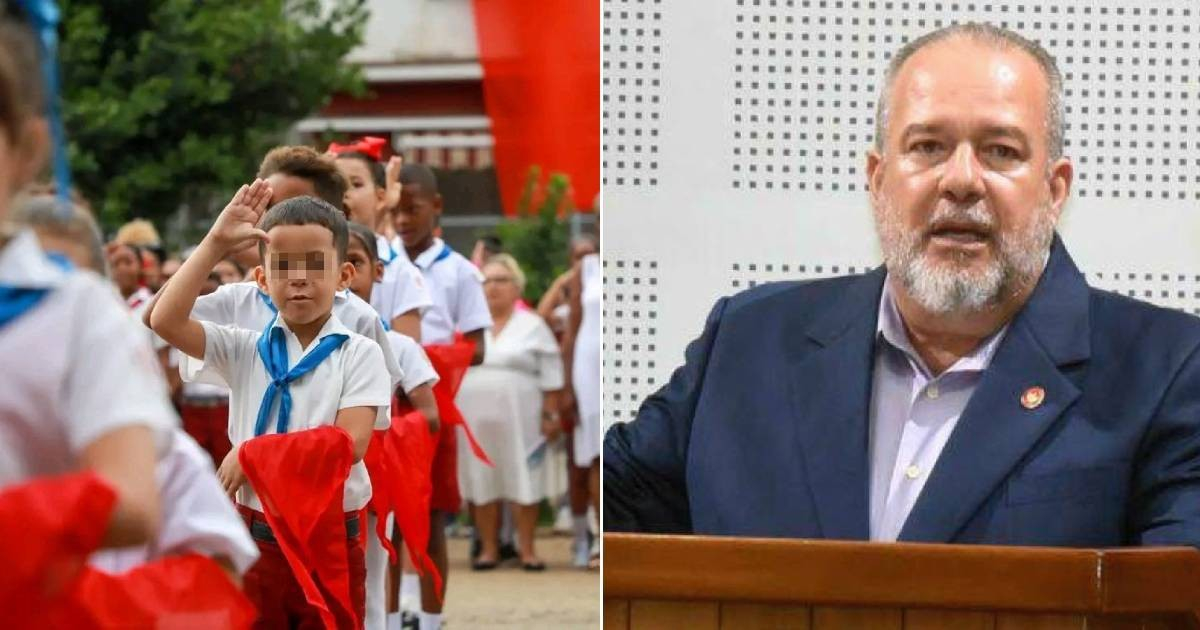
On Saturday, Cuban Prime Minister Manuel Marrero Cruz took to his social media account to express admiration for the ceremonial exchange of blue scarves for red ones in the José Martí Pioneer Organization. He described the event as a beacon of hope amid the nation's hardships, which he attributed to the "harshest imperial blockade."
However, this statement sparked a wave of critical reactions from Cubans who highlighted the stark contrast between the official narrative and the harsh realities of hunger, power outages, and medical shortages faced by families on the island.
Marrero noted, "In #Cuba, the changing of the scarf is a special moment for the pioneers, teachers, and families. The children's joy in swapping their blue scarves for red ones is a source of inspiration during these challenging times, under the impact of the harshest imperial blockade."
The public's response was swift and forceful: Cubans, both within and outside the island, rejected the message, pointing out that children experience not joy and hope, but hunger and scarcity.
Reality of Hardship Contrasts Official Statements
The disparity between the government's rhetoric and the actual situation is glaring. As per the Food Monitor Program data from April 2026, 96.91% of Cubans lacked adequate food access, and 33.9% of households reported at least one member going to bed hungry in the previous month.
UNICEF reported that 9% of Cuban children under five years old suffer from severe nutritional deprivation, while 48.5% of students aged six to eleven do not receive meals or snacks at school.
Moreover, over 11,000 Cuban children awaited delayed surgeries due to power cuts and a shortage of medical supplies. The survival rate for children with cancer reportedly dropped from 85% to 65% this year.
Recurring Pattern of Government Denial
This is not the first instance where Marrero's statements have provoked such backlash. In May, when he accused the United States of attempting to "strangle" Cuba, social media users responded with direct criticism of the regime.
During the same month, as power outages persisted, the phrase "In the UNE chief's block, there is power" went viral, symbolizing the disparity between the ruling class and ordinary citizens.
Similar reactions have followed other officials. On June 1, Díaz-Canel's praise of Cuban children as a "treasure" was met with similar criticism. Likewise, on June 5, the president of the National Assembly's claim that "nobody here dies of hunger" incited further outrage.
The World Food Program indicates that Cuba is grappling with escalating challenges to food security amidst a prolonged recession, inflation, and fuel shortages—issues the regime solely attributes to the U.S. embargo, while international bodies and opposition also point to the structural deficiencies of the state-run economic model.
Essential medications in Cuba were available at just about 30% of their usual supply levels in 2026, a fact not forgotten by Cubans when the prime minister speaks of their children's "joy."
Understanding Cuba's Current Challenges
What is the significance of the scarf ceremony in Cuba?
The scarf ceremony involves Cuban children exchanging blue scarves for red ones as part of the José Martí Pioneer Organization, symbolizing a rite of passage and a moment of pride for families and educators.
Why are Cubans critical of the government's portrayal of reality?
Many Cubans criticize the government for downplaying the severe economic hardships, such as hunger, medical shortages, and power outages, that they face daily, contrasting with the optimistic official statements.
How has the food crisis affected Cuban children?
The food crisis has severely impacted Cuban children, with a significant percentage experiencing severe nutritional deprivation and lacking access to regular meals at school.