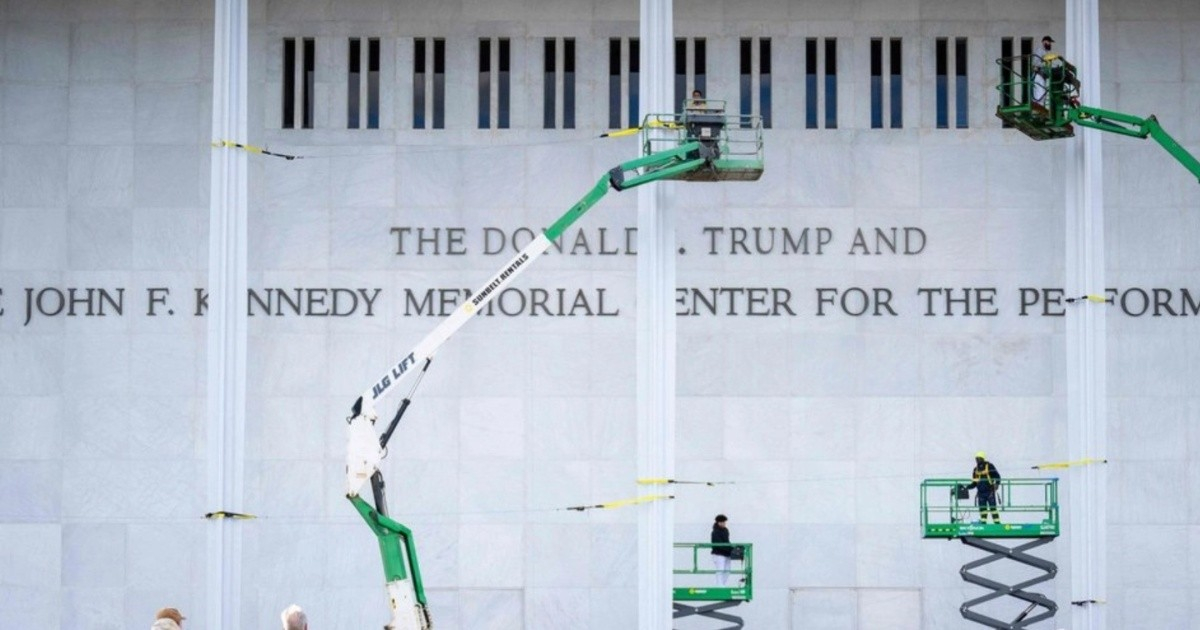
In the early hours of Saturday, crews began the task of removing former President Donald Trump's name from the facade of the John F. Kennedy Center for the Performing Arts in Washington D.C. This action followed the expiration of a deadline set by a federal court to eliminate any mention of Trump from the iconic cultural venue.
The removal operation unfolded amid a backdrop of legal tensions. On Friday, Federal Judge Christopher Cooper denied a request from the Kennedy Center to delay the enforcement of his ruling. An appeal filed later that night was also rejected, as reported by NPR, the American public radio network.
Midnight Removal Efforts
Just past midnight, the institution sought to extend the deadline to noon on Saturday, citing delays caused by thunderstorms. They assured the court that the removal efforts were underway and set to conclude "in the early hours of the morning."
On Friday, scaffolding was installed around the section of the facade where Trump's name was displayed. As night fell, workers covered the scaffolding with tarps and began dismantling the letters. The crew left the site around 3:30 a.m., although the tarps remained in place, obscuring a clear view of whether all letters had been removed.
Public Reaction and Legal Implications
Throughout the night, dozens gathered in the plaza facing the building, snapping photos and chanting "take it down." Among them was Ohio’s Democratic Representative Joyce Beatty, a member of the board who initiated the lawsuit to reverse the name change.
Judge Cooper's decision on May 29 stated that only Congress has the authority to rename the facility, which was established by federal law in honor of President John F. Kennedy. The board's action to add Trump's name without such approval was deemed illegal. The ruling also halted plans to close the center for a major two-year renovation originally set to commence in July.
Urgency and Structural Concerns
The Kennedy Center's administration argued in their appeal that the renovation was critical due to potentially fatal structural damage. "The district court's decision prevents us from closing to properly repair the building, which includes potentially deadly structural damages such as rusted beams and parking deck ceilings at serious risk of collapse," the appeal read.
Trump's name was physically added to the facade on December 20, 2025, renaming the venue as "The Donald J. Trump and the John F. Kennedy Memorial Center for the Performing Arts." Two days later, Beatty filed her lawsuit.
Even before the physical removal, the Kennedy Center had partially complied with the ruling: a memo issued on June 4 directed staff to use only the official name in emails and documents, the website removed Trump's name, and communications for the June 28 Mark Twain Prize ceremony no longer included it.
The legal battle for control over the Kennedy Center is part of a series of unprecedented changes Trump initiated at the institution during his second term. He removed half of the board, appointed his own nominees, and was elected president of the council, sparking a wave of artist cancellations and public controversy.
Key Questions about the Kennedy Center Legal Dispute
Why was Trump's name removed from the Kennedy Center?
The name was removed following a federal court ruling that only Congress can approve name changes for the center, which was initially established to honor President John F. Kennedy.
What were the reasons for the Kennedy Center's appeal?
The Kennedy Center appealed the decision, arguing that the facility urgently needed repairs for potentially life-threatening structural issues, which required closing the center for renovations.
How did the public react to the name removal?
Many people gathered outside the center, taking photos and chanting for the name to be taken down. The removal operation attracted significant public attention and support.