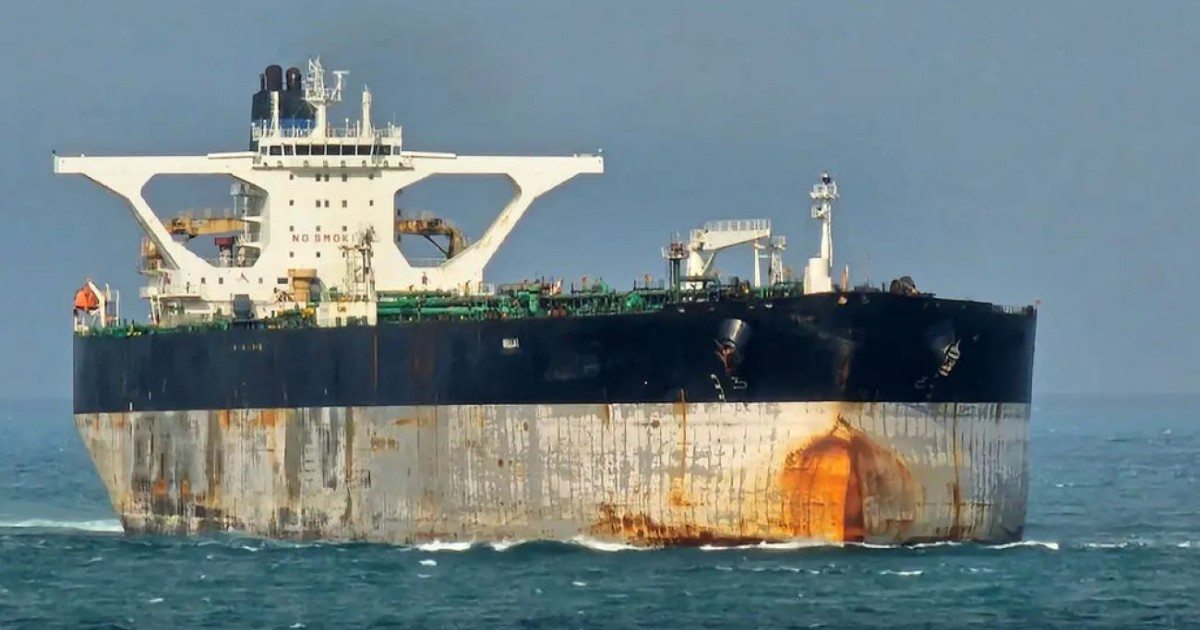
Avtandil Kalandadze, a 47-year-old from the Republic of Georgia, admitted guilt in front of the United States District Court in Washington D.C. this past Friday. He was charged for his refusal to heed the commands of the U.S. Coast Guard during a prolonged chase across the Atlantic Ocean, as stated by the Department of Justice.
Kalandadze served as the captain of the Motor Tanker Bella 1, a vessel considered part of the notorious "ghost fleet" known for transporting oil from Iran and Venezuela to benefit U.S. adversaries.
According to the plea deal, between September and late December 2025, the Bella 1, under Kalandadze's leadership, moved approximately 1.8 million barrels of Iranian-origin oil to Asia.
Throughout this period, the captain employed systematic evasion techniques: he navigated with the Automatic Identification System (AIS) turned off and concealed the vessel's identity while executing ship-to-ship oil transfers in international waters.
Intercepted and Pursued Across the Atlantic
In December 2025, as the Bella 1 was en route to Venezuela, it was intercepted by the U.S. Coast Guard Cutter Munro. The vessel refused to comply with the stop order and fled across the Atlantic Ocean over several weeks, covering nearly 4,900 miles from the Caribbean Sea to the North Atlantic.
During the pursuit, and acting on the directions of a corporate representative from the ship's operator, Kalandadze ignored repeated commands to halt and destroyed records and information on board.
Seizure and Diplomatic Repercussions
By January 7, 2026, the Munro assisted in the legal seizure of the vessel, which by that time had been renamed Marinera and adopted the Russian flag on December 24, 2025. Russia condemned the action, labeling it an "illegal interception" on the high seas. Meanwhile, the Bella 1 had been under sanction by the Office of Foreign Assets Control (OFAC) since June 2024 due to its connections with Iran's Islamic Revolutionary Guard Corps (IRGC), which is classified as a foreign terrorist organization.
Kalandadze admitted his guilt before Judge Beryl A. Howell for failing to comply with a Coast Guard stop order. Sentencing is scheduled for August 7, 2026, with a maximum penalty of five years imprisonment. He will be deported once his sentence is served.
Legal and National Security Ramifications
Jeanine Ferris Pirro, the U.S. Attorney for the District of Columbia, emphasized, "This defendant endangered the lives of American sailors and Coast Guardsmen while attempting to evade U.S. sanctions and transport illicit oil. Today’s guilty plea makes it clear that those who endanger our military and try to undermine our sanctions laws will be held fully accountable."
This case, investigated by Homeland Security Investigations (HSI) and the FBI, sets a precedent as the first criminal guilty plea by a "ghost fleet" captain in the United States. It is part of a larger crackdown on the network of ships that supply the regimes of Iran and Venezuela.
Another vessel from the same network, the Skipper, faced forfeiture proceedings in February 2026 for carrying 1.1 million barrels of oil intended for Cubametales, a Cuban state enterprise sanctioned by the OFAC since July 2019.
Assistant Attorney General for National Security, John A. Eisenberg, issued a stern warning to the ghost fleet operators: “Kalandadze’s guilty plea should serve as a warning to the owners and operators of the ghost fleet. The Department of Justice and our partners will pursue the ghost fleet from the Caribbean Sea to the North Atlantic, across the Indian and Pacific Oceans, the Persian Gulf, and everywhere in between. They will not escape."
Insights on the 'Ghost Fleet' Legal Actions
What are the consequences for Kalandadze's guilty plea?
Kalandadze faces a maximum of five years in prison and will be deported after serving his sentence for refusing to comply with a Coast Guard stop order.
Why is the Bella 1 significant in this case?
The Bella 1 was part of the "ghost fleet" involved in transporting sanctioned oil from Iran and Venezuela, challenging U.S. sanctions and maritime laws.
How did Russia react to the seizure of the vessel?
Russia condemned the seizure as an "illegal interception" on international waters, as the vessel had adopted the Russian flag shortly before the incident.