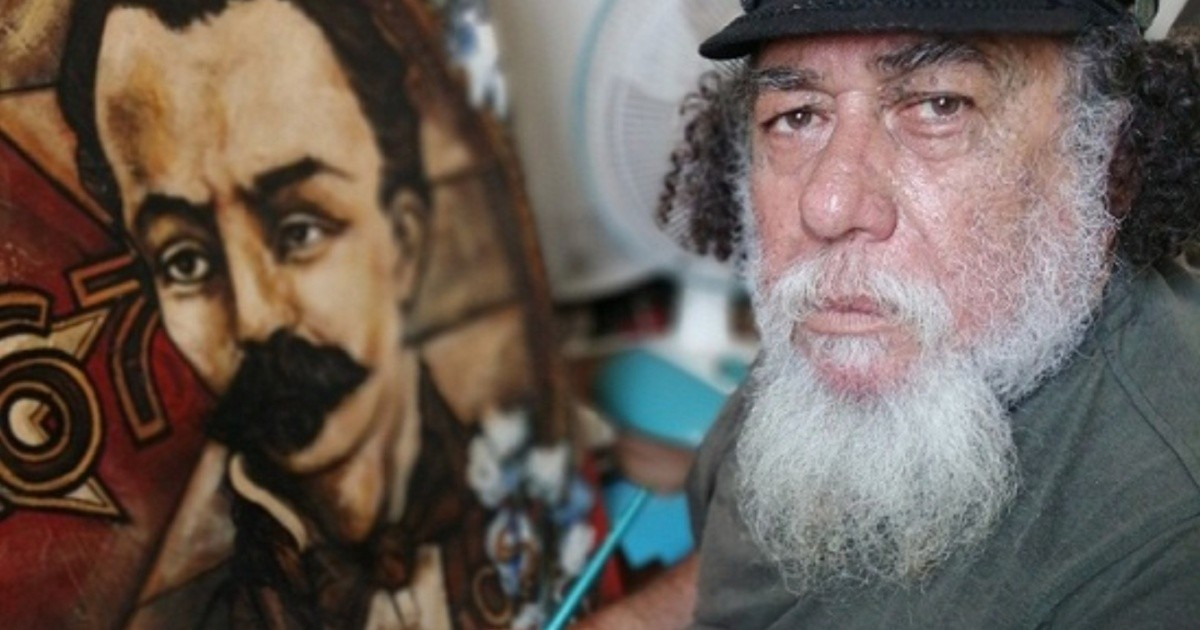
Agustín Antonio Villafaña Rodríguez, a celebrated Cuban Master of Visual Arts, has reached out via Facebook, offering certified original pieces from his personal collection—including ceramics, paintings, and drawings—in exchange for the installation of a 5 kW solar panel kit at his home-studio located in Playa, Havana.
At 73, Villafaña is facing significant health challenges related to his respiratory system and mobility. "I need a cool, safe, and ventilated environment to improve my quality of life," he expressed in the announcement, which was shared by Hamnet Raymat to connect him with potential suppliers or collaborators.
"I have decided to make the following offer: I am willing to provide certified and registered original works from my personal collection of ceramics, paintings, and drawings. This is in the hope of collaborating with a supplier for the installation of a solar panel kit at my home-studio, which would benefit and ease my health condition and artistic work," Villafaña elaborated.
Villafaña's Artistic Legacy
Villafaña is a well-established figure in Cuban visual arts, boasting a career that spans over five decades. He graduated from the National Art School of Cubanacán in 1972, and his work has been exhibited in international events across more than twenty countries. He serves as the general director of Casa Yeti, a studio-gallery and sociocultural project affiliated with the UNEAC, with over two decades of history. In 2018, he was nominated for Cuba's National Plastic Arts Award, the most prestigious accolade in the field.
Energy Crisis and Solar Panel Demand
This offer underscores the desperation prompted by the energy crisis affecting all sectors of Cuban society. The country ended 2025 amidst the worst electrical crisis in decades: generation shortfalls exceeding 2,147 MW and power outages lasting up to 24 hours daily in some areas. The national power grid experienced six complete failures over 18 months, the last one occurring on March 16, 2026, leaving nine out of sixteen thermoelectric plants offline simultaneously.
In such circumstances, solar panels have become a critical necessity, yet they remain inequitably accessible. The Cuban government sells them for over 75,000 pesos, more than twenty times the average salary, and in the informal market, a basic photovoltaic kit can cost upwards of $1,000.
The scale of the issue is evident in import statistics: Cuba purchased $117 million worth of solar panels from China in 2025, compared to $48 million in 2024 and just $5 million in 2023, but the distribution fails to reach those in greatest need.
Even Alfredo López Valdés, director of the Electrical Union, suggested in October 2024 that Cubans should buy their own solar systems to disconnect from the national grid, implicitly acknowledging the state's inability to ensure supply.
Those interested in reaching Villafaña can do so through the following phone numbers: +53 72038116, +53 53300846, and +53 53247978. The artist's situation—having to leverage decades of artistic creation to secure basic health conditions in his own home—vividly illustrates the extent to which Cuba's energy collapse has infiltrated the daily lives of its most revered citizens.
Understanding Cuba's Energy Crisis and Solar Panel Situation
What is the main reason for the energy crisis in Cuba?
The energy crisis in Cuba is primarily due to significant power generation deficits and outdated infrastructure, leading to frequent and prolonged outages.
Why are solar panels so expensive in Cuba?
The high cost of solar panels in Cuba is attributed to limited availability, government pricing, and import expenses, making them financially out of reach for most citizens.
How has the energy crisis affected Cuban society?
The crisis has disrupted daily life, affecting everything from personal health and comfort to economic activities, as citizens face constant power outages and financial strain.