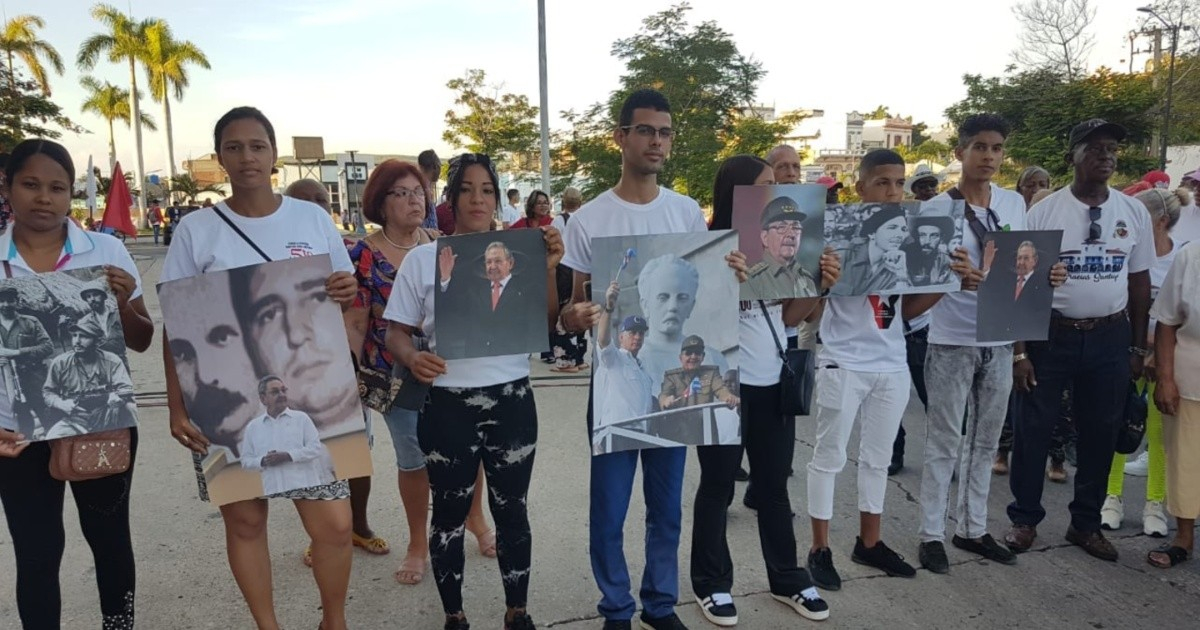
On Saturday, Santiago de Cuba became the center of an anti-imperialist rally in support of Raúl Castro. This event marked the first local response following the main rally in Havana on Friday, which was organized in reaction to criminal charges filed by the U.S. Department of Justice against the former Cuban leader.
Local official media outlets, TV Santiago and CMKW Radio Mambí, shared images on social media of citizens dressed in red, bearing Cuban flags and portraits of Castro. They gathered in front of the city's Anti-imperialist Platform, adorned with the emblem of the 26th of July Movement.
TV Santiago posted, "Santiago de Cuba wakes up today adorned with patriotic colors. At the Anti-imperialist Platform, we denounce the latest plot by the U.S. government to tarnish Cuban leader Raúl Castro Ruz," using the hashtag #RaúlEsRaúl.
Meanwhile, CMKW Radio Mambí declared, "Santiago de Cuba stands ready to fight! Our people are gathering at the Anti-imperialist Platform with hearts and history held high, ready to support General of the Army Raúl Castro Ruz, in defense of the Revolution and Cuba's dignity."
This rally in Santiago is the first provincial iteration of the main event held in front of the U.S. Embassy in Havana, under the slogan "The Homeland is Defended," which saw Miguel Díaz-Canel attending in an olive-green combat uniform, though he did not speak. The only speech at the Havana event was delivered by Gerardo Hernández, national coordinator of the Committees for the Defense of the Revolution, who read a message attributed to Raúl Castro himself, who was absent from the gathering organized in his honor.
The Cuban regime mobilized buses, military personnel, police officers, and state workers to populate the Havana rally, a traditional strategy of so-called "open forums" to project a façade of popular unity against external pressures.
The catalyst for this mobilization was the criminal charges against Raúl Castro, which were declassified on May 20 by Acting U.S. Attorney Todd Blanche at Miami's Freedom Tower. These charges, approved by a federal grand jury in the Southern District of Florida on April 23, include conspiracy to murder U.S. citizens, two counts of aircraft destruction, and four counts of murder related to the deaths of Carlos Costa, Armando Alejandre Jr., Mario de la Peña, and Pablo Morales. These four members of Brothers to the Rescue were shot down over international waters in the Florida Strait by Cuban Revolutionary Air Force MiG-29s on February 24, 1996.
A key piece of evidence in the indictment is an audio recording from June 1996, in which Castro allegedly ordered the downing of the planes.
The Council of State and the National Assembly of Cuba have condemned the charges as "infamous, immoral, and illegitimate," while Canal Caribe reported that the rallies aim to "denounce the despicable and infamous act by the U.S. Department of Justice against the leader of the Cuban Revolution."
This situation unfolds as Cuba faces a record-breaking electrical deficit, exceeding 2,000 MW in mid-May, with blackouts lasting more than 20 hours a day, alongside widespread shortages of food and fuel.
The regime has officially called for open forums across the country amidst this internal crisis, starting this Saturday and continuing until June 3, 2026, when Raúl Castro will turn 95 years old.
Understanding the Charges Against Raúl Castro
What are the charges against Raúl Castro?
Raúl Castro faces charges of conspiracy to murder U.S. citizens, destruction of aircraft, and murder of four members of Brothers to the Rescue, as per the indictment by the U.S. Department of Justice.
Why were these events organized in Cuba?
The rallies were organized as a show of support for Raúl Castro and to project unity against what the Cuban regime views as unjust external pressures from the United States.
What evidence supports the charges against Castro?
A key piece of evidence is an audio recording from June 1996, allegedly capturing Castro ordering the downing of the planes involved in the Brothers to the Rescue incident.