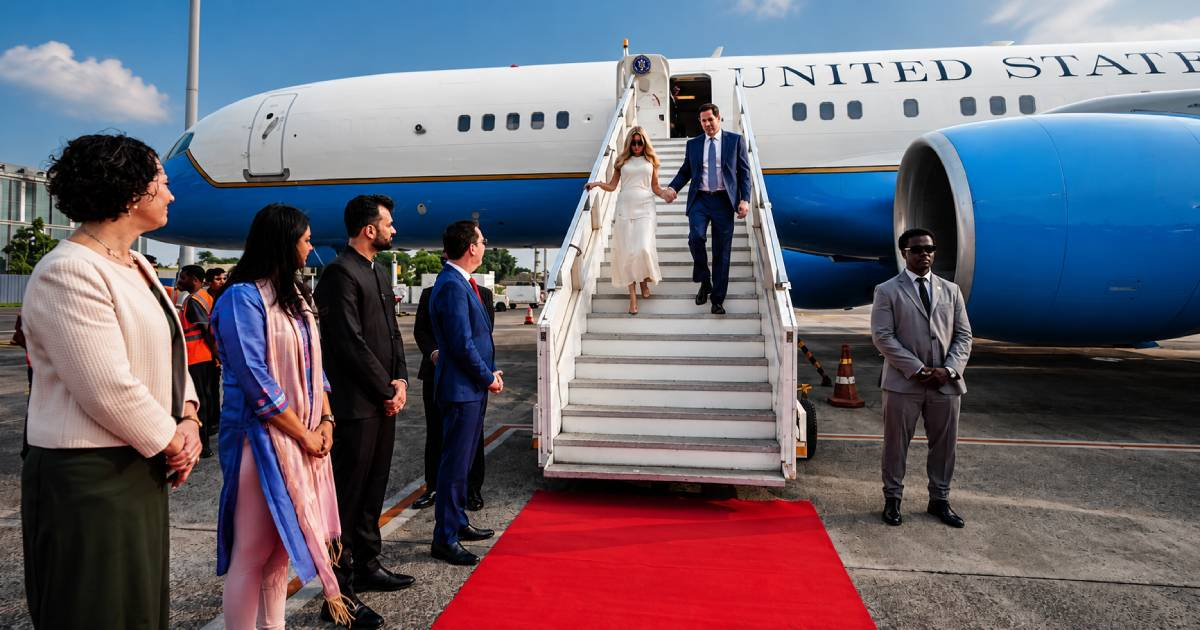
Marco Rubio touched down in India on Saturday for an official visit, as confirmed by the U.S. Secretary of State himself.
"Landed in India. Looking forward to a great visit!" Rubio announced on his X account, sharing a photo of his arrival alongside his wife. The image captures them descending the steps of a U.S. government aircraft, greeted by a red carpet and formal diplomatic reception.
This trip, extending until May 26, includes stops in Kolkata, Agra, Jaipur, and New Delhi, marking Rubio's first visit to India since he took office as Secretary of State during the Trump administration.
Prior to reaching New Delhi, Rubio visited Sweden, commencing his diplomatic tour on May 21.
Energy Dominates the Agenda
The primary focus of this journey is energy. Rubio emphasized before his departure that "India is a great ally and partner," expressing Washington's desire to sell as much energy as India is willing to purchase amid a global crude crisis.
The highlight of the trip will be the Quad ministerial meeting—a strategic forum comprising India, the United States, Japan, and Australia—scheduled for May 26 in New Delhi.
Impact on Cuba: Delayed Change?
For those closely monitoring U.S. policy towards Havana, Rubio's absence suggests that significant shifts are unlikely during his time abroad.
Speculation abounds on social media with rumors hinting at "a major shift this weekend" concerning Cuba. However, without Rubio in the U.S., these remain speculative.
Rubio has been a key architect of the Trump administration's pressure campaign against the Cuban regime. Since January 2026, the U.S. has imposed over 240 sanctions on Cuba, including Executive Order 14404, signed on May 1, which directly targeted GAESA, the military conglomerate controlling around 70% of Cuba’s economy.
On May 7, the U.S. sanctioned GAESA, its CEO Ania Guillermina Lastres Morera—Brigadier General of the Revolutionary Armed Forces—and Moa Nickel S.A. Rubio described GAESA as "the heart of the Cuban kleptocratic communist system," aiming to "deny the Cuban regime and military access to illicit assets."
The repercussions of these sanctions are already evident: shipping companies like Hapag-Lloyd and CMA CGM have halted cargo bookings to and from Cuba, and Sherritt International's shares plummeted by up to 30%. Foreign companies have until June 5 to sever ties with sanctioned Cuban entities or face secondary sanctions.
On May 21, Rubio labeled Cuba a "failed state," asserting that its economic system is "broken" and irreparable under the current political regime.
The day prior, he proposed a new engagement with Cuba involving $100 million in food and medicine, contingent upon the Catholic Church or charitable organizations handling distribution, not GAESA, though he deemed an agreement with Havana unlikely.
With Rubio in India until May 26, any significant developments in Washington's policy towards Cuba are expected to be on hold until at least the following week.
Understanding the U.S.-Cuba Policy Amidst Rubio's India Visit
What is the purpose of Marco Rubio's visit to India?
Marco Rubio is visiting India to strengthen ties and discuss energy sales, amidst a global crude oil crisis. His visit also includes attending the Quad ministerial meeting.
How does Rubio's trip impact U.S. policy towards Cuba?
Rubio's absence from the U.S. suggests that any significant changes in U.S. policy towards Cuba are unlikely to occur during his time abroad.
What are the implications of the U.S. sanctions on Cuba?
The sanctions have led to international shipping companies suspending services to Cuba and have caused a significant drop in stock prices for companies like Sherritt International. Foreign businesses have until June 5 to comply with these sanctions.