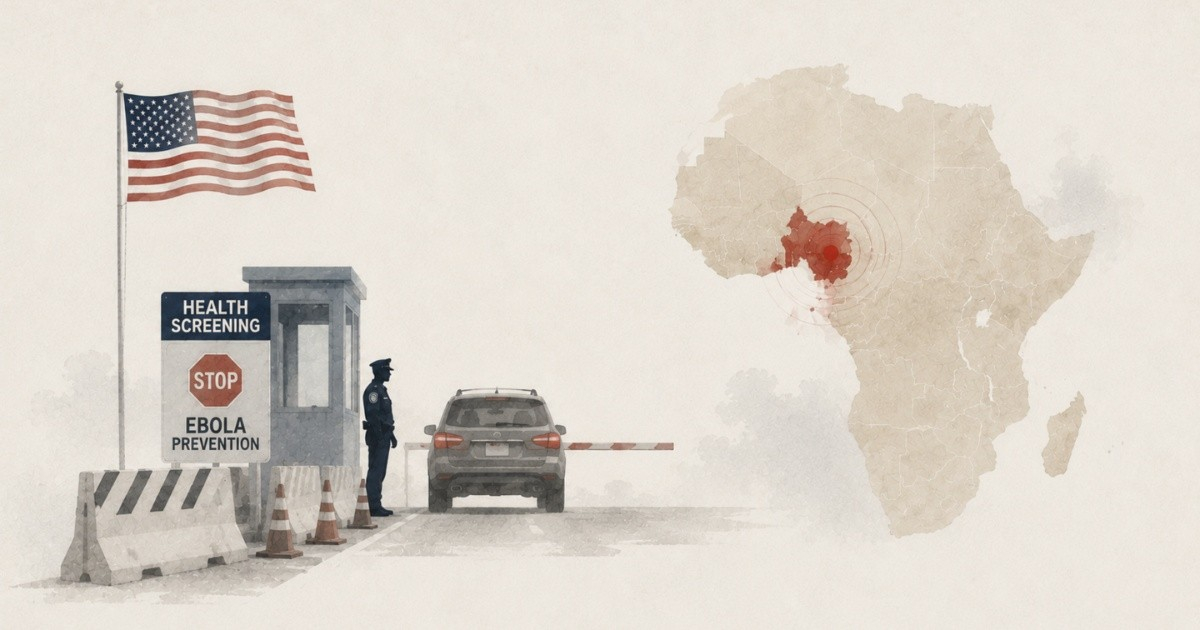
This past Friday, Tedros Adhanom Ghebreyesus, Director-General of the World Health Organization (WHO), reported 750 suspected cases and 177 deaths from Ebola in the Democratic Republic of the Congo (DRC). He emphasized that the actual extent of the outbreak might be "far greater" than current figures suggest.
On May 17, the WHO took the unprecedented step of declaring the outbreak a global health emergency. This marked the first instance where the organization's director-general issued such an alert without first convening an emergency committee, highlighting the perceived urgency as the epidemic spreads rapidly.
In reaction, the United States has progressively tightened its control measures. On May 18, the Centers for Disease Control and Prevention (CDC) issued an order under Title 42, suspending entry for 30 days for foreigners who have been in the DRC, Uganda, or South Sudan in the preceding 21 days. This restriction applies to flights departing after 11:59 p.m. on May 20.
U.S. citizens and permanent residents returning from these countries are now directed to Washington Dulles International Airport for enhanced health screenings, which include temperature checks, a travel history questionnaire, and a 21-day text message monitoring period.
The State Department raised travel advisories on May 19 to Level 4 ("Do Not Travel") for the DRC, Uganda, and South Sudan, and Level 3 for Rwanda. Issuing simultaneous Level 4 alerts for three countries due to a single health issue is exceptionally rare.
Secretary of State Marco Rubio made clear Washington's priorities: "Our number one priority will always be ensuring that Ebola does not reach the United States. That is our foremost obligation." He also acknowledged the response was belated, saying, "We should have started this two weeks ago."
Rubio further criticized the WHO for being "slow" in identifying the strain, asserting the organization "failed miserably during COVID, covering up for China." Tedros countered that these critiques might stem from a "lack of understanding" of the International Health Regulations, explaining that confirmation was delayed until May 14 because initial tests were negative and samples needed to be sent to a lab in Kinshasa, 1,700 kilometers from the outbreak's epicenter.
The restrictions have already led to an aviation incident: Air France flight AFR378 bound for Detroit was diverted to Montreal on Friday due to a passenger from the DRC who should not have boarded. The asymptomatic passenger returned to Paris, while other travelers proceeded to Detroit.
The outbreak is driven by the Bundibugyo strain, the virus's rarest variant, which lacks an approved vaccine or specific treatment and has a fatality rate between 25% and 40%. The epicenter is located in the Ituri province, a conflict-ridden area in eastern Congo, where over 100 armed groups operate and more than 273,000 people are internally displaced, according to the United Nations.
The WHO assesses the global risk as low, but considers it high in the DRC and the sub-Saharan African region. In Uganda, the situation remains "stable," with only two confirmed cases and one death, and no new infections reported.
Ebola Outbreak and U.S. Response FAQs
What measures has the U.S. implemented in response to the Ebola outbreak?
The U.S. has issued a Title 42 order suspending entry for foreigners from affected countries, enhanced health screenings for returning citizens and residents, and increased travel advisories.
Why did the WHO declare the Ebola outbreak a global health emergency?
The WHO declared the outbreak a global health emergency due to the rapid spread of the virus and the potential for a far-reaching impact, despite not having convened an emergency committee.
What is the Bundibugyo strain?
The Bundibugyo strain is a rare variant of the Ebola virus, lacking an approved vaccine or specific treatment, with a fatality rate of 25% to 40%.