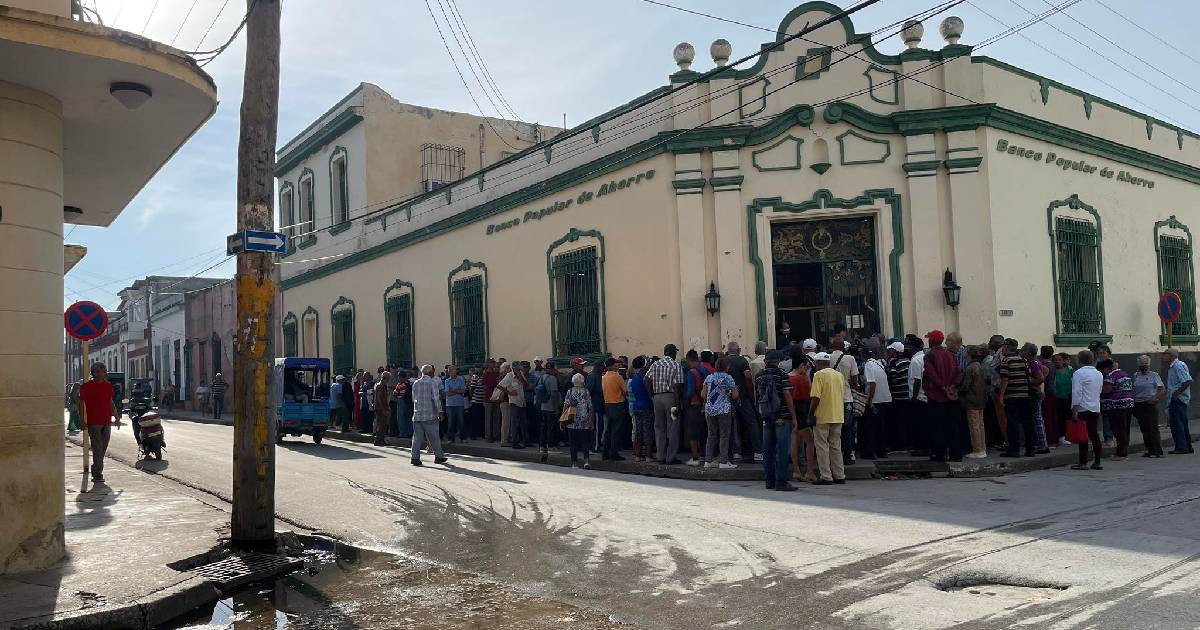
Once again, numerous retirees have flooded the bank branches in Holguín this month, attempting to collect their pensions amidst complaints of lengthy lines, disorganization, and a lack of genuine solutions for a vulnerable, aging population.
This recurring issue was highlighted on Facebook on Friday by digital creator Pedro Lorenzo Hechavarría Pupo. He shared an image depicting a group of elderly individuals gathered around the Banco Popular de Ahorro, located at the intersection of Aguilera and Maceo streets, in the heart of the Cuban City of Parks. His caption read, "A new month... The same problem," alluding to the persistent chaos surrounding pension collections.
Responses from fellow Cubans echoed the growing frustration over a situation that has become common across the nation. "All the banks are like this: crowded with seniors trying to collect their pensions," remarked a user named Elizabeth Aguilera, who also questioned the failure of the supposed solutions introduced by the regime's push for bank digitalization.
The Struggles of Elderly Cubans
Numerous accounts describe distressing scenes of elderly individuals, some in wheelchairs, lining up as early as five in the morning to secure a spot at the banks. Jorge Barciela recounted witnessing an amputee waiting in line to receive his pension, criticizing those who designed a digital banking plan "without ever having seen a bank branch during the heat of summer or a power outage."
The outrage is further fueled by references to the state's neglect of those who dedicated decades of work to the country. "Many gave their lives to the Homeland," wrote Miriam Peña Hernández, who condemned that countless seniors endure hunger, heat, and sleepless nights due to power outages before facing these queues.
Proposals for Change and Government Indifference
While some users noted attempts at organization in certain branches, like collecting ID cards and cards in advance, the consensus remains that a structural solution is lacking. "That problem belongs to no one," summarized another commenter.
In the absence of effective solutions, citizens propose reinstating the home payment service previously provided by postal workers or implementing special assistance for those with limited mobility. Rosa Luz bluntly stated: "Terrible, it’s like this everywhere in the country, truly abusive."
Jose Luis Viñals concluded the discussion with a sentiment shared by many Cubans: "The sad reality is that no one in power cares."
The scenes of elderly individuals crowded outside banks starkly contrast with the official narrative of digitalization and financial efficiency promoted by the Cuban government. In reality, many seniors lack smartphones, stable internet access, or the knowledge to use banking apps, leaving them reliant on cash and in-person transactions for pensions that barely cover basic needs.
The System's Failures and the Reality of Digital Banking
Cuba is home to over 1.7 million retirees who depend on a bank system in disarray, plagued by scarce ATMs, terminals rendered useless by power outages, and branches with limited hours.
The banking policy launched in August 2023 has exacerbated the situation instead of resolving it. In Pinar del Río, only about 10% to 12% of monthly transactions are conducted digitally.
Even the Provincial Government Coordinator, Calex Edilio González Chill, acknowledged that the digital banking effort "has created an additional problem rather than facilitating people's lives."
Official media in April admitted that "cash remains the undisputed king of the daily economy," with illegal surcharges of up to 20% for electronic payments being normalized throughout much of the country.
During that same month, seniors were found sleeping on the porch of the Banco de la Caridad in Camagüey, using sheets and cardboard to secure a spot for the following day. In January, Cienfuegos deployed police to organize the lines amid the banking service breakdown.
Following a partial increase approved in 2025, the maximum pension is 4,000 Cuban pesos per month, equivalent to less than $10 in the informal market.
The Family Assistance System, which could aid the most vulnerable, only supports 67,000 individuals out of the more than 1.7 million pensioners across the nation.
Challenges of Pension Collection in Cuba
Why are elderly Cubans facing difficulties in collecting their pensions?
Elderly Cubans struggle to collect their pensions due to a disorganized bank system, long queues, and a lack of effective solutions for the vulnerable aging population. The government's push for digital banking has not addressed these issues adequately.
What solutions have been proposed to improve the pension collection process?
Proposed solutions include reinstating the home payment service previously provided by postal workers and implementing special assistance for individuals with reduced mobility. These measures aim to alleviate the burden on elderly citizens.
How has the digital banking policy affected pension collection?
The digital banking policy, introduced in August 2023, has worsened the situation rather than solving it. Many retirees lack access to digital resources, leaving them dependent on cash and manual transactions.