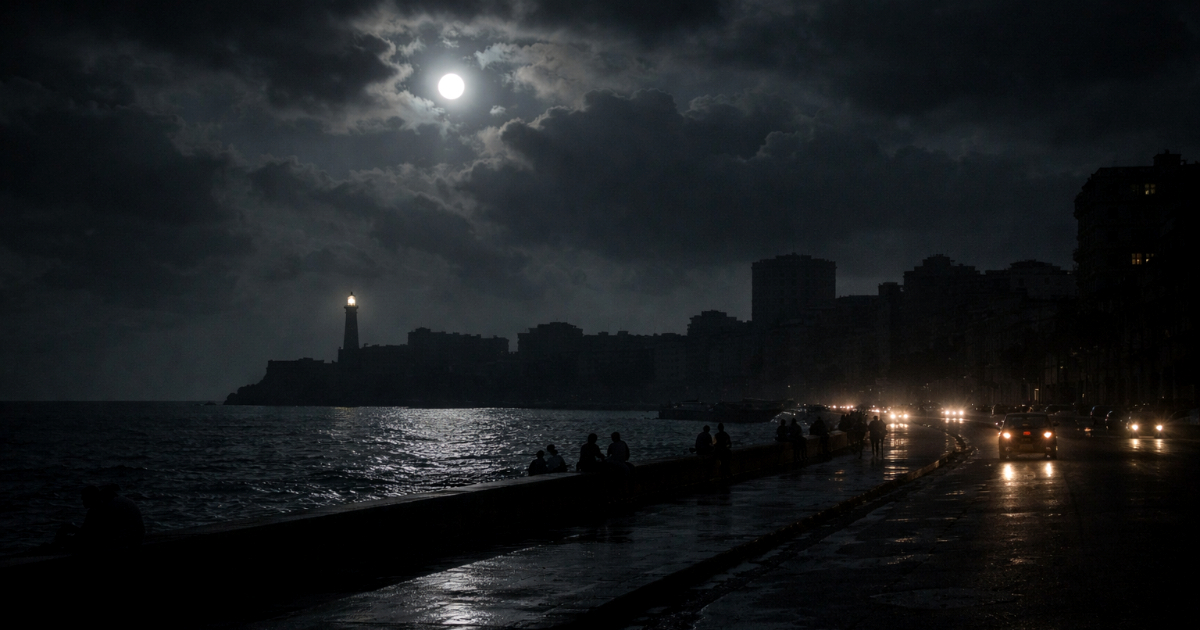
On Friday morning, Cuba awoke to yet another day plagued by widespread power outages. According to the latest update from the Unión Eléctrica, as of 6:00 AM, the National Electric System had a mere 1,300 MW available, compared to a demand of 2,746 MW, leaving 1,454 MW uncovered.
The outlook for the evening's peak demand period appears even grimmer. The Unión Eléctrica anticipates having 1,360 MW against a peak demand of 3,200 MW, which results in a shortfall of 1,840 MW and an estimated impact on 1,870 MW.
Thursday's situation was no better. The official report indicated that the highest shortfall due to generation capacity deficit reached 1,910 MW at 9:30 PM. Power cuts persisted throughout the entire day and night.
Several immediate factors contribute to the collapse. Three units are currently out of order: Unit 1 at the CTE Ernesto Guevara de la Serna, Unit 2 at the CTE Lidio Ramón Pérez, and Unit 5 at the CTE Antonio Maceo.
Additionally, three other units are undergoing maintenance: Unit 5 at the CTE Mariel, Unit 6 at the CTE Renté, and Unit 5 at the CTE Nuevitas. In total, thermal generation limitations account for 505 MW being out of service.
For the evening peak, the only expected addition is the incorporation of Unit 1 at the Energás Boca de Jaruco plant with 30 MW, alongside the completion of Unit 6 with another 30 MW, which offers only a marginal contribution against the structural deficit.
The 54 solar photovoltaic parks installed by the regime contributed 3,843 MWh with a maximum capacity of 606 MW at midday. However, this generation disappears precisely when it's most needed: during the nighttime peak demand.
This crisis is part of a broader decline that hit its worst point just eight days ago. On May 14, a historic deficit record was set at 2,174 MW, leaving nearly 70% of the Cuban population simultaneously without electricity.
The fundamental cause is the chronic shortage of fuel. President Miguel Díaz-Canel admitted on May 2 that the oil donated by Russia is "running out these days" and that the government is uncertain about when the next fuel shipment will arrive.
The Russian shipment, approximately 730,000 barrels, docked at the port of Matanzas on March 31, following over three months without significant foreign supply.
The humanitarian consequences are severe. In April, the UN warned that Cuba's energy crisis is having a "systemic and increasingly severe" impact on health, water, food, education, transportation, and telecommunications.
The exhaustion among the population is palpable. "We are reaching the limit," one Cuban woman remarked this week, encapsulating the frustration of millions enduring power cuts lasting up to 22 hours a day.
Understanding Cuba's Energy Crisis
What is causing the severe power shortages in Cuba?
The severe power shortages in Cuba are primarily caused by a combination of factors, including broken and under-maintained power units and a chronic shortage of fuel, exacerbated by insufficient foreign oil supply.
How are the power outages affecting the Cuban population?
The power outages are having devastating humanitarian impacts, affecting essential services such as health, water, food, education, transportation, and telecommunications, leading to widespread public frustration.
What measures are being taken to address the power crisis in Cuba?
The Cuban government is attempting to address the power crisis by bringing additional power units online, like the recent incorporation of units at Energás Boca de Jaruco, but these measures are insufficient against the larger structural issues.