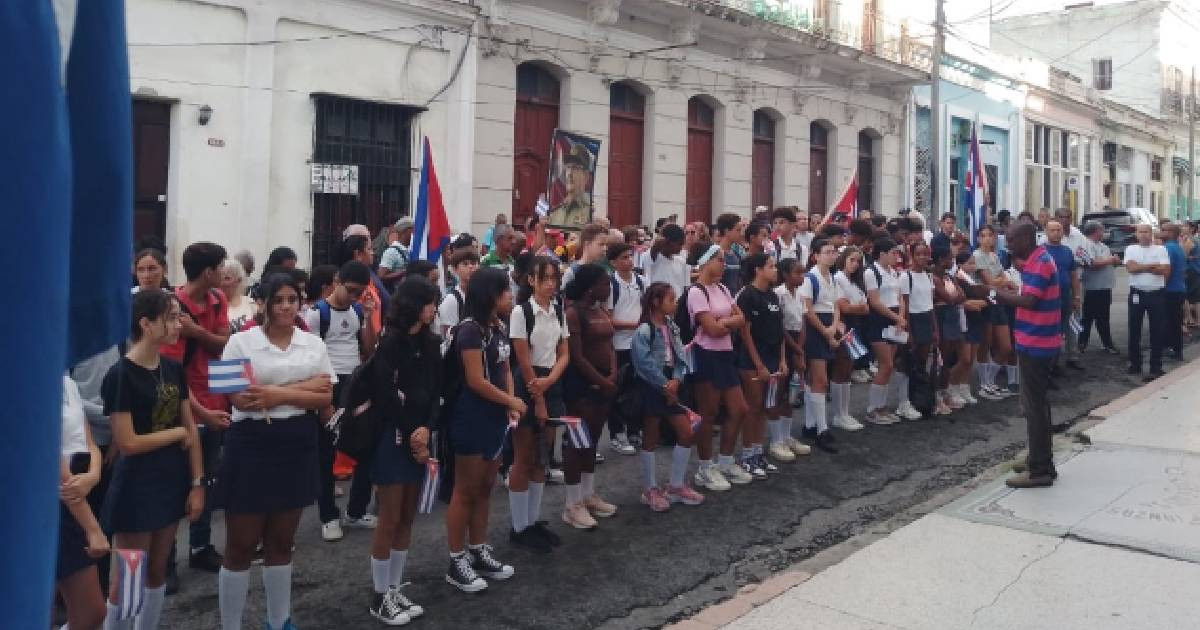
On Friday, hundreds of residents from Cienfuegos gathered at the Provincial Electric Company to protest the U.S. government's criminal charges against former President Raúl Castro. During the event, attendees declared that "Cuba won't become another Venezuela," according to the official newspaper, 5 de Septiembre.
The rally, held just a few blocks from the historic José Martí Park, was part of a nationwide series of demonstrations organized in response to the formal charges against Castro. These charges were announced on May 20 in Miami by Acting Attorney General Todd Blanche.
Approved by a grand jury in the Southern District of Florida on April 23, the indictment accuses the former Minister of the Revolutionary Armed Forces and five former Cuban military officers of the February 24, 1996, shootdown of Brothers to the Rescue aircraft, in which four Cuban-Americans—Armando Alejandre Jr., Carlos Costa, Mario de la Peña, and Pablo Morales—were killed.
The charges include conspiracy to murder U.S. citizens, destruction of civilian aircraft, and four counts of homicide, carrying potential life sentences or the death penalty.
Regime's Fear of U.S. Pressure Strategy
The chant in Cienfuegos reveals the regime's fear of Washington employing the same maximum pressure tactics it used to force change in Venezuela. In January, former Venezuelan President Nicolás Maduro was captured and brought before U.S. justice, leading to an abrupt halt in Venezuelan oil shipments to Cuba.
The central event of the day took place at the José Martí Anti-Imperialist Tribune in Havana, opposite the U.S. Embassy. Cuban leader Miguel Díaz-Canel appeared in military fatigues but broke tradition by not delivering a speech.
The sole speaker was Gerardo Hernández, national coordinator of the Committees for the Defense of the Revolution. He conveyed a brief message from Castro, who did not attend the event organized in his honor.
Family and Government Response
In defense of her father, Mariela Castro, daughter of the Army General, publicly stated that "no one will kidnap him," and shared his words: "No one will take me alive. They'll find me fighting."
The regime deployed numerous public buses to boost attendance, starkly contrasting the severe fuel crisis crippling the country, where transportation meets only 42% of its planned targets.
Secretary of State Marco Rubio labeled Raúl Castro a "fugitive." When questioned about a potential capture operation, he replied, "I won't discuss how we would bring him here," further fueling comparisons to the Venezuelan scenario.
Castro turns 95 on June 3, and in April, Díaz-Canel described him as "frail due to his advanced age."
On Friday, the Cuban president dedicated a José Martí quote on Facebook, stating, "The turbulent and brutal North that despises us has yet to know us: in trying to divide us, it has united us more," as posted on his X account.
Understanding the U.S. Charges Against Raúl Castro
What are the charges against Raúl Castro?
Raúl Castro faces charges of conspiracy to murder U.S. citizens, destruction of civilian aircraft, and four counts of homicide. These charges stem from the 1996 shootdown of Brothers to the Rescue aircraft.
Why does the Cuban regime fear U.S. pressure?
The Cuban regime fears the U.S. might apply the same maximum pressure tactics used in Venezuela, which led to the capture of Nicolás Maduro and a halt in Venezuelan oil shipments to Cuba.
How has the Cuban government responded to the charges?
The government organized nationwide demonstrations and used public transport to increase attendance at rallies. Leaders, including Miguel Díaz-Canel and Gerardo Hernández, have spoken out against the charges, emphasizing unity and resistance.