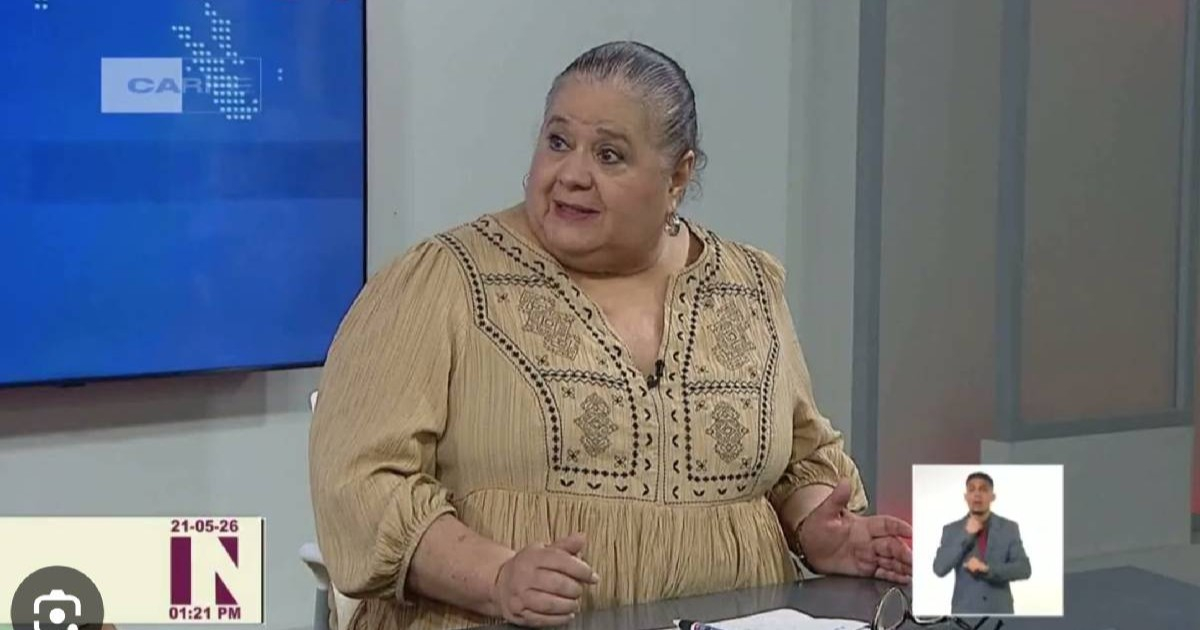
Cuban state television journalist Bárbara Betancourt, who claims to have worked closely with Raúl Castro, expressed her "outrage" over the federal charges issued by the U.S. Department of Justice, which she described as "perverse and infamous."
Betancourt appeared on Canal Caribe this Thursday to defend the former dictator following the federal criminal charges announced the previous day, coinciding with Cuba's formal independence anniversary in 1902.
She explained that her reaction was not one of surprise but rather "outrage": "This was something that had been anticipated for quite a while, as it has been talked about for many years."
Betancourt characterized the indictment as "a collection of cynicism, hypocrisy, and falsehoods," declaring that it "has nothing to do with justice, even less with the truth."
The journalist argued that Washington "had this show shelved for a long time" and chose the symbolic date of May 20 due to its significance for certain sectors of the Cuban exile community.
Drawing a parallel between Raúl Castro's situation and the arrest of Nicolás Maduro in Venezuela, Betancourt warned that both cases are part of a broader external aggression strategy, although she acknowledged that "these are different scenarios."
Regarding a potential military response, Betancourt was firm: "It won't be a walk in the park. It won't be a walk in the park, for millions of reasons that I believe each individual knows."
When asked about Raúl Castro's potential reaction, she mentioned that the former dictator "might be preparing his response," recalling his farewell words: "as long as I live, I will keep my foot in the stirrup."
The interview is part of the Cuban regime's coordinated response to the federal charges, which include conspiracy to murder U.S. nationals, aircraft destruction, and four homicide charges related to the downing of two Brothers to the Rescue planes on February 24, 1996, resulting in the deaths of Armando Alejandre Jr., Carlos Costa, Mario de la Peña, and Pablo Morales.
Miguel Díaz-Canel labeled the indictment as a "political action, without any legal basis," while Foreign Minister Bruno Rodríguez accused Marco Rubio of being a "spokesman for corrupt and vengeful interests."
On Friday, the Cuban Council of State and Parliament formally condemned the charges, joining the institutional support chorus for the former dictator.
The practical impact of the charges is limited: Raúl Castro is 94 years old, remains outside U.S. jurisdiction, and there is no extradition treaty between Cuba and the United States. The federal grand jury returned the charges on April 23, 2026, placing the case under the jurisdiction of the Southern District of Florida.
Key Questions About the Charges Against Raúl Castro
What are the charges against Raúl Castro?
The charges include conspiracy to murder U.S. nationals, aircraft destruction, and four counts of homicide due to the downing of two Brothers to the Rescue planes in 1996.
Why is the May 20 date significant?
May 20 holds symbolic significance as it marks the formal independence of Cuba in 1902, a date that resonates deeply within certain sectors of the Cuban exile community.
What is the response from the Cuban regime?
The Cuban regime has condemned the charges, with leaders like Miguel Díaz-Canel and Bruno Rodríguez dismissing them as politically motivated and lacking legal foundation.