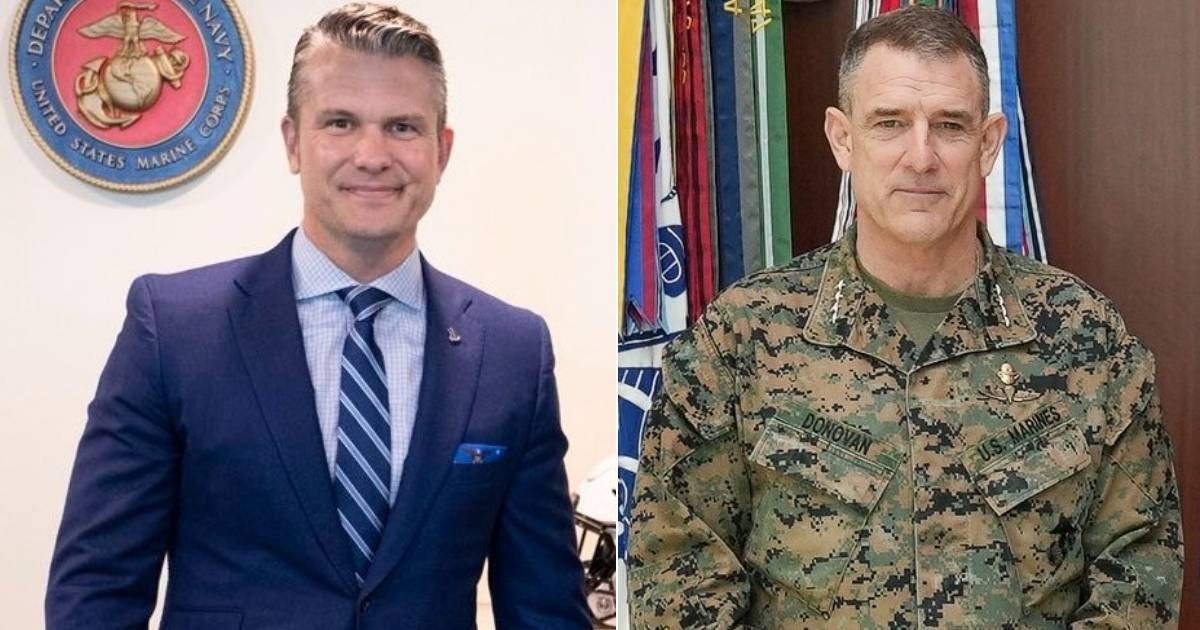
General Francis Donovan, the head of the United States Southern Command (SOUTHCOM), held a meeting on Thursday with Secretary of Defense Pete Hegseth at the Pentagon. This meeting was reported by journalist Julia Jester of MSNOW News, who cited a source with direct knowledge of the encounter.
Initiated at Hegseth's request, the meeting comes during a period of heightened tension between Washington and Havana, the likes of which haven't been seen in decades. The arrival of the aircraft carrier USS Nimitz in the Caribbean last Wednesday—coinciding with Cuba's Independence Day—and a series of actions with significant symbolic impact against the regime have contributed to this escalation.
The USS Nimitz's deployment is part of Operation Southern Seas 2026 and includes the destroyer USS Gridley and the replenishment ship USNS Patuxent. SOUTHCOM described this formation as "the epitome of readiness, presence, unmatched reach and lethality, and strategic advantage."
President Trump dismissed any notion that the deployment aims to intimidate Cuba. "Not at all. We're going to help them," he stated, referring to the island as a "failed state" lacking electricity, money, and food. Trump rejected the idea that the aircraft carrier is meant to pressure the regime and expressed his desire to "open Cuba to Cuban Americans so they can return and assist."
Meanwhile, Secretary of State Marco Rubio acknowledged to the press that "honestly, I don't see much progress" in negotiations with the Cuban regime, despite confirming that the U.S. ambassador recently met with Havana officials and that the CIA director visited the island a few weeks ago.
Rubio was clear about the regime's prospects: "At the end of the day, they have to make a decision. Their system doesn't work. Their economic system doesn't work. It's broken and cannot be fixed with the current political system." He also warned that "Cuba cannot keep buying time or expect us to back down."
When asked about the potential arrest of Raúl Castro—formally accused last Wednesday for the 1996 downing of Brothers to the Rescue planes—Rubio remained deliberately cryptic: "I'm not going to discuss how we plan to bring him here. Why would I tell the media? If there's an announcement, we'll let you know afterward, not before."
The security context surrounding the Donovan-Hegseth meeting is intense. Last Saturday, Axios revealed that Cuba had acquired over 300 military drones from Russia and Iran, with discussions about possible uses against the Guantanamo Naval Base and Key West. The following day, Politico reported that SOUTHCOM had begun contingency planning exercises related to Cuba.
Since January 2026, the Trump administration has imposed over 240 sanctions on Cuba and intercepted at least seven tankers carrying oil intended for the island. These measures have slashed Cuban energy imports by between 80% and 90%, causing power outages of up to 25 hours daily in more than 55% of the country.
Rubio summed up Washington's stance with a direct warning: "The president's preference is always a negotiated and peaceful agreement. That remains our preference. But with Cuba, to be honest, the likelihood of that happening with the current leadership is not high."
U.S.-Cuba Relations and Military Tensions
What prompted the meeting between General Donovan and Pete Hegseth?
The meeting was held at the request of Pete Hegseth amid rising tensions between the United States and Cuba, particularly after the deployment of the USS Nimitz in the Caribbean.
What is the significance of the USS Nimitz's deployment in the Caribbean?
The deployment of the USS Nimitz is part of Operation Southern Seas 2026 and is intended to demonstrate readiness, presence, and strategic advantage in the region.
How has the Trump administration impacted Cuba's energy imports?
The Trump administration has imposed over 240 sanctions, significantly reducing Cuba's energy imports by 80% to 90% and causing widespread power outages.