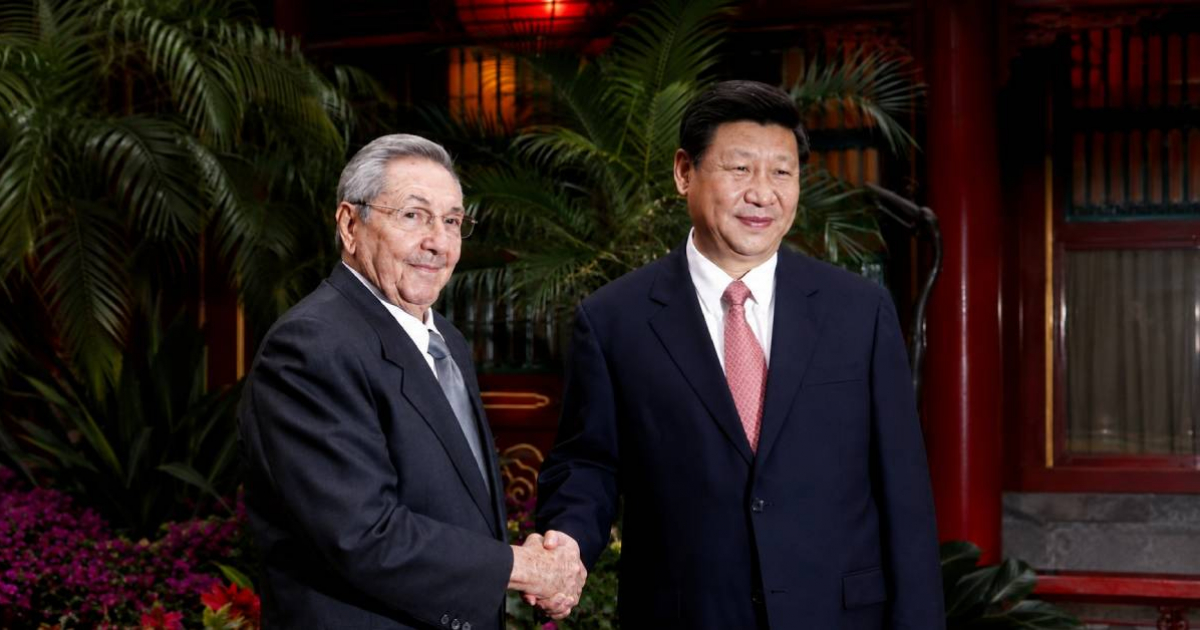
On Thursday, China vocally defended Raúl Castro and criticized Washington's decision to file criminal charges against the Cuban Army General. This response comes during a period of heightened diplomatic activity involving Beijing, Moscow, and the White House.
Chinese Foreign Ministry spokesperson Guo Jiakun expressed, during a press conference, China's stance: "We oppose the misuse of judicial proceedings." He further warned, "The U.S. must stop threatening Cuba with the use of force."
Guo also emphasized that "China steadfastly supports Cuba in safeguarding its national sovereignty, dignity, and opposing external interference."
Beijing reiterated its opposition to unilateral sanctions that lack a basis in international law and are not sanctioned by the United Nations Security Council.
China's reaction followed a day after the U.S. Department of Justice filed criminal charges against Raúl Castro for the downing of two civilian aircraft from the Brothers to the Rescue organization on February 24, 1996. The incident resulted in the deaths of four individuals: Armando Alejandre Jr., Carlos Costa, Mario Manuel de la Peña, and Pablo Morales.
The charges against Castro include conspiracy to murder U.S. citizens, aircraft destruction, and four counts of murder. Alongside Castro, five Cuban military officers were indicted, one of whom, Luis Raúl González-Pardo Rodríguez, is already in U.S. custody.
Interim Attorney General Todd Blanche was clear in his statement regarding the indictment: "For the first time in nearly 70 years, the top leadership of the Cuban regime has been charged in the United States for alleged acts of violence resulting in the deaths of American citizens. If you kill Americans, we will pursue you. It does not matter who you are. It does not matter the position you hold."
The geopolitical context of China's support is noteworthy. Last week, Trump visited China and was warmly received by Xi Jinping, with whom he agreed to establish trade and investment councils and a commitment to purchase approximately 200 Boeing aircraft.
Just five days after that summit, Vladimir Putin arrived in Beijing for his state visit, marking the 25th anniversary of the China-Russia Good-Neighborliness Treaty and signing nearly two dozen bilateral agreements.
Meanwhile, Russia had already promised last Thursday "political, diplomatic, and material support" to Cuba amid escalating pressures from Washington, which since January 2026 has imposed more than 240 new sanctions against the island.
This sequence of events—Trump being honored in Beijing, followed by Putin's visit days later—highlights China's role as a central figure in a geopolitical realignment where support for Havana serves as a coordinated political signal against Washington.
The Cuban regime, for its part, rejected the U.S. accusation. Miguel Díaz-Canel described it as a "political action, without any legal basis," while Foreign Minister Bruno Rodríguez called it a "farce" aiming to reinforce a fraudulent narrative to justify heightened aggression against the Cuban people.
Despite the historical significance of the accusation, its impact is mainly symbolic: Castro is 94 years old, has never set foot on U.S. soil, and no extradition treaty exists between Cuba and the United States.
Key Questions on U.S.-Cuba-China Relations
What are the charges against Raúl Castro?
Raúl Castro faces charges including conspiracy to murder U.S. citizens, destruction of aircraft, and four counts of murder related to the 1996 downing of civilian planes.
How has China responded to the U.S. charges?
China has defended Raúl Castro, opposing the U.S.'s legal actions and warning against threats of force, while supporting Cuba's sovereignty and dignity.
What is the significance of the U.S. indictment of Castro?
The indictment is largely symbolic given Castro's age and the lack of an extradition treaty, but it marks a rare legal move against Cuba's top leadership for past violent acts.