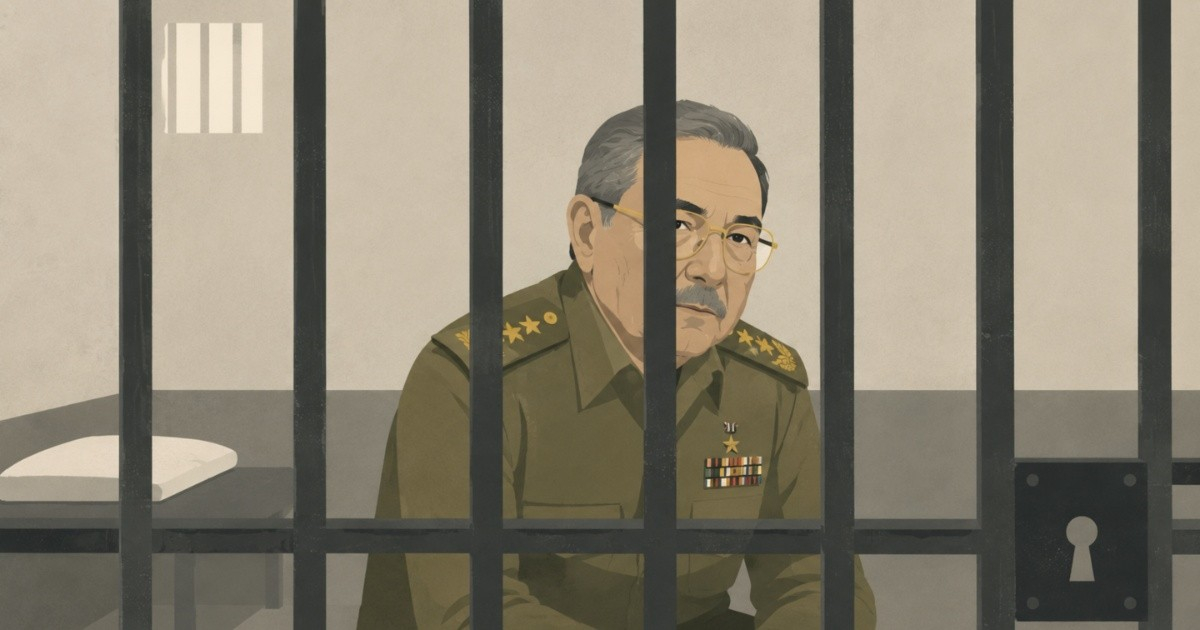
The U.S. Department of Justice unveiled a formal indictment on Wednesday against Raúl Modesto Castro Ruz and five former Cuban military officers for their alleged involvement in the downing of two civilian aircraft belonging to the Brothers to the Rescue organization on February 24, 1996, over the international waters of the Florida Strait.
The charges against the 94-year-old Castro include conspiracy to murder U.S. nationals, two counts of destruction of aircraft, and four counts of murder for the deaths of Carlos Costa, Armando Alejandre Jr., Mario de la Peña, and Pablo Morales, three of whom were American citizens.
If convicted, Castro could face the death penalty or a life sentence.
Historic Legal Action Against Cuban Leaders
Acting Attorney General Todd Blanche emphasized the historic nature of this action: "For the first time in nearly 70 years, high-ranking Cuban regime officials are charged in the United States for acts of violence that resulted in the deaths of American citizens. If you kill Americans, we will pursue you. No matter who you are. No matter what title you hold."
FBI Director Kash Patel highlighted that the investigation remained active: "For 30 years, these families sought answers, and the FBI never forgot."
Perseverance of Justice
Federal Prosecutor for the Southern District of Florida, Jason A. Reding Quiñones, stated, "The passage of time does not erase murder, nor does it diminish the value of these lives."
The indictment alleges that since the early 1990s, Cuban intelligence agents infiltrated Brothers to the Rescue and relayed detailed information about their flight operations to the Cuban government, information that military commanders used to plan the attack.
Weeks before the incident, Cuban military pilots conducted training exercises to locate and intercept slow-moving civilian aircraft.
The Day of the Attack
On the day of the attack, three BTTR planes took off from Opa-locka Airport; two of them—registered as N2456S and N5485S—were shot down by air-to-air missiles fired by MiG fighters under the command structure overseen by Raúl Castro.
A third plane, carrying founder José Basulto, managed to escape. The bodies of the four victims were never recovered.
Among the five co-defendants is Luis Raúl González-Pardo Rodríguez, 65, identified as one of the pilots directly involved in the shootdown.
González-Pardo was already in U.S. custody, arrested in November 2025 after entering the United States with humanitarian parole in 2024 and lying about his past in the Revolutionary Air Force on his residency application.
Community and Political Reactions
The announcement was accompanied by a ceremony at Miami's Freedom Tower to honor the victims. President Donald Trump hailed the indictment as "a great day" for the Cuban-American community.
The Cuban regime immediately rejected the charges. Díaz-Canel called the indictment a "political action, without any legal basis," arguing that Cuba acted in "legitimate defense" against alleged violations of its airspace, a stance the regime has maintained for three decades.
Raúl Castro, who appeared visibly frail during the May Day event in Havana, has not held formal positions since 2021, though he still possesses symbolic influence within the regime. He will turn 95 on June 3.
Legal Implications for Raúl Castro and Co-Defendants
What are the charges against Raúl Castro?
Raúl Castro faces charges of conspiracy to murder U.S. nationals, destruction of aircraft, and murder related to the deaths of four individuals, three of whom were American citizens.
What might be the consequences if Castro is convicted?
If found guilty, Raúl Castro could face either the death penalty or a life sentence.
How did the U.S. officials react to the indictment?
U.S. officials, including Acting Attorney General Todd Blanche, emphasized the historic nature of the charges and reiterated their commitment to pursuing justice for the victims.
What was the Cuban government's response to the charges?
The Cuban regime, led by Díaz-Canel, dismissed the charges as a political maneuver lacking legal foundation, maintaining their long-standing defense that they acted in legitimate defense of their airspace.