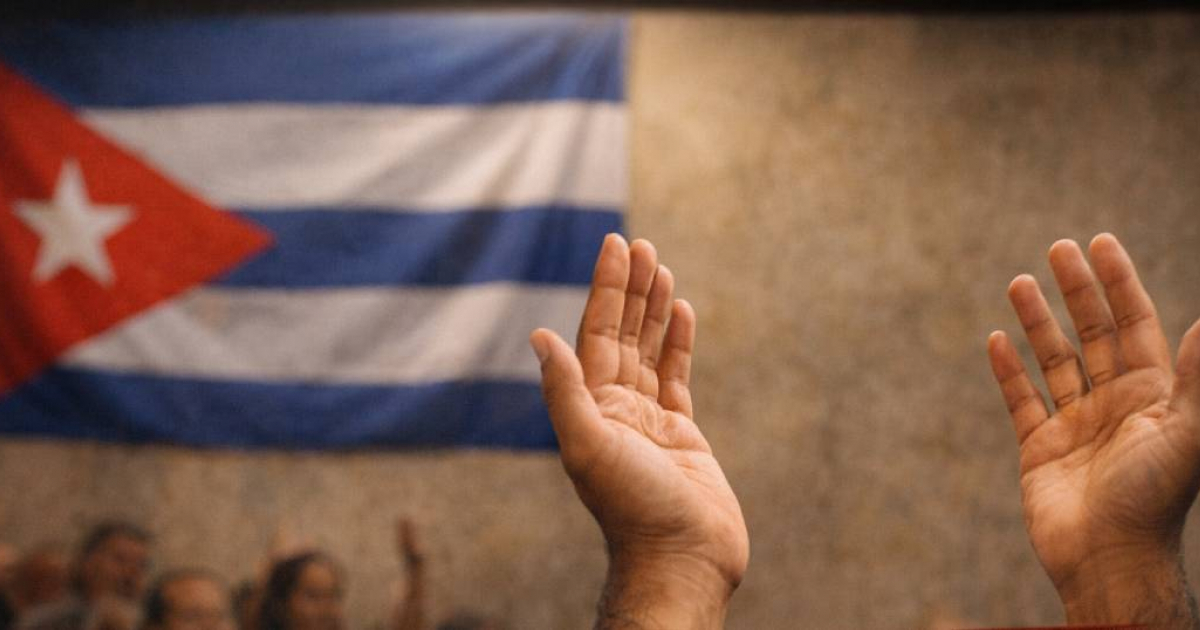
In commemoration of the 124th anniversary of the founding of the Republic of Cuba, Santiago de Cuba's Santo Tomas Apostol Parish delivered a stirring message advocating for freedom. Authored by A.P. León, the statement calls upon the Virgin of Charity of El Cobre, urging that "this suffering land" not be forgotten.
Entitled "Virgin of Charity, We Pray for Cuba's Freedom," the message reflects on how 19th-century independence fighters placed their hopes in the Mother of God. A resonating song echoed through the rebel fields: "Virgin of Charity, Patroness of Cubans, with the machete in hand we ask for freedom."
The core of the message is a direct reproach of the current state of the nation: "Today, 124 years after the Republic's establishment, Cubans, witnessing the dream of the mambises disintegrated and the Apostle's ideals manipulated, beseech at her feet not to forget this suffering land."
The reference to the "Apostle" is aimed at José Martí, a pivotal moral and intellectual figure in Cuban history, whose image has been historically co-opted by the regime to bolster its narrative.
Criticizing the "manipulation" of Martí's ideals serves as a direct condemnation of how the Cuban government has exploited this legacy throughout over six decades of dictatorship.
The message also recalls that 50 years after the Republic's founding—in 1952—the so-called "Virgin Mambisa" traveled across Cuba: "Cities, hospitals, churches, prisons all received her blessing. With every step, she was gifted dresses or keys to the city."
The image of the Virgin of Charity was declared Cuba's official Patroness by Pope Benedict XV on May 10, 1916, at the request of veteran mambises led by Major General Jesús Rabí, on behalf of the Liberation Army.
This historical connection between Marian devotion and the struggle for independence is central to A.P. León's message: the same men who fought for Cuba's freedom placed their faith in the Virgin, and today the Church invokes that symbol to denounce the betrayal of that dream.
The statement was released amid a day filled with symbolic activities. Miami's National Shrine of Our Lady of Charity held a special mass to honor the anniversary and pray "for the imminent freedom of the island," urging gratitude to God for "our homeland" and requesting "the restoration of a Cuba with justice, peace, and prosperity."
On the same day, Secretary of State Marco Rubio addressed the Cuban people, offering, on behalf of President Trump, $100 million in food and medicine, provided that distribution would be managed directly by the Catholic Church or other trusted charitable organizations, rather than the Cuban government or GAESA.
Rubio asserted that "Cuba is under GAESA's control" and proposed a vision for a "new Cuba" where citizens can own businesses, criticize the government without fear, and elect their leaders.
Miguel Díaz-Canel publicly responded to Rubio's message that very day, during an occasion when the exiled community and opposition groups experienced unusual anticipation regarding potential political change on the island.
A.P. León's message concludes with a plea encapsulating the sentiments of millions of Cubans both on the island and abroad: "Virgin of Charity, pray to your beloved Son for Cuba!!"
Understanding the Impact of A.P. León's Message on Cuba
What is the significance of the Virgin of Charity in Cuban history?
The Virgin of Charity is a symbol of hope and protection for Cubans, deeply intertwined with the country's struggle for independence. She was declared the official Patroness of Cuba in 1916, representing a spiritual guide during times of conflict.
How has the Cuban government used José Martí's legacy?
The Cuban regime has historically appropriated José Martí's image and ideals to legitimize its authority, often manipulating his legacy to support its own political narrative despite contradictions with Martí's original vision for Cuba.
What was Marco Rubio's proposal to the Cuban people?
Marco Rubio proposed offering $100 million in food and medicine to the Cuban people, with the condition that distribution be handled by trusted organizations such as the Catholic Church, and not by the Cuban government or GAESA.