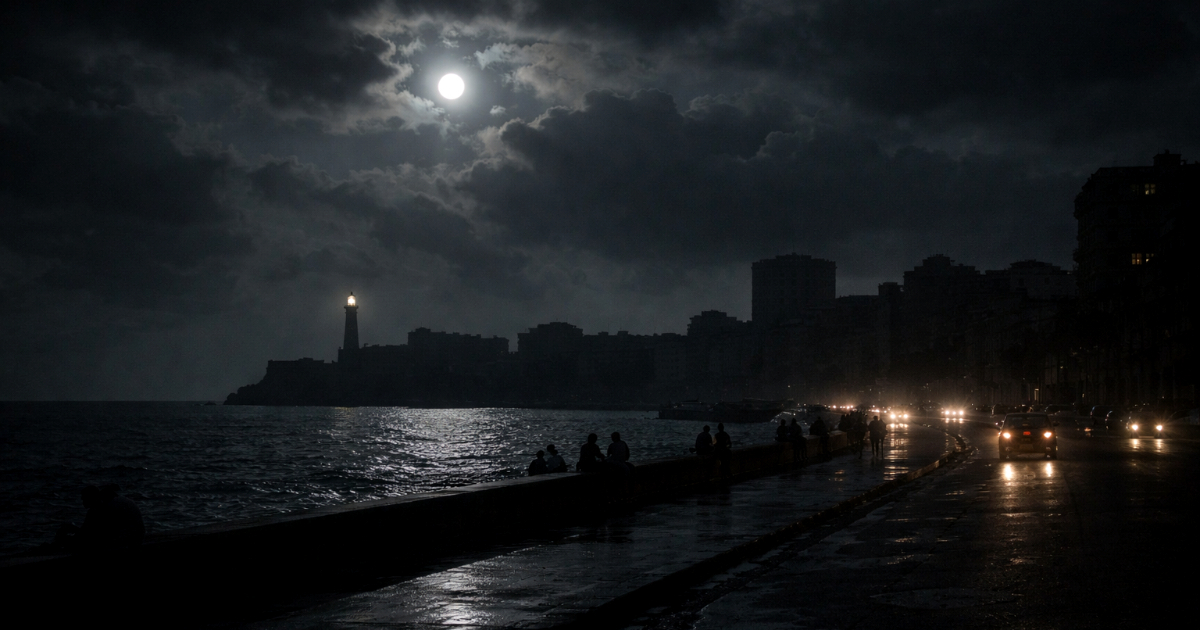
On Wednesday morning, Cuba woke to another day of extensive blackouts. The National Electric System (SEN) reported a mere 1,300 MW availability at 6:00 AM, with demands reaching 2,780 MW. Already, 1,474 MW were compromised since the early hours.
As night falls, the outlook becomes even bleaker. An anticipated peak demand of 3,250 MW against a still limited 1,300 MW availability forecasts a shortfall of 1,950 MW, potentially affecting 1,980 MW across the nation’s provinces.
The preceding day fared no better, with the highest impact recorded at 1,965 MW around 9:50 PM, as power outages persisted throughout the day and into the night.
Power Crisis Deepens with No Immediate Relief
Lázaro Guerra Hernández, the General Director of Electricity at the Ministry of Energy and Mines, stated on Canal Caribe that immediate relief is non-existent. "No new power sources are expected today; those under repair and maintenance won't be operational," he confirmed.
Units offline include Unit 1 of the Ernesto Guevara De La Serna power plant, Unit 2 of the Lidio Ramón Pérez plant, and Units 3 and 5 of the Antonio Maceo plant, all due to breakdowns.
Additionally, Unit 5 of the Mariel plant, Unit 6 of the Renté plant, and Unit 5 of the Nuevitas plant are undergoing maintenance, with 418 MW further incapacitated due to thermal generation limitations.
Fuel Shortages Exacerbate Power Crisis
The root cause of this crisis is a critical scarcity of fuel. Guerra Hernández admitted reliance solely on domestic resources: "Currently, we are generating only with national sources, including crude from gas and renewable resources."
About 1,400 MW remain unavailable in the SEN due to the absence of imported fuel.
Solar Power Provides Limited Daytime Relief
Some respite comes from 54 new photovoltaic solar parks, which generated 3,222 MWh on Tuesday with a peak power of 432 MW at noon, temporarily mitigating daytime disruptions without solving the nighttime deficit.
This dire situation stems from months of shortages. Energy and Mines Minister Vicente de la O Levy disclosed on May 14 that Cuba had "absolutely no fuel oil, nor any diesel." That day, SEN's capacity plummeted to 976 MW, leaving 70% of the country simultaneously without electricity, marking the year's lowest point.
Official data indicates that Cuba requires eight fuel shipments monthly to sustain its economy and energy production. However, between December 8, 2025, and late April 2026, only one shipment arrived. A Russian donation of 100,000 tons of crude, processed at the Cienfuegos refinery, provided the only significant relief but was depleted by early May.
While the regime blames the U.S. embargo for the crisis, the true culprits are outdated infrastructure, decades of poor management, and utter reliance on imported fuel, leading to a structural collapse of a system long at its breaking point.
The May 2026 crisis is the year's worst, with a record 2,174 MW deficit on May 14. Cubans endure up to 20-hour daily blackouts, with no immediate resolution in sight.
Understanding Cuba's Power Crisis
What is the current power availability in Cuba?
As of the latest reports, Cuba's power availability is around 1,300 MW, far below the demand of 2,780 MW.
What are the underlying causes of Cuba's power crisis?
The crisis is driven by a critical fuel shortage, outdated infrastructure, and a heavy reliance on imported fuel, compounded by decades of mismanagement.
How is Cuba attempting to mitigate the power shortage?
Cuba is utilizing domestic energy sources, including renewable options like solar power from new photovoltaic parks, which offer limited daytime relief.