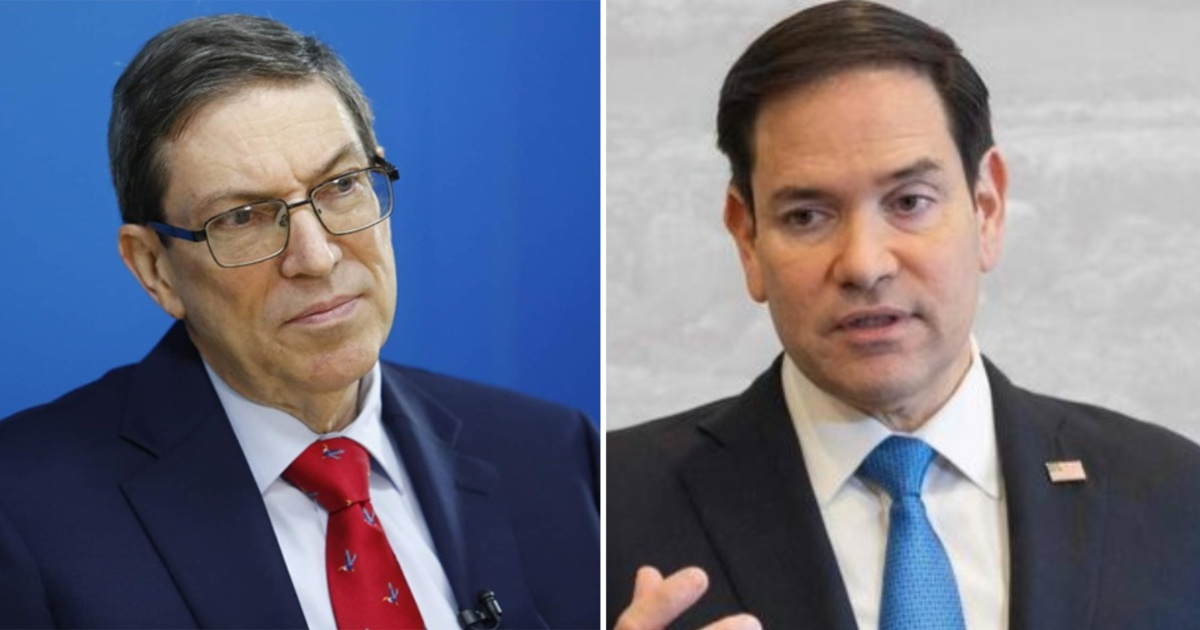
Cuba's Foreign Minister, Bruno Rodríguez Parrilla, lashed out at U.S. Secretary of State Marco Rubio on Wednesday following Rubio's video message to the Cuban people on Independence Day. Rodríguez accused Rubio of perpetuating a "deceptive narrative" to mask the harm that, according to Rodríguez, is caused by Washington's sanctions.
In a Facebook post, Rodríguez described Rubio as a "spokesperson for corrupt and vengeful interests," primarily based in South Florida. He argued that Rubio's views do not reflect the sentiments of the majority of Americans, nor of the Cubans living in the U.S.
The foreign minister also criticized Rubio's announcement of a $100 million aid package in food and medicine, though he stopped short of outright rejecting it: "He continues to speak of a $100 million aid package that Cuba has not refused, but its cynicism is evident to anyone considering the devastating effects of the economic embargo and energy blockade."
Rodríguez took the opportunity to denounce the symbolism chosen by Rubio, accusing him of using May 20th—a date the regime sees as the start of a neocolonial era—to attempt to revert Cuba to being a "dependent appendage of the U.S."
He concluded his post with a declaration of principle: "Neocolonial Cuba and the Platt Amendment are relics of the past. Independence and sovereignty define the present and the future."
Rubio's Message to the Cuban People
In his first message directly addressing the Cuban people in Spanish, Rubio placed the blame squarely on the military-business conglomerate GAESA—established by Raúl Castro three decades ago—for plundering billions while Cubans endure power outages lasting up to 22 hours a day.
According to Rubio, GAESA controls assets worth $18 billion and dominates 70% of the Cuban economy through ventures in hotels, construction, banking, retail, and remittances.
"The real reason you're experiencing shortages of electricity, fuel, and food is because those in control of your country have siphoned off billions of dollars, with none of it used to aid the people," Rubio stated.
Rubio was even more blunt in his assertion: "Cuba is not governed by any revolution. Cuba is governed by GAESA."
Regime's Reaction
The Cuban regime offered a multifaceted response. President Miguel Díaz-Canel labeled May 20th as a symbol of "intervention, interference, dispossession, and frustration" and disparaged those who support Rubio's message as "mercenaries of dishonor."
Deputy Foreign Minister Carlos Fernández de Cossío accused Rubio of "lying so repeatedly and unscrupulously" about Cuba to justify a "cruel and ruthless aggression."
This exchange comes amid escalating tensions: on May 1st, Trump signed Executive Order 14404 imposing new sanctions, and on May 7th, Rubio announced direct sanctions against GAESA, setting June 5th as the deadline for foreign companies to sever ties with the conglomerate.
On the same Wednesday, the U.S. Department of Justice filed formal charges against Raúl Castro for ordering the downing of two Brothers to the Rescue planes on February 24, 1996, resulting in the deaths of four individuals over international waters, as reported by El País.
Rubio concluded his message with a direct warning to the Cuban people: "Here in the United States, we stand ready to open a new chapter in the relationship between our peoples and our countries. Currently, the only barrier to a better future is those who control your country."
Understanding the Tensions Between Cuba and the U.S.
What is GAESA and why is it significant?
GAESA is a military-business conglomerate in Cuba, founded by Raúl Castro. It controls a significant portion of the Cuban economy, including hotels, construction, banking, and more, making it a central figure in discussions about the country's economic challenges.
How has the U.S. escalated its stance against Cuba recently?
The U.S. has increased its pressure on Cuba through new sanctions, including Executive Order 14404 signed by Trump and direct sanctions announced by Rubio against GAESA, pushing foreign companies to cut ties with the conglomerate.