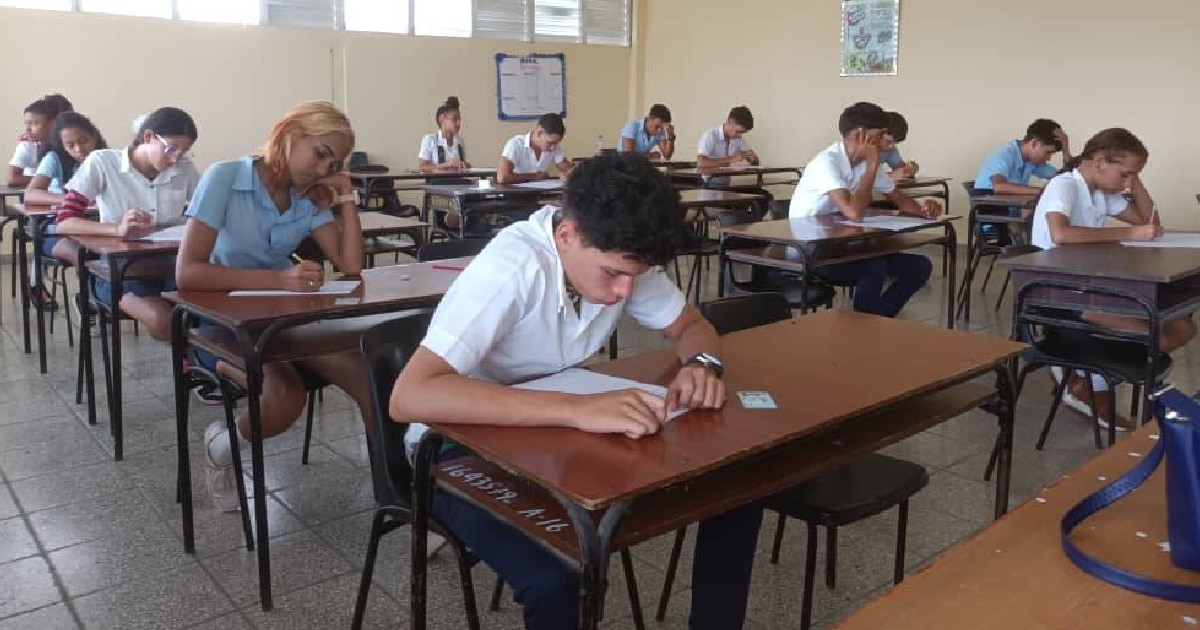
The recent announcement by Cubadebate about the cancellation of university entrance exams has unleashed a storm of criticism on social media, capturing the true pulse of public sentiment in Cuba regarding this decision.
The Cuban government's abrupt decision to call off university entrance exams for the 2026-2027 academic year and advance the school year's closure to the period of June 15 to 30 was revealed by Education Minister Naima Ariatne Trujillo Barreto and Higher Education Minister Walter Baluja García during the Round Table program.
Public Discontent and Sarcastic Reactions
Among the numerous comments, a prevailing sentiment emerged: a palpable concern about the apparent decline in the Cuban educational system. One user sarcastically remarked, "Buying a kerosene lamp for the next literacy campaign," echoing the frustration many expressed.
This ironic nod to the 1961 Literacy Campaign — often touted by the Cuban regime as a landmark educational achievement — highlights the perceived deterioration in Cuba's education over the years.
Critics were blunt: "In a few years, we'll witness a new literacy campaign; entering higher education is not a hobby, regardless of some students' cognitive abilities."
Contradictions and Broken Promises
A frequently voiced criticism was the inconsistency with the pandemic precedent: "Even during the COVID-19 period, entrance exams were not canceled, but now they are."
This contradiction is even more striking given that Minister Trujillo Barreto had declared in March 2026, "No one has thought of saying, let's suspend the school year," assuring that exams would proceed on June 5 (Mathematics), June 9 (Spanish), and June 12 (Cuban History).
Some commenters bluntly pointed out, "Didn't they just say it was fake news not too long ago?"
Voices of Frustration from Students and Educators
Outrage also came from those who had studied under previous rules: "Hey, I struggled so much in 12th grade because I really burned the midnight oil for the entrance exam, and now they make it so easy."
A self-identified teacher warned about structural consequences: "If the system doesn't change, our nation will be worse off in the future, with no professionals to lead the country forward."
Another widely cited comment was unequivocal: "Removing exams doesn't improve education... it only masks the disaster. A country doesn't progress by promoting students through decree but by forming capable youth. Later we see university graduates who can't write, teachers without skills, and empty professionals. Rigor isn't cruelty; it's respect for the future."
Impact on Specialized Schools and Mixed Reactions
Concerns specifically emerged regarding students from vocational pre-university institutes of exact sciences (IPVCE): "Totally affected by this decision and at a disadvantage because the allocation of degrees for them wasn't better evaluated," a user pointed out, alluding to their more stringent ranking systems compared to regular pre-universities where, according to several commenters, grades are "given away."
There were also voices defending the measure, arguing that students endure extreme conditions — power outages lasting over twenty hours, hunger, sleep deprivation — making fair evaluation impossible, and recalling that such exams didn't exist in the 1970s and 1980s either.
The minister described the course process as one of "extraordinary sensitivity, tremendous sacrifice, and commitment," attributing the hardships to "the aggressive policy of the United States government," without acknowledging any internal responsibility for the educational collapse.
Highlighting the severity of the issue: in the 2024-2025 school year, only 51.5% of applicants passed the entrance exams out of 18,402 students, with extreme cases like Las Tunas, where merely 16.7% succeeded.
Frequently Asked Questions on Cuba's Education Crisis
Why did the Cuban government cancel university entrance exams?
The Cuban government canceled the exams for the 2026-2027 academic year, citing extreme conditions faced by students, including long power outages and other hardships. However, the decision has been met with public criticism and perceived as a sign of educational decline.
What has been the public reaction to the cancellation of exams?
The public reaction has been overwhelmingly negative, with many expressing concerns about the deterioration of the educational system and the lack of consistency with previous policies during the pandemic.
How have students and educators responded to this decision?
Students and educators have expressed frustration, warning of long-term negative impacts on the nation's future and criticizing the decision as merely a facade that doesn't address the core issues of the educational system.