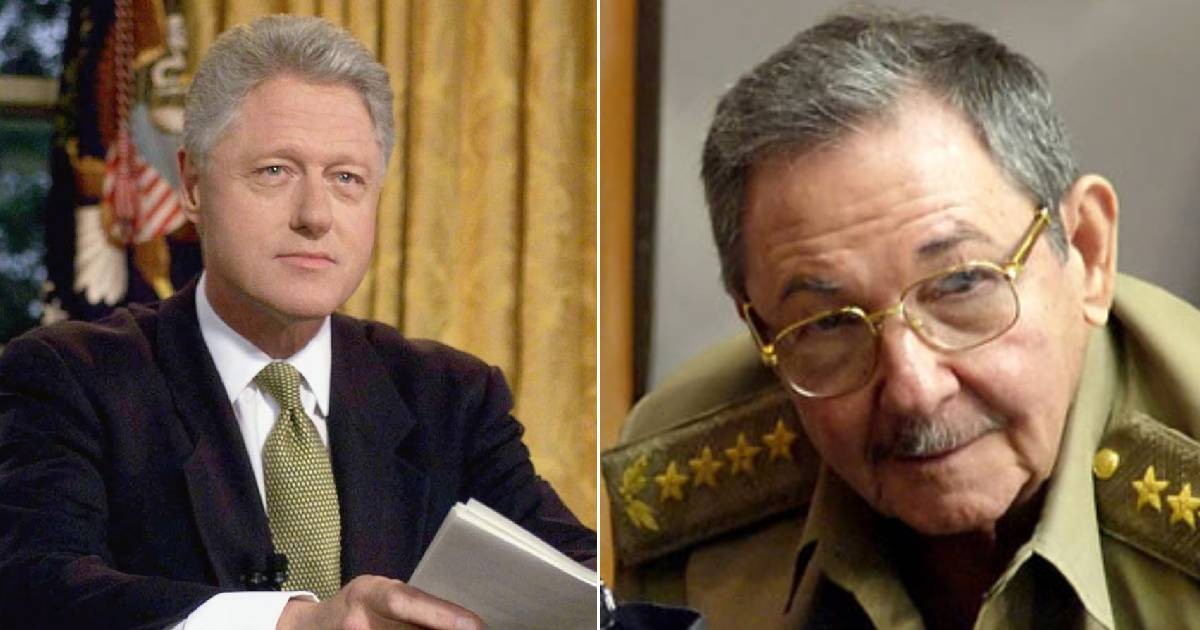
On February 26, 1996, President Bill Clinton stood before the press to denounce the downing of two civilian planes belonging to Brothers to the Rescue by Cuban military jets. His response was firm in rhetoric but strategically restrained: collective sanctions against the Cuban government, yet no criminal charges against Raúl Castro, who was then head of the Revolutionary Armed Forces.
During the White House briefing, Clinton termed the incident "a blatant violation of international law" and outlined a set of retaliatory measures. He directed Ambassador Madeleine Albright to call an emergency session of the UN Security Council, suspended charter flights indefinitely between the United States and Cuba, tightened travel restrictions for Cuban officials on U.S. soil, and expanded the reach of Radio Martí.
The attack had taken place two days prior, on February 24, 1996, when Cuban Air Force MiG fighters shot down two unarmed civilian Cessna planes over international waters in the Florida Straits, killing four Cuban-Americans: Armando Alejandre Jr. (45), Carlos Costa (30), Mario de la Peña (24), and Pablo Morales (30). Their bodies were never recovered.
The International Civil Aviation Organization determined that the shootdown occurred 9 to 10 nautical miles outside Cuban airspace, making it an illegal act under international law. In response, Clinton expedited the passage of the Helms-Burton Act, which the House of Representatives passed on March 1 with a vote of 336 to 86, and which was signed into law on March 12, 1996. This act codified the economic embargo against Cuba and limited the ability of future presidents to unilaterally ease it.
Nonetheless, the president did not pursue individual criminal proceedings against Raúl Castro or any other Cuban leader. Instead, Washington's strategy focused on penalizing the Cuban state as a whole, rather than targeting its leaders personally.
Legal and Political Challenges
In this context, prosecuting a minister from a sovereign state without an extradition treaty was legally unfeasible and politically unimaginable. Evidence of Raúl Castro's direct involvement would not surface until years later. In June 1996, four months post-attack, Castro was heard in a recording discussing the order he gave: "I said to try to bring them down over the territory, but they entered Havana and left... Well, bring them down at sea when they show up."
The 11-minute, 32-second audio was published in 2006 by El Nuevo Herald and authenticated by Alcibiades Hidalgo, a former personal secretary to Castro. Declassified FBI documents also mention an "Operation Venice," allegedly planning the shootdown with premeditation, supporting the notion that the attack was not a spur-of-the-moment decision.
Nearly three decades later, the Department of Justice is set to announce federal criminal charges against the 94-year-old Raúl Castro this Wednesday. José Basulto, founder of Brothers to the Rescue and a survivor of the attack, expressed the sentiment of the families: "I have wished for this for a long time. I wished for justice to be served, for justice to be realized."
Key Insights into the Brothers to the Rescue Incident
What was the international response to the Brothers to the Rescue shootdown?
The international response included condemnation of the incident as a violation of international law, with the UN Security Council holding an emergency session and the U.S. imposing further sanctions on Cuba.
Why didn't Bill Clinton pursue charges against Raúl Castro?
Clinton's administration chose to penalize the Cuban government collectively rather than pursuing individual criminal charges, due to legal and political challenges, including the absence of an extradition treaty.
What led to the passage of the Helms-Burton Act?
The Helms-Burton Act was expedited in response to the Brothers to the Rescue incident, aiming to codify the economic embargo on Cuba and restrict future presidential authority to ease it.