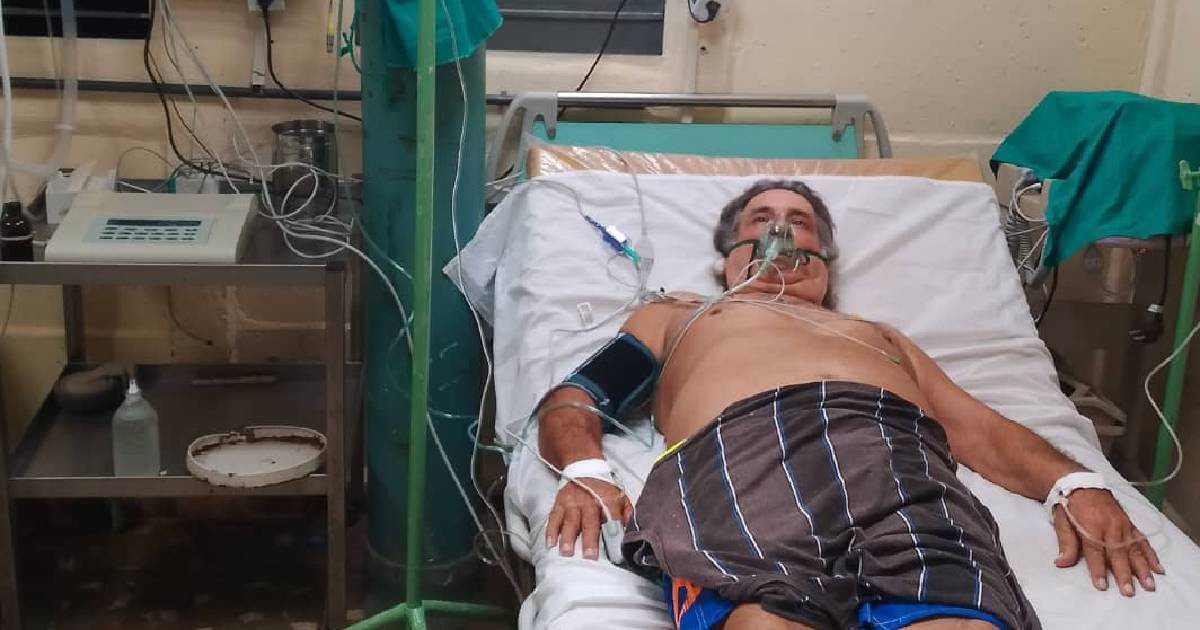
Mailene Nogueras Santiesteban, a former political prisoner from the July 11, 2021, protests, voiced a desperate plea on Tuesday regarding her father’s critical condition. He has been languishing for over 12 hours at the Batabanó Polyclinic in Mayabeque Province, suffering from a heart attack and a blood clot, without the possibility of being moved to an intensive care unit due to a shortage of available beds.
“My father has spent 12 hours at the Batabanó clinic with a heart attack and a blood clot, and there are no ICU beds available to transfer him,” Mailene declared in her public complaint. She detailed how her father was admitted at 10:30 p.m. on Monday with a condition requiring immediate intensive care intervention.
A thrombus, or blood clot, can travel through the bloodstream and potentially cause sudden death if not promptly treated in a specialized unit. Coupled with a heart attack, it presents an immediate life-threatening risk to the patient.
The accompanying photograph reveals an elderly man equipped with an oxygen mask, cardiac monitoring electrodes, an intravenous catheter, and a blood pressure cuff, with a heart rate of 105 beats per minute. The clinic’s surroundings show peeling walls and unclean floors.
Mailene acknowledged the efforts of the medical staff but pointed out that the root of the issue is structural: “The doctors have done what they can with the resources available. I don’t blame them. The reality is different: there aren’t enough ICU beds to transfer him. Not in Batabanó, nor in the reference hospitals.”
The Pascuala R. Rojas Cruz University Polyclinic in Batabanó is a primary care facility not equipped for prolonged critical patient care. The Mayabeque Province has 20 primary care clinics and only four secondary care hospitals.
This complaint emerges amid a systemic healthcare crisis that has worsened in recent months. In July 2025, the Cuban government admitted that only 30% of essential medicines were available. The Cuban Social Rights Observatory reported that by September 2025, merely 3% of citizens could access their medications in state pharmacies.
Even major hospitals are not immune to the collapse. In April 2026, unsanitary conditions in the intensive care unit of the Orlando Pantoja Tamayo General Hospital in Contramaestre, Santiago de Cuba, were exposed. In November 2025, the Calixto García Hospital in Havana suffered a partial roof collapse. That same month, Cubalex warned that the country's hospitals are overwhelmed due to a lack of resources, personnel, and medication.
Mailene was arrested on July 17, 2021, during the crackdown on the 11J protests and became part of the Cuban Political Prisoners’ Sponsor Program.
Her status as a former political prisoner adds another layer to her complaint, highlighting the vulnerability faced by the families of those persecuted by the regime. In May 2026, Justicia 11J reported 775 political prisoners in Cuba, with 338 sentenced for the July 11, 2021, protests.
“Why do we have to beg for a bed that should be a right?” Mailene questioned. “I’m not asking for luxuries. I’m asking for my father to be saved. I’m asking that no one else has to endure this.”
Understanding the Healthcare Challenges in Cuba
What is causing the shortage of ICU beds in Cuba?
The shortage of ICU beds in Cuba is largely due to systemic healthcare issues, including a lack of resources, insufficient infrastructure, and inadequate medical supplies, all of which are exacerbated by the regime's policies.
How does the current healthcare crisis affect Cuban citizens?
The healthcare crisis in Cuba severely impacts citizens by limiting access to essential medical care and medications, leading to potentially life-threatening situations for those who require urgent treatment.