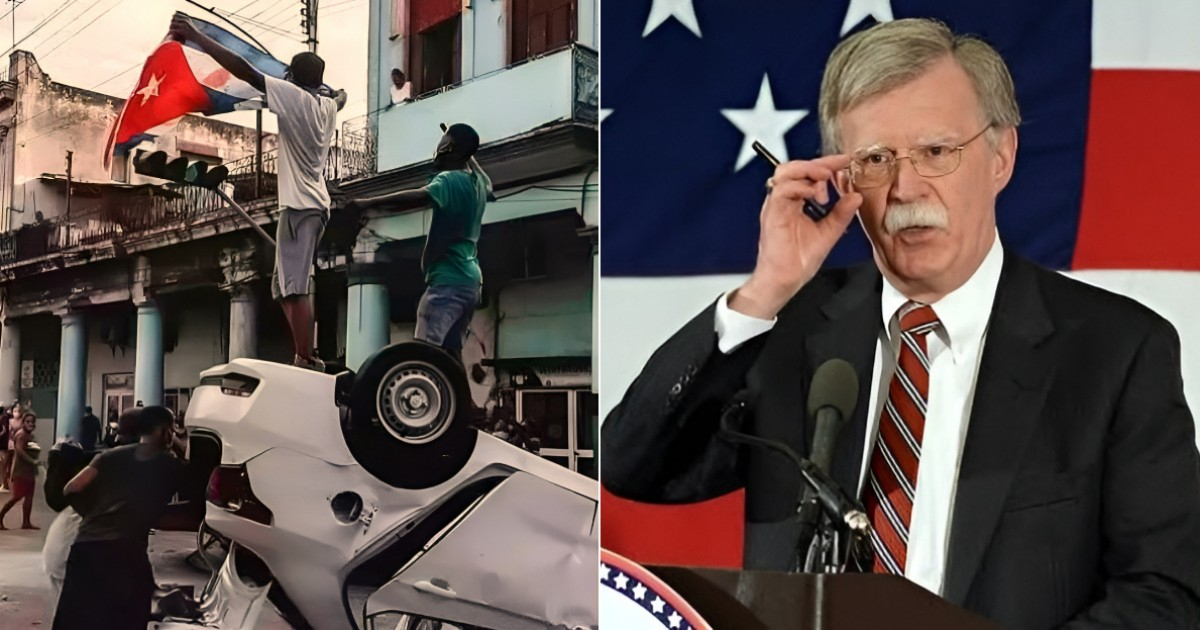
Former National Security Advisor, John Bolton, suggested on Tuesday that the Cuban regime could fall "within a few months." He made these remarks during an interview with 'Hora América' on Radio Exterior de España while stopping over in Madrid.
Bolton pointed out that Cuba is currently experiencing its weakest period in decades. The country is facing an unprecedented energy crisis, a rapidly declining economy, and a reduced oil supply from Venezuela following Nicolás Maduro's downfall.
"The Cuban government has essentially declared it has run out of oil. There are blackouts across the nation. Should the young people in Cuba decide to voice their dissatisfaction, the regime could collapse swiftly," the former advisor stated.
He emphasized the uniqueness of the Cuban situation compared to other regimes: "Cuba is not Venezuela. It's not Iran. It's not Afghanistan," highlighting the island's proximity—just 90 miles from Florida—and its unique historical significance in U.S. foreign policy.
Bolton deemed it "unacceptable" for any remnant of the Castro regime, like Raúl Guillermo Rodríguez Castro, the grandson of Raúl Castro, to remain in power. Rodríguez Castro reportedly took part in recent talks with Washington.
Energy Crisis in Cuba
The energy crisis Bolton describes is acknowledged by the regime itself. In May, Cuba's energy minister admitted the country is "out of fuel" to produce electricity, facing generation deficits exceeding 1,955 MW at peak times, and experiencing blackouts lasting up to 24 hours in several provinces.
Cuba is currently receiving only one fuel shipment out of the eight needed monthly, a situation worsened after Russian oil supplies were exhausted.
U.S.-Cuba Tensions Escalate
Bolton's comments come amid heightened tensions between Washington and Havana. As reported by Politico on Monday, the Trump administration is considering military options against Cuba, ranging from targeted airstrikes to a ground invasion, with Southern Command holding planning meetings on the matter.
On May 14, CIA Director John Ratcliffe visited Havana, marking the highest-level direct contact between the two governments since 2016, meeting with MININT officials and Raúl Castro's grandson.
Simultaneously, the Justice Department is preparing to file criminal charges against Raúl Castro for the 1996 shootdown of Brothers to the Rescue planes, with an announcement expected this Wednesday, May 20.
Bolton credited Secretary of State Marco Rubio as being "the most focused on ending the Castro regime," attributing this determination to his Cuban heritage and the political influence of the exile community in Florida.
Back in April, Bolton warned that Trump might repeat his "mistake" with Venezuela by accepting superficial gestures from Cuba without demanding meaningful structural changes from the regime.
In response, Díaz-Canel took to social media on Tuesday, warning that U.S. military aggression "would cause a bloodbath of unimaginable consequences," while Trump posted on Truth Social: "Cuba asks for help, and we will talk!" indicating the possibility of diplomatic negotiations.
Questions About the Potential Collapse of the Cuban Regime
What are the main factors leading to the potential collapse of the Cuban regime?
The main factors include an unprecedented energy crisis, a rapidly declining economy, and the loss of Venezuelan oil supply.
How does John Bolton view the Cuban regime compared to other countries?
Bolton differentiates Cuba from countries like Venezuela, Iran, and Afghanistan, emphasizing Cuba's proximity to the United States and its unique historical role in U.S. foreign policy.
What military actions is the U.S. considering against Cuba?
The U.S. is considering options ranging from targeted airstrikes to a full-scale ground invasion.