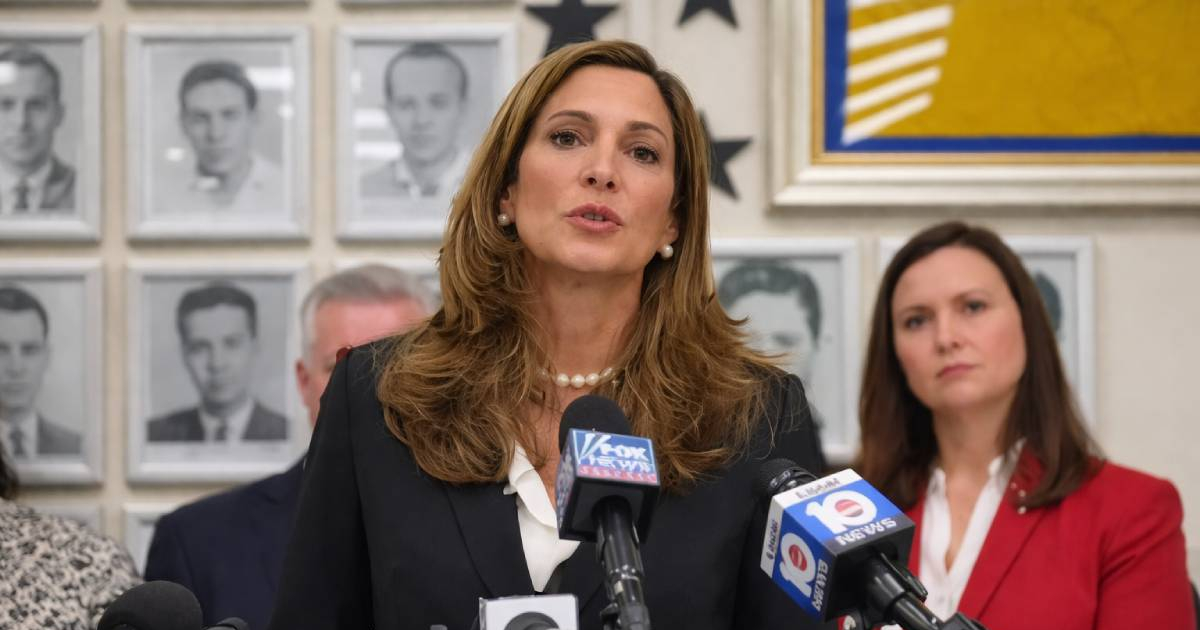
Republican Congresswoman María Elvira Salazar issued a powerful message on X this Tuesday, supporting the Trump administration's aggressive approach against the Cuban regime. This statement came on the same day that Secretary of State Marco Rubio announced new sanctions targeting 11 regime elites and three government organizations.
"The Trump Administration isn't playing games. When President Trump and Secretary Rubio declare that the Cuban regime's time is up, they mean it," Salazar expressed on her X account.
Representing Florida's 27th district, Salazar, who is the daughter of Cuban exiles, clearly stated her position: "Every new sanction sends a consistent message to Havana: the free world knows who they are, what they've done, and where the money is."
Salazar was unequivocal about the regime's nature: "No more concessions to a mafia-like dictatorship that has turned Cuba into a prison and exported repression throughout the Americas."
Her message concluded with a political assessment of the current situation: "The noose is tightening around the dictatorship. For the first time in a long while, the regime appears nervous."
Salazar's statement aligns with the second wave of sanctions announced by Rubio on Tuesday under Executive Order 14404, signed by President Donald Trump on May 1, 2026.
The sanctioned Cuban officials include Roberto Morales Ojeda, Esteban Lazo Hernández, Mayra Arevich Marín, and Raúl Villar Kessell, among others. The targeted entities comprise the Directorate of Intelligence (DGI/G2), the Ministry of the Interior, and the Revolutionary National Police.
Rubio signaled that "more designations are forthcoming in the days and weeks ahead," suggesting that the pressure is escalating.
This second round follows the initial sanctions on May 7, when Washington targeted GAESA — the military conglomerate controlling 40% to 70% of Cuba's formal economy — along with its CEO Ania Guillermina Lastres Morera and the mining company Moa Nickel S.A. Rubio described GAESA as "the core of Cuba's kleptocratic communist system."
Following those sanctions, shipping companies Hapag-Lloyd and CMA CGM halted cargo bookings with Cuba, and Canadian mining company Sherritt International ceased direct operations on the island. The U.S. set a deadline of June 5, 2026, for foreign companies to sever ties with GAESA or face secondary sanctions.
The regime has responded with defensive rhetoric. The Ministry of Foreign Affairs accused Washington of attempting to "provoke internal strife in Cuba," while Miguel Díaz-Canel stated that the sanctions "strengthen our resolve to defend the Homeland."
Since January 2026, the U.S. has imposed over 240 sanctions on the Cuban regime, highlighting the unprecedented scale of current pressure.
Understanding the Impact of Sanctions on Cuba
What is the objective of the sanctions imposed by the Trump administration on Cuba?
The sanctions aim to pressure the Cuban regime by targeting its key figures and economic structures, thereby holding them accountable for their actions and weakening their control.
Who are some of the individuals and entities affected by the recent sanctions?
Individuals like Roberto Morales Ojeda and Esteban Lazo Hernández, along with entities such as the Directorate of Intelligence and the Ministry of the Interior, have been targeted.
How has the Cuban government responded to the sanctions?
The Cuban government has responded with defensive statements, accusing the U.S. of trying to incite internal conflict and asserting their determination to defend their sovereignty.