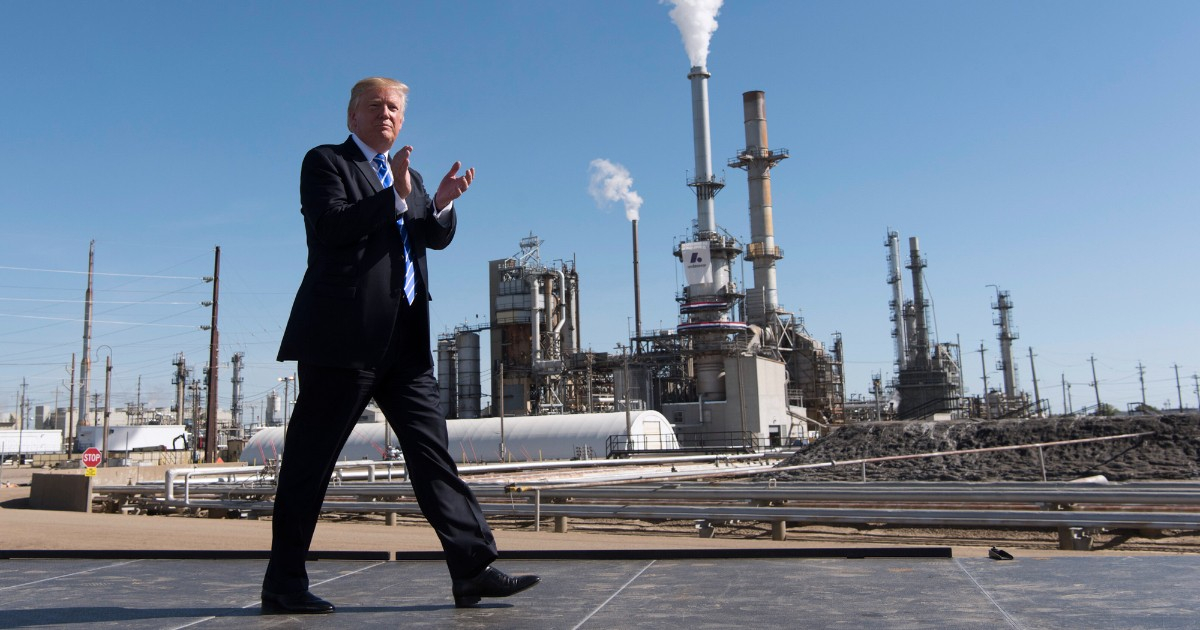
The White House released a comprehensive document on Monday titled "Trump Administration Actions to End Green Energy Regulations," detailing numerous environmental and energy deregulation measures implemented since Trump's return to power in January 2025.
This document, personally shared by President Donald Trump on his social media platform, outlines actions from various federal agencies—including the Environmental Protection Agency (EPA), the Department of the Interior (DOI), the Department of Energy (DOE), the Department of Agriculture (USDA), and others—aimed at dismantling the regulatory framework supporting renewable energy while accelerating oil, gas, and coal projects.
One of the most striking measures is the drastic reduction in the environmental permitting process under the National Environmental Policy Act (NEPA), from several years to a maximum of 28 days. "The new permitting procedures will cut a multi-year process down to just 28 days at most," the document states.
Eight federal agencies have removed all procedural requirements for environmental analysis in their permits and loans, while the Council on Environmental Quality adopted 101 new categorical exclusions under NEPA, exempting 101 activities from any environmental review.
The report also highlights the removal of the "social cost of carbon" consideration from decision-making processes by various agencies, arguing that "climate concerns should not inflate costs for consumers."
In terms of coal, the DOI has ended the federal coal leasing moratorium and rescinded environmental impact statement requirements for leases on more than 3 million acres. Meanwhile, the EPA has repealed the 2024 amendments to mercury emission standards for coal and oil-fired power plants, reverting to the 2012 standards.
The document further reveals that the DOI, USDA, and the Army Corps of Engineers have reformed permits to "prioritize dense energy plants such as natural gas, nuclear, and coal," while downplaying wind and solar projects, which are deemed "unreliable and environmentally destructive."
Regarding electric vehicles, California's mandates have been overturned by Congress through the Congressional Review Act, and the Department of Transportation has proposed reducing fuel efficiency standards to levels achievable by internal combustion engines.
In Alaska, the DOI reopened 1.56 million acres of the Coastal Plain of the Arctic National Wildlife Refuge (ANWR) for oil and gas leasing and approved a plan reopening nearly 82% of the National Petroleum Reserve in Alaska—23 million acres—to extractive industries.
Internationally, the White House announced the withdrawal of the United States from 66 international organizations "that no longer serve American interests," including the United Nations Framework Convention on Climate Change (UNFCCC) and the Intergovernmental Panel on Climate Change (IPCC).
In the financial sector, the Office of the Comptroller of the Currency (OCC), the FDIC, and the Federal Reserve have withdrawn from the NGFS climate network and eliminated climate risk management principles for large financial institutions. The Commodity Futures Trading Commission (CFTC) dismantled its Climate Risk Unit.
The DOE has removed 47 regulations considered burdensome, including efficiency standards for appliances, natural gas requirements, and zero-emission building standards. Additionally, the EPA has closed its environmental justice department.
Trump has also rescinded six of the Biden administration's executive orders on climate and clean energy, including the one implementing the Inflation Reduction Act.
This publication represents the most comprehensive account to date of Trump's "energy dominance" policy, which openly favors fossil fuels over renewable energy sources.
FAQs on Trump's Energy Policies
What is the main focus of Trump's energy policy?
Trump's energy policy primarily focuses on dismantling regulations for green energy and promoting fossil fuels like oil, gas, and coal.
Which major environmental act has been affected by the new permitting process?
The National Environmental Policy Act (NEPA) has been significantly affected, with the permitting process reduced to a maximum of 28 days.
How has Trump's policy impacted international climate agreements?
Trump's policy led to the withdrawal of the United States from 66 international organizations, including key climate agreements such as the UNFCCC and IPCC.