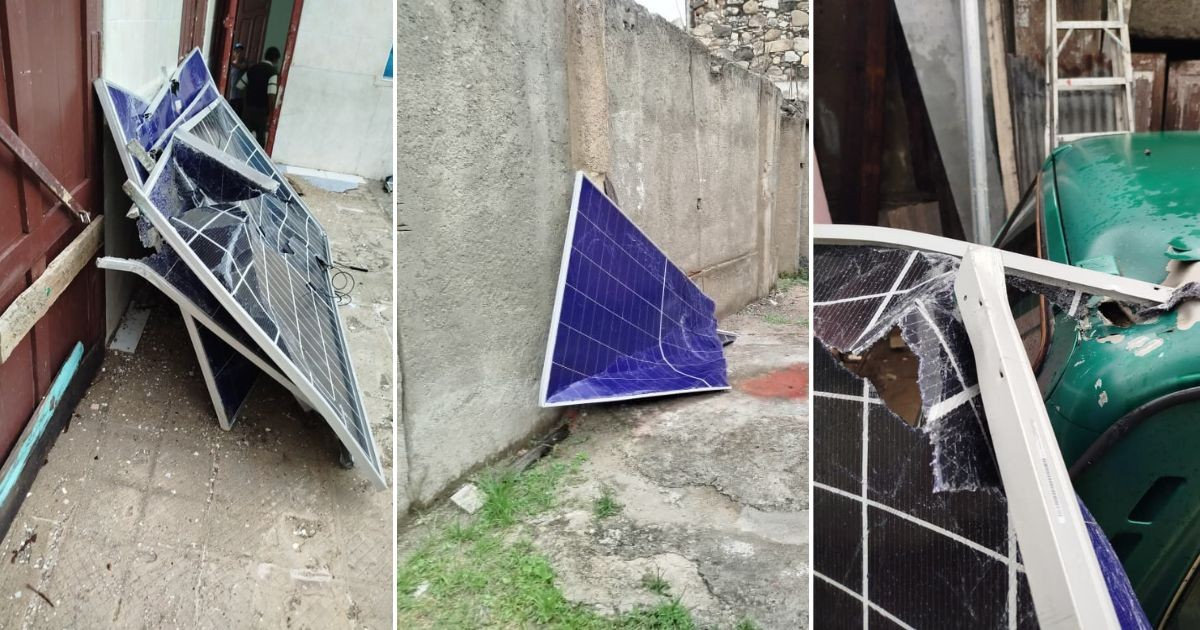
A fierce storm on Monday nearly obliterated the solar panel system at Our Lady of the Rosary Parish in Palma Soriano, Santiago de Cuba, jeopardizing the dining hall that serves almost a hundred vulnerable individuals, primarily the elderly.
The Archdiocese of Santiago de Cuba shared a report on Facebook, accompanied by photos and signed by Yojander Pérez López, illustrating the damage caused by intense winds, lightning, hail, and heavy rainfall that struck the area during the afternoon.
Destruction of Essential Solar Infrastructure
According to the report, of the twelve solar panels originally installed at the parish, only three remain. Nine were torn away, with seven suffering severe damage, including one that became lodged in one of the parish's vehicles.
Photographs reveal shattered glass, twisted aluminum frames, and destroyed solar cells, piled against the parish's walls.
Impact on Community Support Services
The photovoltaic system—comprising 12 panels, an inverter, and batteries—was a recent acquisition made possible through the collaboration of Italian Missionary Fathers and the Diocese of Milan. Its primary function was to ensure the operation of the Parish Dining Hall, which serves nearly a hundred vulnerable individuals, mainly seniors, and provides laundry services for these beneficiaries along with an Educational Review Project for neighborhood children.
The investment addressed Cuba's chronic electrical crisis directly. The parish's statement highlights the decision to invest due to the unstable electricity supply, frequent blackouts, and disconnections from the National Electric System, emphasizing the difficulty of cooking for nearly a hundred people using charcoal in a confined space.
Wider Impact of the Storm
The storm was not an isolated event. On the same day, a severe local storm also hit Bayamo, the capital of Granma, with winds exceeding 100 km/h, 81.5 mm of rain in an hour, hail, and falling trees, worsening the province's electrical infrastructure damage.
Motivated by an equally dire energy context, the National Electric System's availability on Monday was a mere 1,070 MW against a demand of 2,545 MW, with a projected deficit during peak hours exceeding 2,000 MW.
The solar system's destruction raises concerns about the continuity of the dining hall and other social services the parish provides amidst the state's collapse.
Community Resilience Amidst Crisis
In Santiago de Cuba, the Catholic Church and other faiths have increasingly taken on the role of basic assistance providers. The Methodist Church San Juan feeds over 400 people every Sunday, and in May, the Betania House for the Elderly opened with support from donors in the United States.
The Archdiocese's statement concludes with a call for hope: "May God allow us to soon have new panels, so we can continue serving those most in need."
Frequently Asked Questions About the Solar Panel Destruction in Santiago de Cuba
What caused the solar panel destruction at the parish in Santiago de Cuba?
The solar panel system at the parish was destroyed by a severe storm featuring strong winds, lightning, hail, and heavy rain.
How did the storm affect the dining hall operations?
The storm's destruction of the solar panels threatens the dining hall's ability to serve meals to nearly a hundred vulnerable individuals, primarily seniors.
What was the original purpose of the solar panel system?
The solar system was intended to power the parish's dining hall, laundry services, and an educational program, particularly benefiting the elderly and children in the area.