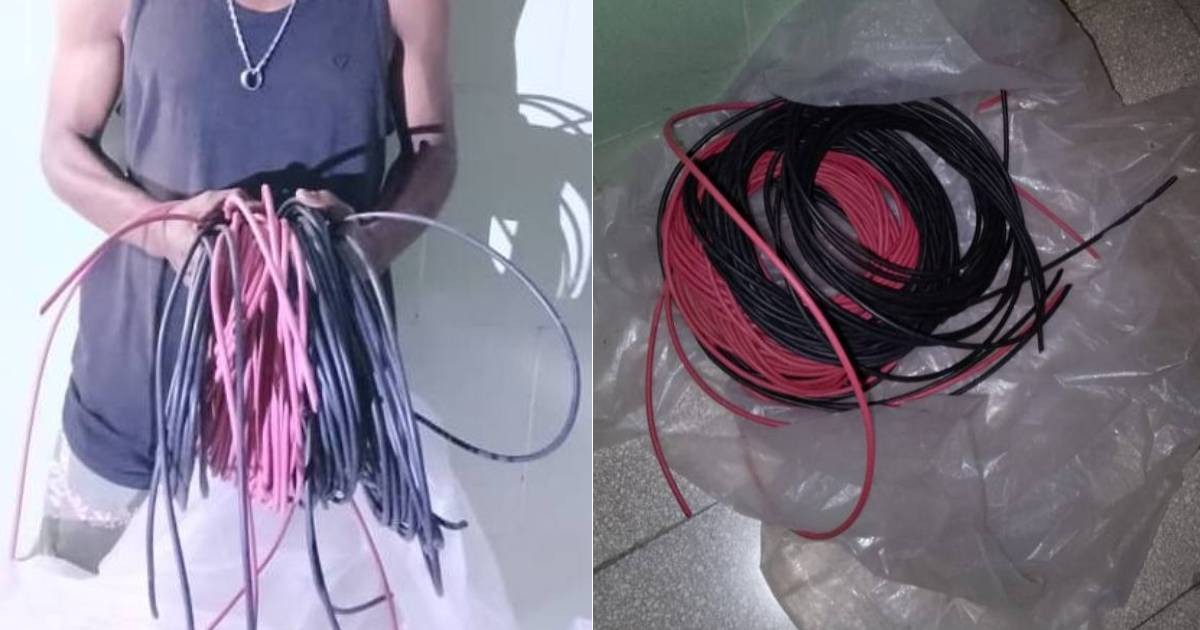
The Cuban police have apprehended a shift supervisor at the Barreras photovoltaic park in the capital's municipality of Guanabacoa. He is accused of stealing over 40 meters of electrical cables from the facility, as reported by the Ministry of the Interior's page "El Cubano Fiel" on Facebook.
Identified as the leader of the park's workforce, the man used his trusted position to cut and remove the cables, according to the report.
The theft had a direct impact on power generation: 24 solar panels were rendered inoperative for several hours, ceasing their contribution to the National Electric System (SEN).
The park's management filed a complaint with the police, who then launched an investigation and searched the suspect's residence. The stolen cables were found and seized as evidence.
This incident occurs amid a severe electrical crisis in Cuba. On Monday, the SEN reported an availability of merely 1,150 MW against a demand of 2,720 MW, with 1,520 MW affected during the day and a projected 2,080 MW shortfall during peak nighttime hours, according to data from Cuba's Electric Union.
The Barreras solar park is part of the regime's strategy to expand solar energy generation. The facility has been visited by high-ranking officials, including Esteban Lazo, President of the National Assembly, and Liván Izquierdo Alonso, the Communist Party's First Secretary in Havana.
This theft is not an isolated incident. In November 2025, Yeraldo Lantigua Padrón was arrested in Colón, Matanzas, accused of stealing 700 meters of cable, four batteries, and 178 connectors from a solar park, and was charged with sabotage.
In September 2025, police apprehended those responsible for stealing more than 50 beams and panels from the Juan Pérez II Photovoltaic Park in Niquero, Granma.
In March 2026, a court in Ciego de Ávila sentenced two men to nine and seven years in prison for stealing approximately 50,000 screws intended for solar panel assembly, classifying the offense as sabotage under Article 125 of the Penal Code.
Earlier this month, a solar panel theft from an ETECSA photovoltaic system in Santiago de Cuba left more than 560 users without service.
In April 2026, the UN warned that Cuba's energy crisis has a "systemic and increasingly significant" impact on health, water, food, transportation, and telecommunications, noting that the island had been without adequate fuel for over three months. In this scenario, thefts from solar infrastructures represent an additional blow to an already strained electric system.
Key Issues Surrounding Cuba's Energy Crisis
What were the consequences of the cable theft in Guanabacoa?
The theft led to the deactivation of 24 solar panels, which were unable to contribute electricity to the National Electric System for several hours.
How does the Cuban energy crisis affect daily life?
The energy crisis in Cuba impacts various aspects of daily life, including health services, water supply, food availability, transportation, and telecommunications, due to insufficient fuel and electricity.
Why is solar energy important in Cuba's strategy?
Solar energy is crucial for diversifying Cuba's energy sources and reducing dependency on imported fuels, which is especially important given the current energy shortages.