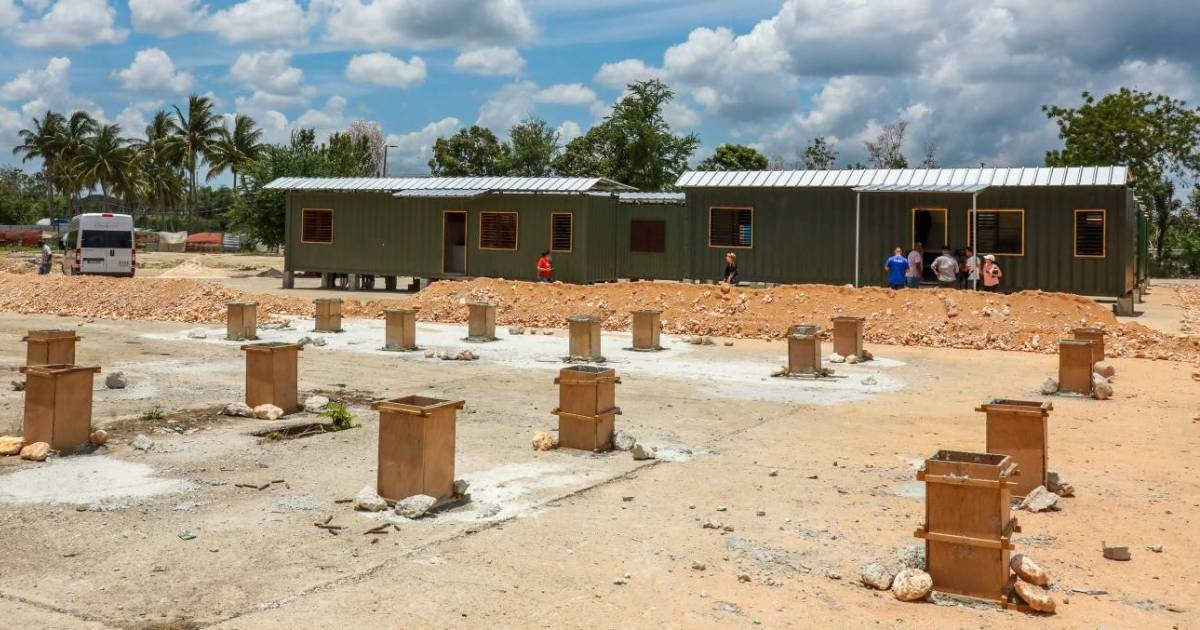
The Cuban regime has unveiled its inaugural urban development project featuring modular homes created from shipping containers in Havana. This initiative is located in the Toledo community, within the Marianao municipality, on a 114,000-square-meter area that used to be the site of the municipal bus terminal, near CUJAE.
According to the Facebook page of the Cuban Government, the modular housing project in Marianao is divided into two phases, each comprising 40 containers, totaling 80 housing units. The area's urban development began in November 2025, with plans to complete the first 10 fully habitable containers by the end of the month, and another 10 by the end of June.
Prime Minister Manuel Marrero Cruz visited the project site to engage with the workers. He focused on the interior space utilization, as well as the electrical and plumbing systems, stressing the importance of bringing "vitality to the Toledo community."
Carlos Quesada Borge, head of Havana's Metal Productions Company, explained that key considerations such as thermal insulation, crucial for the comfort of future residents, have been incorporated into the construction.
Each housing module will feature two bedrooms, a kitchen-dining area, a bathroom, and a small service patio with a laundry area. These homes are primarily intended for individuals in shelters, social cases, young people leaving state care, and single mothers with multiple children.
Community Facilities and Future Plans
The settlement will also include a playground, sports area, food sales venues, and an agricultural market managed by UBPC "La Victoria." The electric company has already installed transformers, and there are future plans to equip rooftops with solar panels.
This endeavor marks the first urban planning project utilizing containers in the Cuban capital and is part of a national program launched by the government in mid-2025. By December of that year, a plan was revealed to convert over 3,500 shipping containers into homes for Havana's municipalities and other provinces.
Challenges and Criticism
Despite the ambitious plan, the government acknowledged the program's failure in November 2025, even after releasing over 1,700 containers for housing purposes. The official housing deficit exceeds 929,000 homes, with 35% of the approximately 4.1 million housing units in poor or mediocre condition.
The model has faced significant criticism. Cubans on social media have dubbed the project "the Microwave" due to the intense heat retained by the metal structures in a tropical country plagued by power outages lasting over 20 hours a day. Additionally, beneficiaries are required to pay nearly one million pesos per unit, a sum equivalent to more than a decade of the average Cuban salary.
Understanding the Container Housing Project in Marianao
What is the purpose of the container housing project in Marianao?
The project aims to provide modular housing made from shipping containers, primarily for individuals in shelters, social cases, young people leaving state care, and single mothers with multiple children.
What are some challenges associated with the container housing project?
Critics have pointed out the extreme heat inside the metal structures, the long power outages, and the high cost, which is equivalent to over a decade of the average Cuban salary.
What facilities will the Marianao container community include?
The community will feature a playground, sports area, food sales venues, and an agricultural market managed by UBPC "La Victoria." Future plans include installing solar panels on rooftops.