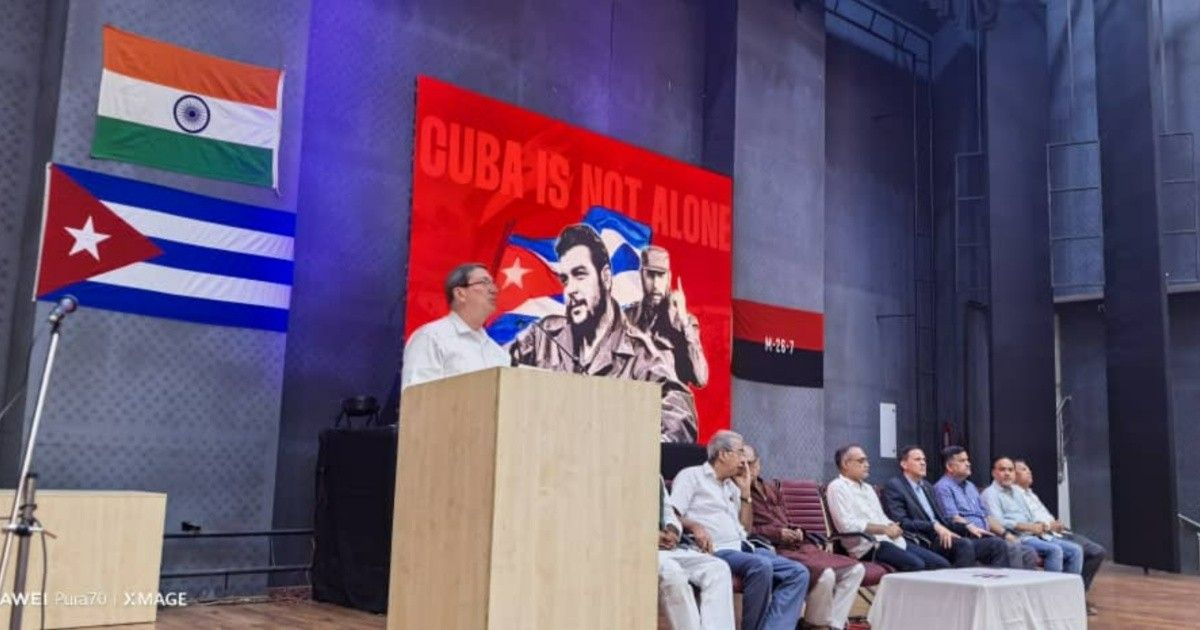
Cuban Foreign Minister Bruno Rodríguez Parrilla acknowledged on Monday, during a solidarity event in New Delhi, India, that Havana and Washington have started an "exchange process," while downplaying its significance by stating it is "nothing unusual."
This admission comes amidst heightened tensions between the two nations, exacerbated by two executive orders from the Trump administration and a recent visit by the CIA director to Havana just four days ago.
In his address, Rodríguez combined the acknowledgment of these contacts with a fiery denunciation, asserting that "Cuba is currently facing one of the most severe situations in its contemporary history" and that the country is under "the threat of direct military aggression by the United States Government."
The minister referred to a statement made by President Donald Trump on January 8, 2026, during a radio interview: "...well, I don't think we can exert much more pressure than going in there and destroying everything."
Rodríguez described the executive order signed by Trump on May 1 as "an act of war," likening it to "a naval blockade" for introducing secondary sanctions applicable to any foreign company or entity doing business with Cuba, even without ties to the U.S. economy.
The January 29 order, which imposes tariffs on countries exporting fuel to Cuba, was portrayed by the regime as a "total energy blockade" that adds to over 60 years of accumulated sanctions and the 243 coercive measures implemented since 2019.
Key Developments in U.S.-Cuba Relations
The most notable turning point in bilateral contacts was the visit of CIA Director John Ratcliffe to Havana last Wednesday, where he met with Cuban Interior Minister Lázaro Alberto Álvarez Casas and Ramón Romero Curbelo, head of the Ministry of the Interior's Intelligence Directorate.
The Communist Party of Cuba confirmed this meeting in an official statement, describing it as an exchange to contribute to the "political dialogue" between the two countries.
According to reports from Axios and USA Today, Ratcliffe conveyed a message from Trump expressing willingness to discuss economic and security issues, but contingent on Cuba making "fundamental changes" and ceasing to be a "safe haven" for Washington's adversaries in the hemisphere.
The CIA also warned that the "window of opportunity" for dialogue would not remain open indefinitely.
Humanitarian Aid and Diplomatic Shifts
Simultaneously, the U.S. offered $100 million in humanitarian aid to Cuba, with planned distribution through the Catholic Church and independent organizations. Initially, the regime denied receiving the offer, dismissing it as a "fable," but last Wednesday recanted, stating it was "willing to listen" to the offer's details.
Trump himself had hinted at this shift last Monday by posting on Truth Social: "Cuba asks for help, and we're going to talk!"
During his speech in New Delhi, Rodríguez reiterated that Cuba will not compromise on key issues: "Our desire is to prevent a humanitarian catastrophe, bloodshed, and the death of both our compatriots and young Americans," he declared, while warning that any military aggression would face "a united people, ready to confront any aggression against our homeland."
The existence of contacts between the two governments is not new: Díaz-Canel confirmed them in March 2026, describing the process as "very sensitive" and calling for it to be handled discreetly, as reported by Prensa Latina.
FAQs on U.S.-Cuba Diplomatic Relations
What prompted the recent exchanges between Cuba and the U.S.?
Recent exchanges between Cuba and the U.S. have been prompted by heightened tensions, including executive orders from the Trump administration and a visit by the CIA director to Havana.
How did Cuba respond to the U.S. humanitarian aid offer?
Initially, Cuba denied receiving the U.S. humanitarian aid offer, dismissing it as a "fable," but later expressed willingness to consider the offer's details.