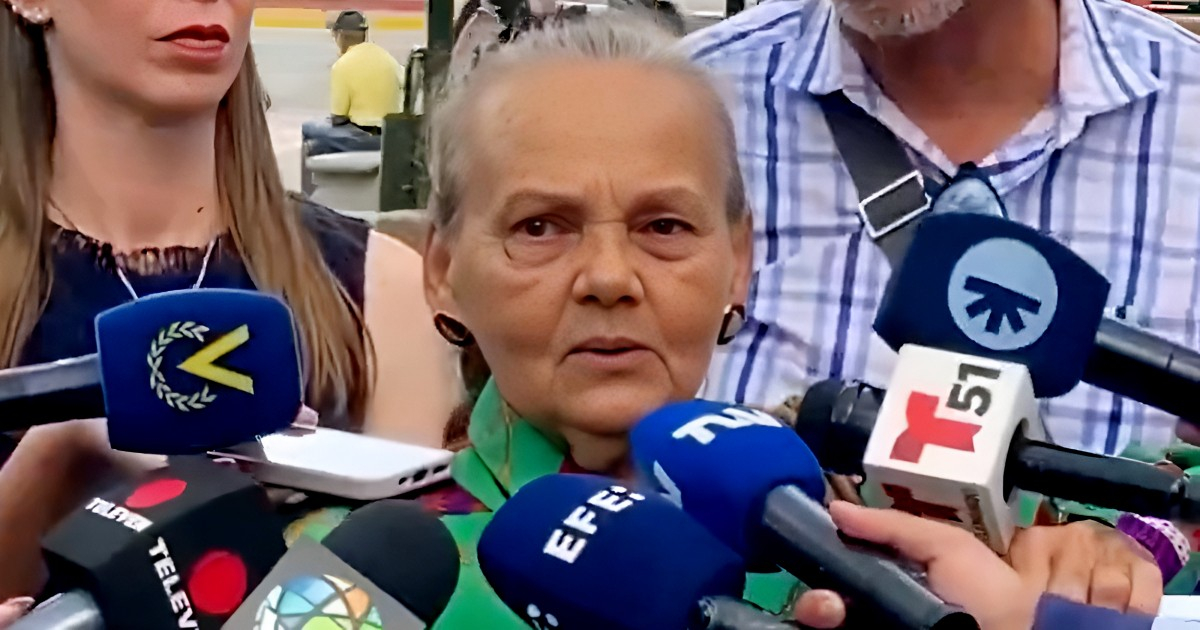
Carmen Teresa Navas, the 83-year-old mother of political prisoner Víctor Hugo Quero, passed away on Sunday. This came shortly after she was able to bid farewell to her son through the exhumation of his body and a memorial service held in Caracas.
Navas had been recently hospitalized, but the medical staff did not disclose the clinical reasons for her death, according to reports from El País.
This case underscores a double crime perpetrated by the Venezuelan regime: Víctor Hugo Quero was killed while in state custody, and his death was concealed for over nine months, denying his elderly mother the chance to say goodbye.
Quero was apprehended on January 1, 2025, near Plaza Venezuela in Caracas, on charges of terrorism and treason.
Desperate Search for Answers
After his arrest, Quero vanished without a trace, leaving his mother to search various prisons across the country for information.
Despite her repeated visits to the maximum-security El Rodeo I prison, authorities continually refused to provide any details regarding her son's whereabouts.
It wasn't until six months later, on July 24, 2025, that the Ministry of Penitentiary Affairs confessed Quero had died from "acute respiratory failure secondary to pulmonary embolism."
A Secret Burial and a Long-Awaited Acknowledgment
His body was secretly buried, and by October 2025, both the Venezuelan Ombudsman and the Prosecutor's Office were still claiming he was detained, even though he had been dead for three months.
National attention surged in May 2026 during a political shift prompted by Nicolás Maduro's arrest by the United States and Delcy Rodríguez assuming the role of interim president. It was then that the government finally acknowledged Quero's death, leading to the exhumation witnessed by Navas, whose son had been unknowingly buried for nine months.
A large memorial service was held in Caracas last Thursday, attended by Navas and family members.
Silence from Authorities and International Outcry
Neither Rodríguez's government nor any state authority has commented on the case.
Journalist Orlando Avendaño was among the first to confirm Navas' passing: "She barely got to say goodbye when the regime finally admitted its crime. She managed to bury him and attend his service."
Marshall S. Billingslea, a U.S. official, condemned the incident as an "atrocity" and vowed for "accountability."
A Systemic Pattern of Injustice
This tragedy is part of a documented trend of unpunished crimes under the Chávez regime: Since 2014, at least 27 political detainees have died in Venezuelan state custody, and at least eight political prisoners have perished in Venezuelan jails since July 2024.
The amnesty declared by Rodríguez in January 2026 proved inadequate: The Penal Forum verified only 768 actual releases compared to the 8,616 the government claimed, and on April 25, Rodríguez announced the end of the amnesty law with hundreds of political prisoners still behind bars.
María Corina Machado, who demanded the release of all political prisoners following Quero's death, called the case the "final act of cynicism and cruelty." She remains unable to return to Venezuela despite repeated promises to do so soon.
Carmen Navas' final public words echoed her immense grief: "I haven't wanted to speak to the press; they killed my son; they never let me see him. No one can surpass a mother's pain."
Understanding the Tragedy of Víctor Quero
What led to the death of Víctor Hugo Quero?
Víctor Hugo Quero died from "acute respiratory failure secondary to pulmonary embolism" while in Venezuelan state custody, as was officially admitted by the Ministry of Penitentiary Affairs.
How did the Venezuelan regime handle Quero's death?
The regime concealed Quero's death for over nine months, secretly burying him and denying his family any information about his fate. It wasn't until May 2026 that the government acknowledged his death.
What has been the international reaction to this case?
International condemnation has been strong, with U.S. official Marshall S. Billingslea labeling the case an "atrocity" and calling for accountability from the Venezuelan authorities.