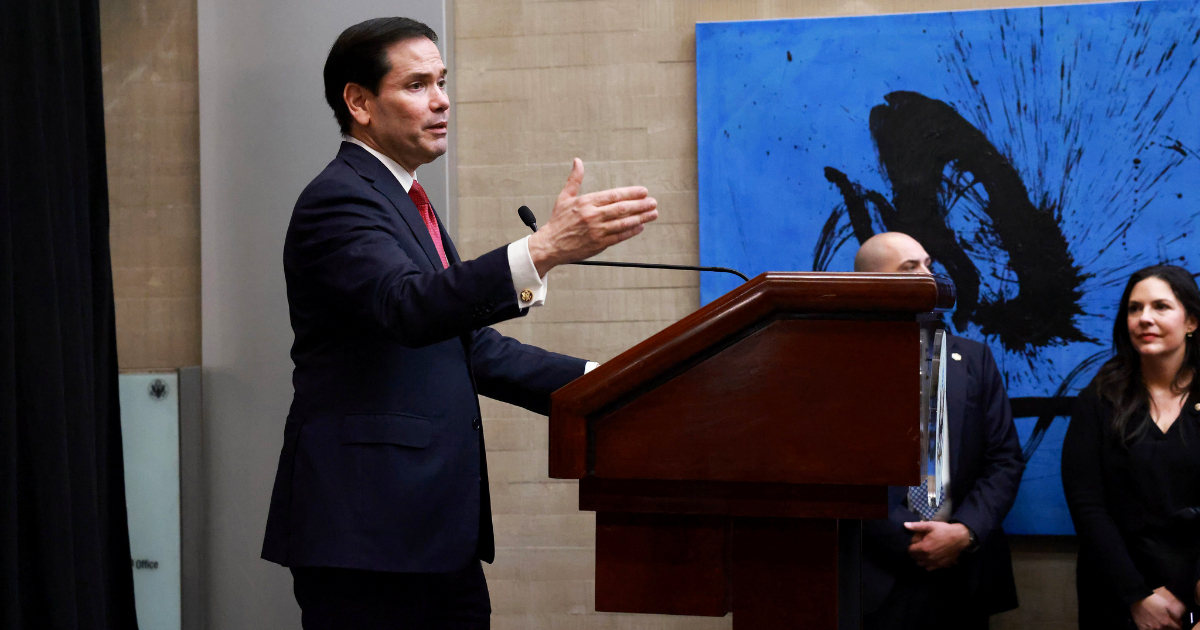
The statement was brief, yet its implications were far from accidental.
When Jeremy P. Lewin, Acting Under Secretary of State and a key advisor to Marco Rubio, declared that "the regime must return these resources to the Cuban people," he was delivering more than just a rhetorical jab at Havana's leadership.
This remark introduces a much more complex notion: the potential for the United States and its allies to not only sanction GAESA but also to reclaim and potentially redistribute assets connected to the Cuban military conglomerate.
This nuance significantly shifts the political landscape of the conversation.
Beyond Sanctions: A New Strategy
For years, Washington has utilized sanctions against GAESA as an economic pressure tool against the military apparatus that controls a substantial portion of Cuba's economy. Yet, the new measures under Executive Order 14404 appear to extend beyond those limits: they explicitly target overseas assets, international bank accounts, and foreign financial entities tied to the conglomerate.
The distinction is substantial. It's no longer merely about restricting future business ventures; it's about scrutinizing wealth accumulated over decades.
Defining "Return to the Cuban People"
This leads to the critical inquiry: What does "returning resources to the Cuban people" truly entail?
On a surface level, it could be interpreted as a political slogan highlighting the disparity between the island's economic woes and the wealth amassed by its military elite.
However, there's a deeper interpretation: Washington may be crafting a narrative around property restitution linked to a potential transition scenario in Cuba.
In international law, there are significant differences between sanctioning, freezing, seizing, and returning assets. Sanctions serve to penalize or exert pressure. Freezing halts the movement of funds. Seizing involves a legal transfer of control. Restitution, however, introduces a different political element: the notion that resources legitimately belong to a population rather than the entities managing them.
This is precisely what Lewin seems to imply when he speaks of "returning" resources to the Cuban people.
Lessons from International Transitions
The formulation is reminiscent of processes observed in other contemporary political transitions. After Muammar Gaddafi's fall in Libya, the international community froze billions linked to the regime. In Iraq, following Saddam Hussein, some recovered assets were used to sustain administrative structures and reconstruction programs under international oversight.
In Eastern Europe, following the collapse of the Soviet bloc, numerous governments initiated processes—often incomplete—of recovering properties and assets associated with communist elites.
A key difference with Cuba is that it is not officially in a post-transition phase. The regime remains in power, which is why Lewin's statement is so significant: it introduces a discourse typically associated with "the day after," even as the political system remains intact.
Implications for Cuba and Beyond
Washington appears to be sending multiple messages simultaneously.
One is directed at Cuba's military leadership: GAESA's external assets are no longer viewed as ordinary state property but as resources possibly amassed through opaque structures and beyond the population's reach.
Another message targets banks, shipping companies, and foreign businesses. The secondary sanctions announced by the Trump administration aim to raise the cost of maintaining financial ties with the Cuban military conglomerate.
The goal seems to extend beyond merely economically suffocating GAESA. It also involves mapping and isolating its international financial network.
But there is a third message, likely the most crucial: the White House might be publicly contemplating the financial architecture of a future Cuban transition.
This hypothesis could explain why the narrative is no longer solely about applying pressure and punishment but about recovery and eventual redistribution.
In this scenario, GAESA's international assets might become subjects of litigation, freezing, or international fiduciary management mechanisms.
However, such a process would not be straightforward. International experience shows that recovering fortunes linked to authoritarian regimes can take years and involve complex legal battles across multiple jurisdictions.
Moreover, a more sensitive question emerges: Who would decide what truly constitutes "the Cuban people"?
A future transitional government? An international mechanism overseen by multilateral organizations? The United States and its allies? Reorganized Cuban institutions following a potential political change?
History demonstrates that reclaiming assets is much easier than managing them legitimately afterward.
There would also be the issue of internal stability. Many contemporary transition processes included negotiation formulas with military or bureaucratic sectors to avert violent collapses. In several countries, state funds or recovered assets ended up being used to finance retirements, demobilizations, police reforms, and institutional reconstruction.
This opens another even more complex debate: If GAESA's assets were ever effectively recovered, could they be used to fund new Cuban institutions, compensate victims of repression, or even support retirement programs for sectors of the state apparatus not directly linked to severe human rights violations?
For now, none of this has been officially proposed. Yet Lewin's statement introduces, for the first time, an explicit idea that was once unthinkable: that the wealth accumulated by the Cuban military conglomerate could someday become the center of an international discussion about restitution, transition, and national reconstruction.
The true significance of the declaration might not lie solely in the sanctions announced this week but in what they politically portend: that Washington is increasingly openly discussing the "day after" GAESA.
Understanding the Future of GAESA's Assets
What is GAESA?
GAESA, or Grupo de Administración Empresarial S.A., is a Cuban military conglomerate that controls a significant portion of Cuba's economy, including tourism, retail, and financial services.
What does the U.S. mean by "returning resources to the Cuban people"?
This phrase suggests reclaiming and possibly redistributing assets tied to GAESA, implying that these resources should belong to the Cuban populace rather than the regime.
How could international assets be recovered?
Recovering international assets would likely involve legal proceedings, international cooperation, and possibly the establishment of fiduciary management systems to oversee the process.
What challenges exist in managing recovered assets?
The main challenges include determining legitimate ownership, creating fair distribution mechanisms, and ensuring that resources are used for the benefit of the Cuban people rather than falling into the hands of another elite group.