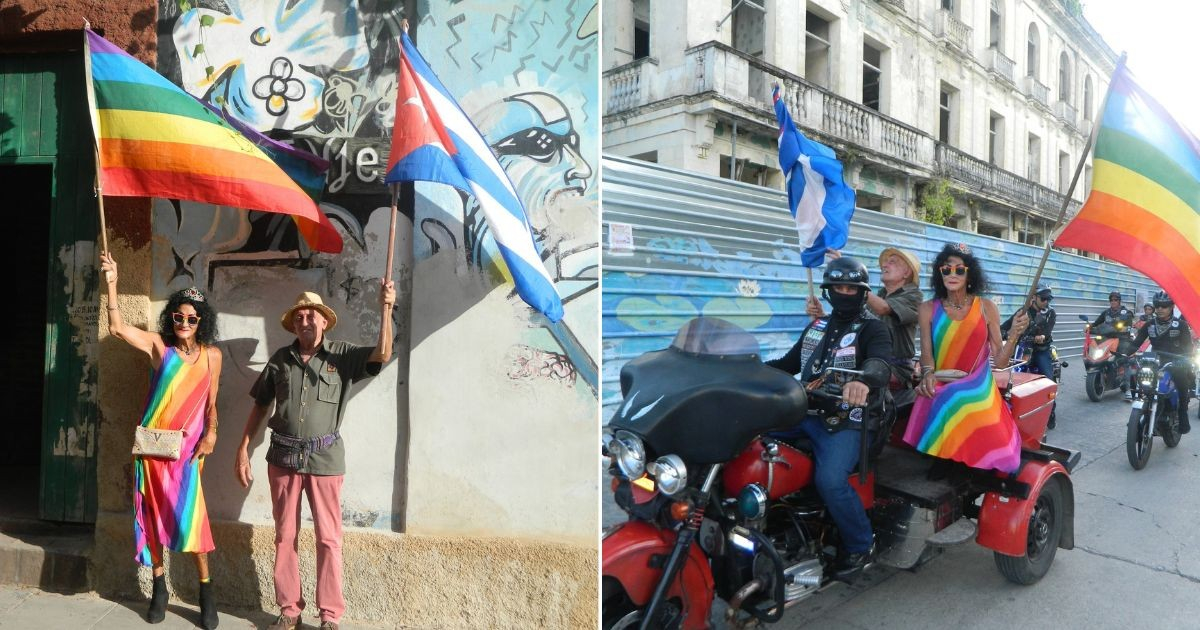
This past Sunday, Santa Clara was awash with vibrant colors during a march celebrating diversity, as part of the 19th Cuban Day Against Homophobia and Transphobia. The event, promoted under the slogan "Love is Law," took place from May 4 to May 21, 2026.
The event was covered by Henry Omar Pérez, a reporter for the Agencia Cubana de Noticias (ACN) in Villa Clara. Pérez is well-known for his alignment with Miguel Díaz-Canel's government.
"The streets were a spectacle of colors in an event led by Ramón Silverio, director of El Mejunje, and Juana 'La Candela,' accompanied by the roar of the Classic Motorcycle Club of Villa Clara," Pérez shared on his Facebook page, echoing the official narrative.
The procession began at El Mejunje, a renowned LGBTIQ+ cultural hub in Cuba, second only to those in Havana, boasting a history spanning 42 years.
Pérez lauded El Mejunje as "a true cathedral of inclusion" and recognized Silverio's influence in fostering a mindset that "is now visible in the streets of Santa Clara."
Also in attendance were groups like Transcuba (Network of Trans People, Couples, and Families) and the HSH Cuba Network - Villa Clara, as highlighted in the shared images.
Legal Advances Amid Practical Challenges
The journalist praised the regime's legal milestones — the 2019 Constitution and the Family Code approved by referendum on September 25, 2022, with 67.87% in favor — as "landmarks that legally enshrine equality."
Yet, activists and organizations point out that the practical implementation of these rights remains inconsistent in schools, healthcare facilities, and workplaces.
A Complex Reality Behind the Celebration
The true backdrop of the event is more intricate than Pérez's portrayal. The Cuban Conga Against Homophobia and Transphobia, initially scheduled for May 17 in Havana, was postponed to July by Mariela Castro Espín, director of CENESEX, due to the country's ongoing electricity crisis.
This postponement starkly contrasts with the image of unity and progress projected in Santa Clara.
Pérez's reportage lacks neutrality. In April 2026, he shared a ballot marked with "I voted for Miguel Díaz-Canel Bermúdez and I would do it again," and in November 2025, he labeled the independent outlet El Toque as "terrorist" and insulted its director José Jasán Nieves.
His coverage of the march follows the typical pattern of official media: it overlooks the crisis, praises the regime's legal frameworks, and portrays the event as a symbol of national unity.
"Despite the nation's complex situation, the city proudly raised the Cuban flag alongside the flag of diversity," Pérez wrote, echoing a sentiment Mariela Castro has often used to link the LGBTIQ+ cause with regime support.
The Cuban Day Against Homophobia and Transphobia has been observed since 2008, but its history is marked by cancellations and tensions. Notably, in 2019, CENESEX canceled the conga in La Rampa, prompting independent activists to organize an alternative march that was suppressed by State Security.
Cuba's Diversity March: Key Questions Answered
What was the main theme of the Santa Clara march?
The march was part of the 19th Cuban Day Against Homophobia and Transphobia, celebrated under the theme "Love is Law."
Who organized the Santa Clara diversity march?
The march was organized by Ramón Silverio, director of El Mejunje, along with Juana 'La Candela' and the Classic Motorcycle Club of Villa Clara.
What contradictions emerged during the event?
While the event celebrated legal advances, activists highlighted inconsistencies in practical application and the postponement of a related event in Havana due to the country's electricity crisis.