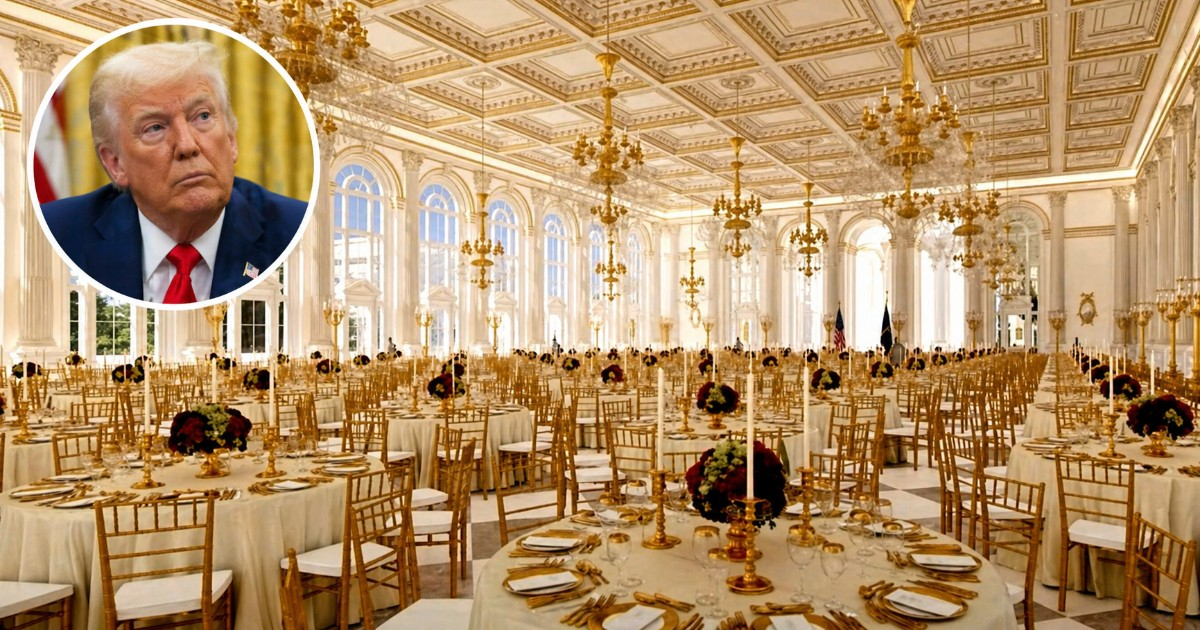
The U.S. Senate on Sunday blocked a fund of roughly $400 million that Republicans had attempted to include in a budget reconciliation package. This funding was intended for the controversial White House Ballroom, one of President Donald Trump's flagship projects.
Senate Parliamentarian Elizabeth MacDonough ruled that the funding did not comply with the Byrd Rule, which dictates what provisions can be included in budget reconciliation bills to avoid the standard 60-vote threshold required for ordinary legislation.
Republicans had tried to insert the funds within a $72 billion package focused on border security and immigration, arguing that the money was essential for strengthening security at the White House.
Their argument was based on an attempted attack on Trump during the Correspondents' Dinner on April 25. During the event, Cole Thomas Allen opened fire at the Washington Hilton entrance, prompting the evacuation of the president, First Lady Melania Trump, and Vice President JD Vance.
Republican Senate leaders announced they would revise the text to make it compatible with reconciliation rules, leaving the door open for another attempt.
Democratic Response and Ongoing Battle
Senate Democratic Leader Chuck Schumer harshly welcomed the setback, stating, “Republicans tried to make taxpayers foot the bill for Trump’s multimillion-dollar ballroom. Senate Democrats fought back and thwarted their initial attempt.”
Schumer further cautioned that the struggle is far from over: “Democrats will continue to oppose this through every available means: via the Byrd process, on the Senate floor through votes, and in any other forum where Republicans attempt to plunder hard-earned American money to fund Trump’s golden palace.”
Project Controversy and Legal Challenges
The project has been mired in controversy since Trump announced it in June 2025 on his Truth Social platform.
The East Wing of the White House—originally built in 1902 during Theodore Roosevelt’s presidency and expanded in 1942—was demolished in December 2025 without Congressional permission, sparking a lawsuit from the National Trust for Historic Preservation.
In March 2026, a federal judge ordered a halt to the construction, but an appeals court temporarily allowed it to proceed in April. On Saturday, a three-judge panel from the D.C. Court of Appeals ruled that construction could continue while a district judge re-evaluates the case.
The proposed space covers approximately 89,000 square feet where the East Wing once stood, with costs ballooning from $200 million to nearly $400 million due to deliberate design expansions.
Trump maintains that the project will be entirely funded through private donations. Just two days prior to the Senate’s block, he announced on Truth Social that “it is under construction, ahead of schedule, and will be the most magnificent facility of its kind in the United States,” with an expected opening in September 2028.
Frequently Asked Questions about Trump's Ballroom Project
Why did the Senate block the $400 million funding?
The Senate blocked the funding because it did not comply with the Byrd Rule, which regulates what can be included in budget reconciliation to avoid the standard 60-vote threshold.
What was the Republican justification for the funding?
Republicans argued that the funding was necessary to enhance White House security, using the attempted attack on Trump during the Correspondents' Dinner as a pretext.
What legal challenges has the ballroom project faced?
The project has faced legal challenges, including a lawsuit from the National Trust for Historic Preservation and a federal judge's order to halt construction, although an appeals court allowed it to resume temporarily.