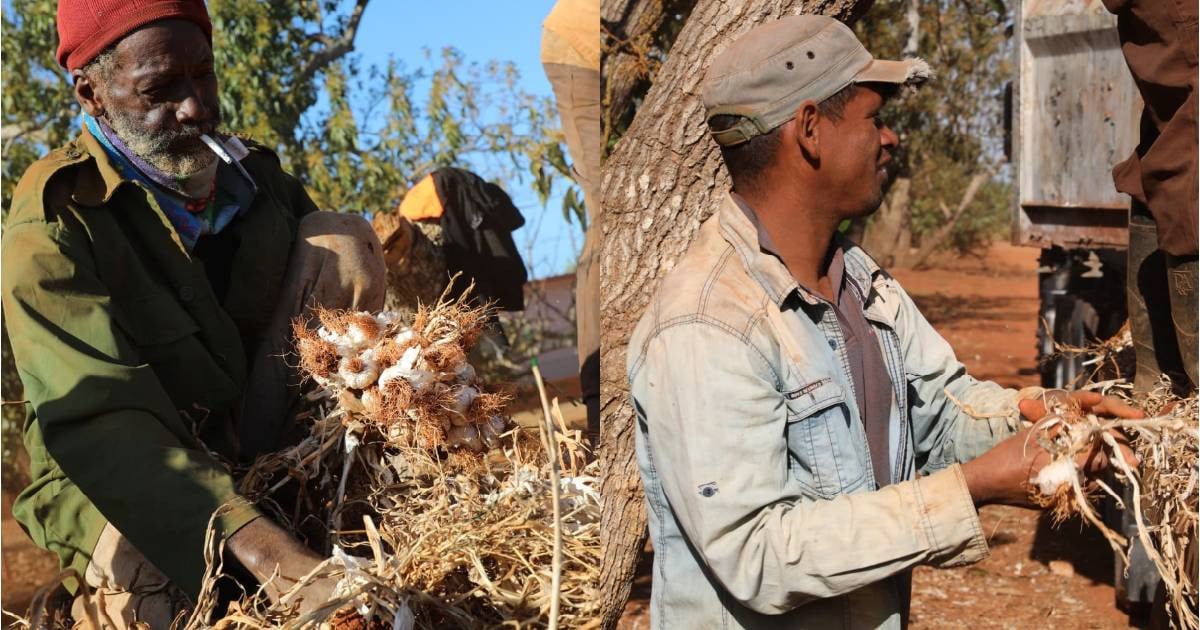
In the province of Artemisa, a significant agricultural hub in Cuba, thousands of temporary workers operate without contracts, social security, or up-to-date documentation. This workforce is crucial to planting and harvesting efforts, as the government struggles to record, safeguard, or replace them, according to a recent report by the official newspaper El artemiseño.
Data from the National Office of Statistics and Information (ONEI) reveals that 24.4% of informally employed individuals across various sectors in Cuba are engaged in agriculture, livestock, hunting, and forestry on a temporary basis.
In Artemisa, around 20 brigades, each comprising at least 10 workers, are active, as acknowledged by Norberto González Pedraza, the provincial delegate of Agriculture. However, actual figures remain elusive even to authorities. The local National Tax Office recognizes only about 200 individuals as day laborers, while the Department of Labor and Social Security reports merely four illegal labor managers and approximately 908 workers.
The Reality of Cash Transactions
Predominantly internal migrants from Holguín, Santiago de Cuba, and Guantánamo, these workers prefer cash payments, dismissing bank transactions not out of ideology, but necessity. "We like to get paid in cash. What use is a card when there aren't even ATMs to withdraw money? Visiting the bank costs at least 500 pesos, and you can only withdraw 1,000 per person. Plus, businesses don't accept transfers, only cash," explained Yudelkis Rodríguez Cabrera, a 34-year-old laborer from Santiago de Cuba who has formed his own brigade in Güira de Melena.
This statement underscores the collapse of the banking system enforced by the Central Bank of Cuba since 2023, which has proven utterly ineffective in rural areas due to a lack of ATMs and connectivity.
Economic Paradox and Agricultural Crisis
José Antonio Martínez, known as Cheo, who relocated from Holguín 31 years ago, works in Güira de Melena. "We earn about 3,000 pesos per day for garlic work. I make 200 pesos per row in sweet potato fields and can work through five rows in a couple of hours," he shared. His work philosophy is straightforward: "I work off the books. My priority is having food for today."
These laborers often earn more than formal employees since they do not pay taxes or contribute to social security, creating a paradox that authorities acknowledge but fail to address. Willian Ernesto González, the owner of La Rosa farm in Artemisa, bluntly states, "Without them, we can't progress!"
González Pedraza warns of future repercussions. "By not addressing the issue now, they doom themselves to future challenges, which will burden the state's social assistance funds sooner rather than later," he analyzed.
This scenario unfolds amid an agricultural crisis that leaves markets empty on Farmer's Day, May 17. Rice production plummeted from 304,000 tons in 2018 to just 111,000 in 2025, while tubers, eggs, and milk production decreased by 44%, 43%, and 37.6% respectively.
In 2021, the government introduced Resolution 80 to regulate agricultural labor management, later supplemented by Decree-Law 80 in 2024. Yet, the gap between legislation and reality remains vast, as farmers operate without guarantees, and non-payment by the state Acopio system discourages formalization.
A temporary worker from Granma, documented by the newspaper Trabajadores, captured the sentiment of an entire generation of Cuban laborers: "Legally, I don't exist for my retirement."
Understanding Cuba's Agricultural Labor Challenges
Why do Cuban agricultural workers prefer cash payments?
Cuban agricultural workers prefer cash payments because there are insufficient ATMs and poor banking connectivity, making electronic transactions impractical.
What is the role of temporary laborers in Artemisa's agriculture?
Temporary laborers are essential to the agricultural productivity of Artemisa, as they handle much of the planting and harvesting without formal employment status or protections.
What challenges does the Cuban government face with informal agricultural workers?
The government struggles with accurately recording and providing protections for these workers, whose informal status and cash-based economy complicate regulatory efforts.