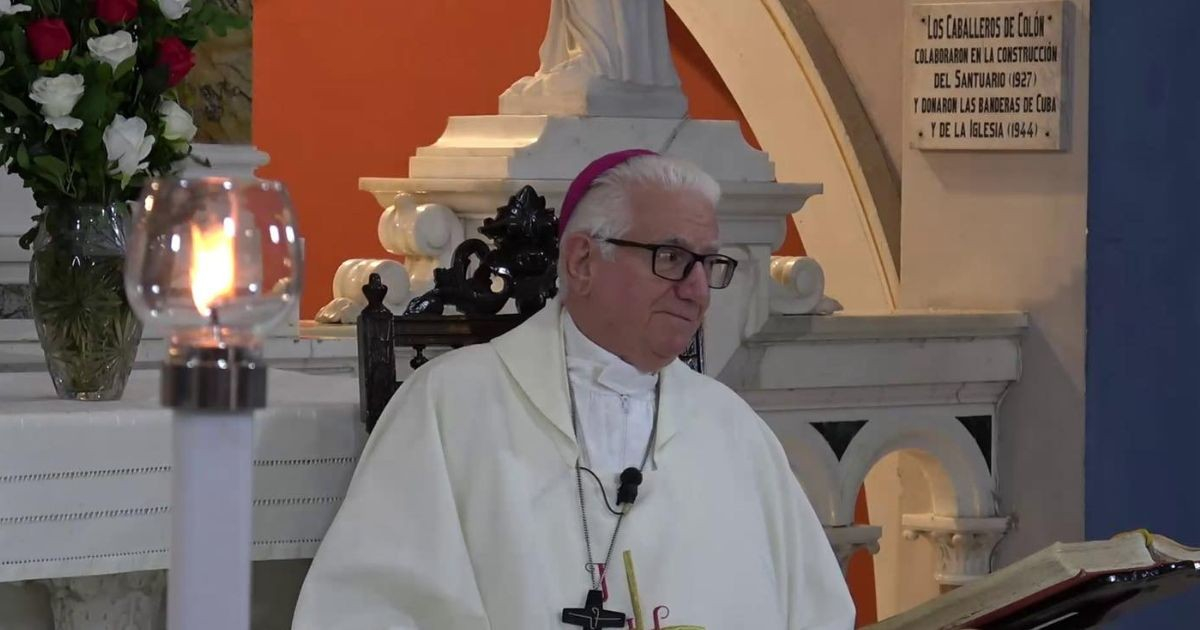
From the revered Basilica of Our Lady of Charity of El Cobre, Archbishop Dionisio García Ibáñez of Santiago de Cuba made a powerful call for transformation this Sunday. During the homily for the Solemnity of the Ascension, he did not mince words in addressing the necessity for change.
The archbishop's sermon, which the Archdiocese of Santiago de Cuba shared, was unequivocal: "We know that change is necessary. I mentioned at the beginning of the Mass that we all must change, and Cuba, too, must change. There need to be measures that alter the country's current state."
García Ibáñez criticized complacency regarding the island's crisis, invoking a biblical image to challenge his audience: "Do I leave everything to God and stand idly by? At that moment, two angels might appear and ask, 'What are you doing with your arms crossed?'"
His message extended beyond spiritual realms, directly addressing Cuba's political and social conditions by calling for specific "measures" to improve the lives of its people.
This declaration came shortly after the U.S. government proposed a $100 million humanitarian aid package for Cuba, under the condition that the aid would be distributed through the Catholic Church, Caritas, and independent organizations, bypassing state intervention.
The proposal positioned the Church as a pivotal player in the ongoing tensions between Washington and Havana. Initially, Foreign Minister Bruno Rodríguez Parrilla dismissed the proposal as a "fable," though his stance later softened. In response, Díaz-Canel defended the regime's relationship with the Church, describing it as "rich and productive."
The archbishop's address on Sunday is part of a broader, ongoing critique from El Cobre's pulpit. In January 2026, the Cuban Bishops' Conference issued its most pointed collective statement, read in parishes nationwide: "Cuba needs change, and it is increasingly urgent," warning of potential "social chaos" and pleading for "no more bloodshed or mourning in Cuban families."
Back in November 2025, García Ibáñez labeled the nation's situation as "nonsensical" amidst poverty, the aftermath of Hurricane Melissa, and the spread of diseases. In March 2024, he appealed to the Virgin of Charity with the popular outcry of "electricity, food, and freedom."
This recent homily occurs under intense scrutiny of the Cuban Church. In January 2026, the State Security threatened Cuban priests over their public criticisms, heightening the significance of the archbishop's continued and emboldened stance from the island's most iconic sanctuary.
García Ibáñez concluded his homily with a statement that transcends religious boundaries: "Cuba needs witnesses of Christ, the world needs witnesses of Christ, those who, among our sins and weaknesses, are proclaimers of His word."
Key Questions About the Archbishop's Call for Change in Cuba
Why did Archbishop García Ibáñez call for change in Cuba?
Archbishop García Ibáñez urged change in Cuba to address the ongoing crisis and improve the country's political and social conditions. He emphasized the need for concrete measures to transform the lives of the Cuban people.
How did the U.S. government's proposal affect the Church's role in Cuba?
The U.S. proposal for $100 million in humanitarian aid, contingent on distribution through the Catholic Church and independent organizations, highlighted the Church's critical role in the political dynamics between Washington and Havana.
What historical context supports the Archbishop's message?
The Archbishop's message is part of a consistent pattern of critique from the Church. Previous statements from the Cuban Bishops’ Conference and García Ibáñez have called for urgent changes to prevent social chaos and improve living conditions.