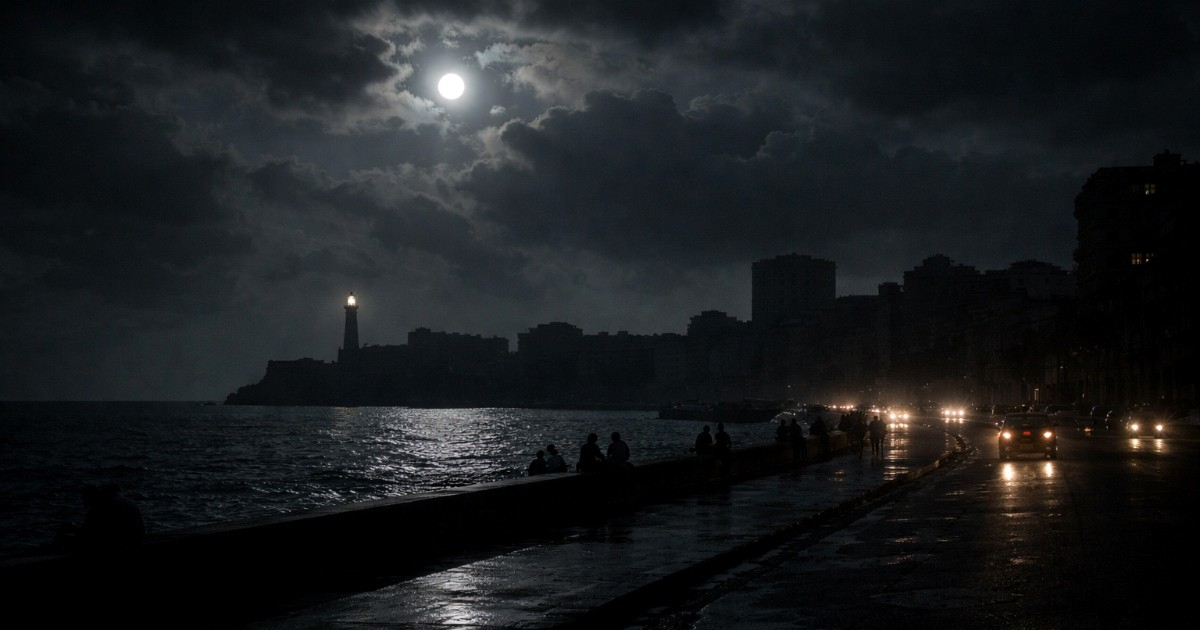
This Sunday, Cuba found itself plunged into another day marked by widespread power outages.
According to an official statement from the Unión Eléctrica (UNE), at 6:00 am, the National Electric System (SEN) had a mere 1,070 MW available, while demand reached 2,545 MW, leaving 1,457 MW without power.
The outlook for peak hours appears even bleaker.
The UNE projects that only 1,147 MW will be available to meet a peak demand of 3,200 MW, resulting in a deficit of 2,053 MW and an expected impact of 2,083 MW during high-demand periods.
Saturday's situation was already dire. The maximum impact reached 2,041 MW at 9:10 pm, surpassing earlier forecasts due to the failure of the second unit at the Santa Cruz Thermal Power Plant (CTE) and limitations on the fourth unit at the CTE Cienfuegos.
The capital could not escape the turmoil.
Havana's Electric Company reported a 24-hour power outage in the city on Saturday. The peak impact was 447 MW at 9:10 pm.
The company also acknowledged that "emergency circuit shutdowns of 110 MW" were necessary and that "restoring service was not possible," with six blocks and emergency circuits—totaling 322 MW—still affected at the time of their report.
The system's ongoing failures are alarming.
Five units from the CTE Ernesto Guevara De La Serna, Antonio Guiteras, Lidio Ramón Pérez, and Antonio Maceo remain out of service. Additionally, three units are under maintenance, and 423 MW are offline due to thermal generation limitations.
The 54 installed photovoltaic parks contributed 3,963 MWh on Saturday, peaking at 616 MW at noon, a figure that diminishes at night due to the lack of large-scale storage batteries. Solar energy is insufficient to offset outages as the thermoelectric infrastructure continues to deteriorate.
This crisis is not an isolated incident but the latest manifestation of a structural collapse that the regime has failed to halt.
On May 13, a record deficit of 2,153 MW was recorded, and the following day, the shutdown of the CTE Antonio Guiteras—its ninth failure in 2026—caused a partial SEN collapse from Ciego de Ávila to Guantánamo.
The Minister of Energy and Mines, Vicente de la O Levy, admitted that Cuba has "absolutely no fuel, diesel, only accompanying gas."
A Russian donation of 100,000 tons of crude, processed at the Cienfuegos refinery, was depleted by early May without the regime securing an alternative supply.
The government's focus on solar energy does not address the underlying issue.
Under social pressure, Prime Minister Manuel Marrero merely instructed to "better distribute" the outages in Havana, a response that highlights the government's inability to offer real solutions.
Meanwhile, in provinces like Holguín, Granma, Santiago de Cuba, and Guantánamo, power cuts exceed twenty hours daily, prompting Cubans to protest with cacerolazos against a regime that prefers to blame the U.S. embargo rather than take responsibility for seven decades of disastrous management.
The CTE Antonio Guiteras, the country's largest individual generator, may resume operations on May 19, although its structural condition is precarious: the plant has not undergone major maintenance since 2010, making any recovery forecast a fragile promise.
Power Outages and Energy Crisis in Cuba
What is causing the massive power outages in Cuba?
The power outages are primarily due to a significant shortfall in electricity availability compared to demand, exacerbated by the failure and maintenance of several thermal power units.
How is the Cuban government responding to the energy crisis?
The government has instructed better distribution of outages but has struggled to provide a long-term solution, focusing on solar energy which is insufficient to meet the current demand.
What are the impacts of the energy crisis on Cuban citizens?
Cuban citizens face prolonged daily power cuts, leading to public protests and increased frustration with the government's inability to manage the crisis effectively.