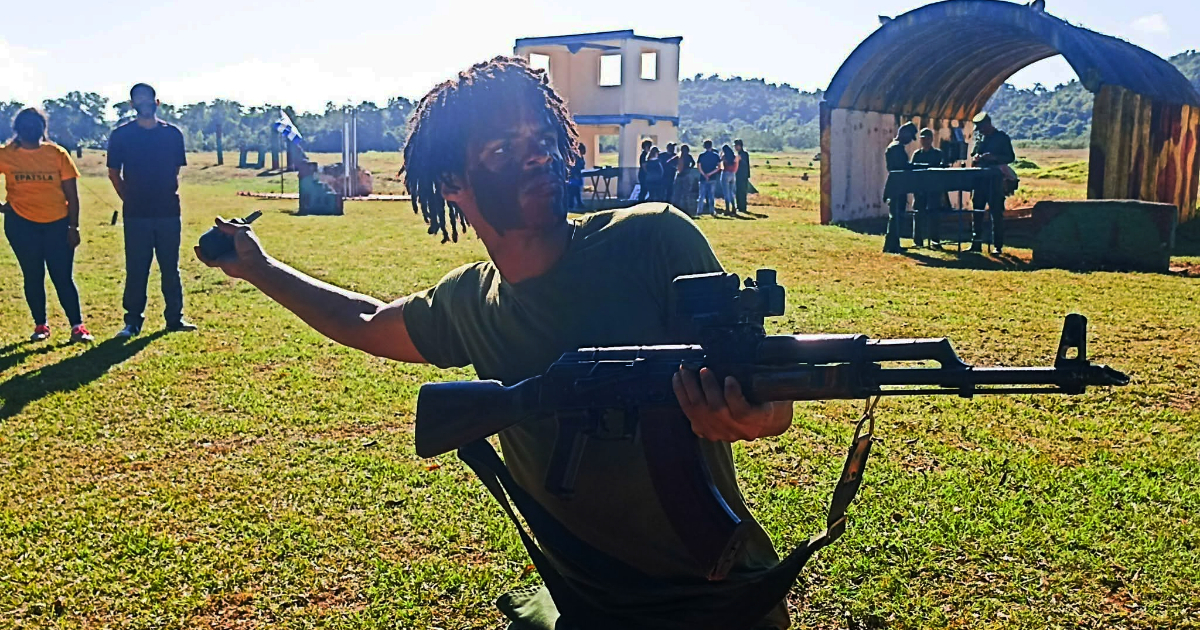
Amid escalating tensions with the United States, the Cuban government has publicly reinstated elements of its "war of the whole people" doctrine, as highlighted in a CNN report from Havana.
The American news network broadcasted footage and interviews detailing military drills involving civilians and exercises organized by Cuban authorities. This comes as the Trump administration intensifies political, economic, and strategic pressure on the island.
The report was released shortly after CIA Director John Ratcliffe's visit to Cuba, amidst speculation about a potential federal indictment in the U.S. against Raúl Castro for the 1996 downing of Brothers to the Rescue planes.
CNN notes that the atmosphere in Cuba is fraught with fear and uncertainty, fueled by rumors of escalating conflict with Washington.
Public Military Training and Fearful Atmosphere
In this environment, state-run Cuban media have started showcasing images of citizens engaging in military training and participating in territorial defense exercises.
The so-called "war of the whole people" was a strategy promoted by dictator Fidel Castro during the Cold War, aimed at preparing civilians to resist a potential foreign invasion through guerrilla tactics and resistance strategies.
According to CNN, despite the ideological and military framework of the regime still incorporating this doctrine, recent footage has garnered attention due to the ongoing standoff with the U.S.
Military Capabilities and Internal Mobilization
Some videos depict soldiers conducting maneuvers with outdated Soviet weaponry and even transporting military equipment using oxen, highlighting the material deterioration faced by Cuba's military apparatus after years of economic crisis and resource scarcity.
Yet, experts cited by CNN believe that the regime retains the ability for internal mobilization.
Military historian Hal Klepak told CNN that the Cuban Armed Forces could offer resistance in a conflict due to their organizational experience and the state's capacity to rapidly mobilize segments of the population.
"They have repeatedly demonstrated their ability to mobilize the population," the expert stated.
Rhetoric and Economic Struggles
Meanwhile, Cuban official rhetoric has also intensified.
During the May Day parade, Miguel Díaz-Canel declared that Cubans were prepared to "give their lives for the revolution," in a speech underscored by references to national sovereignty and resistance to U.S. pressures.
CNN adds that Cuban Civil Defense has recently issued guidelines for families to prepare backpacks with essential items in case of a hypothetical military aggression.
This hardening of the defensive narrative coincides with one of the most severe economic crises the island has faced in decades. Prolonged power outages, fuel shortages, and supply scarcities have exacerbated social discontent.
Although there are no public indications of imminent military intervention, the report concludes that the Cuban regime appears determined to politically and psychologically prepare its population for a prolonged confrontation with Washington.
Understanding Cuba's Military Preparations and Economic Challenges
What is the "war of the whole people" doctrine?
The "war of the whole people" is a strategy initiated by Fidel Castro during the Cold War, aimed at preparing the Cuban civilian population to resist foreign invasions through guerrilla tactics and resistance strategies.
Why has Cuba revived military exercises involving civilians?
Cuba has revived these exercises amid rising tensions with the United States, as a means to prepare the population for potential conflicts and to reinforce its defensive posture.
How has the economic situation in Cuba affected its military capabilities?
Cuba's economic struggles have led to the deterioration of its military resources, evident in the use of outdated equipment and improvised transport methods, such as using oxen for moving military pieces.