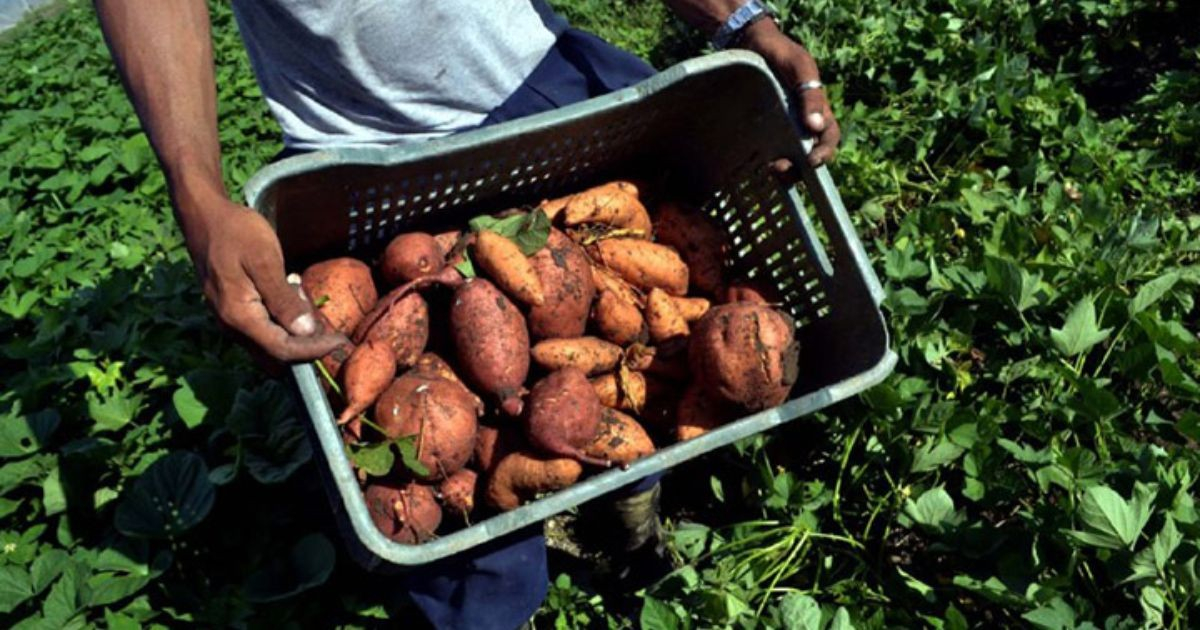
While nearly a third of Cuban households went hungry in 2025 and citizens took to the streets demanding "Electricity and Food!", the state media is today celebrating a new scientific achievement that the regime touts as a sign of progress: the development of new sweet potato clones of the El Dorado variety at the Punta La Cueva agroecological farm in Cienfuegos province.
This announcement, released on Saturday by the Cuban News Agency, comes with suspicious timing: tomorrow, May 17, marks the celebration of Cuban Farmers' Day, with Cienfuegos hosting the national event for the 65th anniversary of the National Association of Small Farmers.
Emilio Bermúdez Cuellar, the farm's owner, elaborated on their experiments with clones B-20, B-30, and B-60, noting that the latter has shown "the best performance under the local soil and climate conditions."
According to Bermúdez Cuellar, prototypes four and six of this variety achieve "yields exceeding 25 tons per hectare," with tubers weighing more than 200 grams maturing in just 120 days, boasting "optimal quality for human consumption."
The farm owner further emphasized that this variety is resistant to the sweet potato weevil (Cylas formicarius), the pest that causes the most damage to sweet potato crops in Cuba, and noted that the crops can "withstand up to 10 days without water" without losing vigor.
Challenges of Cuban Agriculture Beyond Seeds and Pests
As if Cuba's agricultural issues were solely about seeds and pests, Bermúdez Cuellar added that the vine "does not rely on chemical fertilizers or technology packages, only requiring a bit of organic matter sourced from the farm": a trait that conveniently aligns with the regime's inability to import agricultural supplies, which, according to economic studies, has decreased by up to 80% in recent years.
The project is a collaboration with the University of Cienfuegos and the Tropical Root Crops Research Institute, led by Master of Science Alfredo Morales. The seeds will also be distributed to the Youth Labor Army and the Military Region, as even sweet potatoes in Cuba have a military vocation.
Bermúdez Cuellar pledged that the seeds "will not be sold but donated to producers to help them establish their own seed banks and reduce the high market prices of this tuber."
The Stark Reality of Food Scarcity in Cuba
This final statement is worth noting: the project's promoter himself acknowledges that sweet potatoes, historically one of the most affordable and accessible staples in the Cuban diet, are now "expensive." In Havana, sweet potatoes reached prices of 80 to 120 CUP per pound in March 2026, while in Cienfuegos—the very province of the scientific announcement—a single sweet potato could cost up to 300 CUP.
The disparity is staggering. According to the 2025 "Cuba is Hungry" survey by the Food Monitor Program, 33.9% of Cuban households experienced hunger, an increase of 9.3 percentage points from the previous year. By April 2026, 96.91% of the population lacked sufficient access to food.
A quarter of Cubans went to bed without dinner, 29% of families cut out a daily meal, and 80.4% reported that power outages—lasting up to 20 to 22 hours daily as acknowledged by the Energy Minister—hindered food preparation.
In this dire situation, protests erupted this week in various parts of Havana with the slogan "Electricity and Food!," while a Cuban mother’s cry resonated across social media: "The children are going hungry."
On May 3rd, Miguel Díaz-Canel inadvertently summed up the scale of the crisis with a remark that sounded more like a warning than a promise: "We will eat what we are capable of producing." If the regime’s response to that statement is a handful of sweet potato clones in a Cienfuegos farm, the outlook for Cuban tables is far from hopeful.
Insights into Cuba's Food and Agriculture Crisis
What are the new sweet potato clones developed in Cienfuegos?
The new clones of sweet potatoes developed at Punta La Cueva farm in Cienfuegos include varieties B-20, B-30, and B-60, with the B-60 clone showing the best performance under local conditions.
How has food scarcity affected Cuban households?
In 2025, 33.9% of Cuban households experienced hunger, and by 2026, 96.91% of the population did not have adequate access to food, with many families cutting meals or going to bed hungry.
What are the challenges facing Cuban agriculture?
Cuban agriculture faces challenges beyond seed and pest issues, including a significant reduction in agricultural imports and reliance on limited organic resources due to economic constraints.