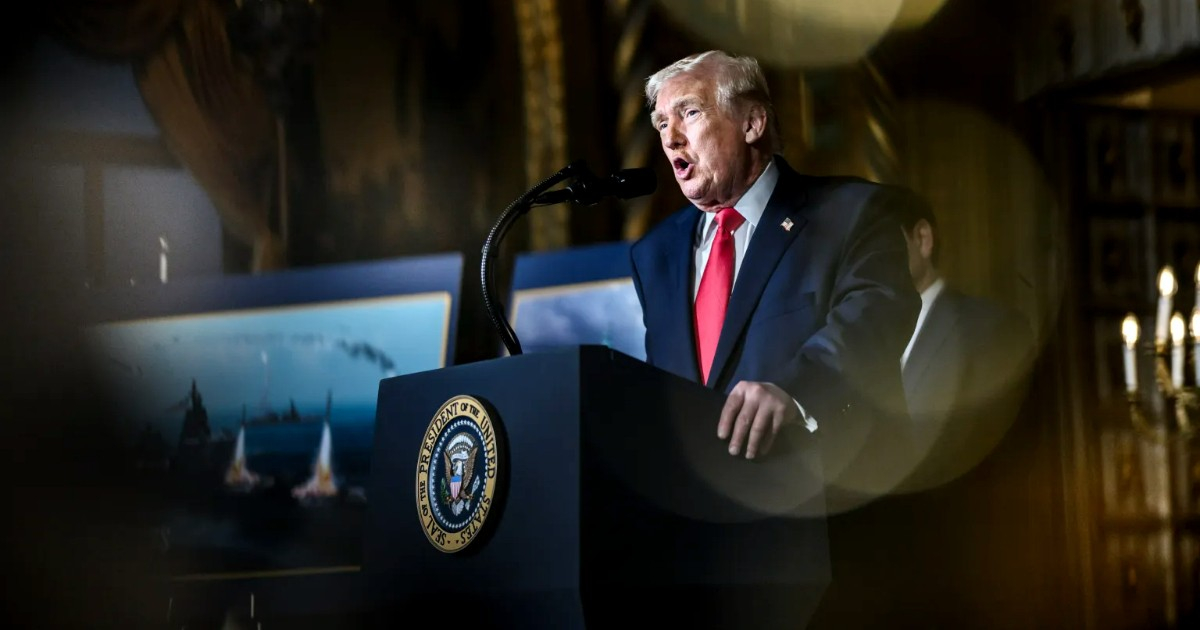
On Friday, former President Donald Trump declared the successful elimination of Abu-Bilal al-Minuki, identified as the second-in-command of ISIS worldwide, through a collaborative operation conducted by U.S. forces and the Nigerian military.
The announcement was made on Trump's Truth Social platform shortly after 11 PM on May 15. He described the mission as "meticulously planned and highly complex."
"Tonight, under my directive, courageous U.S. forces and the Nigerian Armed Forces flawlessly executed a meticulously planned and highly complex mission to remove the world's most active terrorist from the battlefield," Trump stated.
Trump highlighted that al-Minuki "believed he could hide in Africa, unaware that we had sources keeping us informed of his activities."
"He will no longer terrorize the people of Africa or assist in planning operations against Americans. With his removal, ISIS's global operation is significantly weakened," Trump added, also expressing gratitude to the Nigerian government for their "partnership in this operation."
Al-Minuki, a Nigerian national, was a senior commander of the Islamic State in West Africa Province (ISWAP) and head of operations for the Lake Chad division within ISIS's General Directorate of Provinces.
In the sanctions records, his full name is Abu Bakr ibn Muhammad ibn 'Ali al-Mainuki. He was designated as a Specially Designated Global Terrorist by the U.S. government in June 2023, during the Biden administration, resulting in the freezing of his assets and a ban on transactions with U.S. entities.
Trump did not disclose the precise location in Nigeria where the operation took place. The Russian agency TASS reported that there is currently no information about civilian casualties.
Ongoing Anti-Terrorism Campaign in Nigeria
This operation is part of a sustained anti-terrorism campaign that Washington has been conducting in Nigeria under Trump's second administration. In December 2025, he ordered airstrikes in northwest Nigeria on Christmas Eve, justified as a response to massacres of Christians attributed to ISIS.
The then-Secretary of Defense, Pete Hegseth, confirmed these attacks, and Nigeria acknowledged that the operations were conducted "in collaboration with the United States." Reports indicated this operation might have included Tomahawk missiles launched from a ship in the Gulf of Guinea, targeting the Sokoto region.
ISWAP primarily operates in northeastern Nigeria — in the states of Borno, Yobe, and Adamawa — and in the Lake Chad basin, with extensions into Cameroon, Chad, and Niger. The group emerged from Boko Haram after pledging allegiance to the Islamic State in March 2015 and solidified as the dominant jihadist faction in West Africa following the death of Boko Haram leader Abubakar Shekau in May 2021.
The United States had approximately 200 soldiers deployed in Nigeria focused on training and intelligence, along with drones supporting the Nigerian army, which facilitated the prolonged tracking of al-Minuki until his elimination.
Frequently Asked Questions on ISIS Operations in Africa
Who was Abu-Bilal al-Minuki?
Abu-Bilal al-Minuki was identified as the second-in-command of ISIS worldwide and a senior commander of the Islamic State in West Africa Province (ISWAP).
Where did the joint operation to eliminate al-Minuki take place?
The exact location within Nigeria where the operation occurred was not disclosed, but the mission was executed by U.S. forces and the Nigerian military.
What is ISWAP?
ISWAP stands for the Islamic State in West Africa Province, a group that operates primarily in northeastern Nigeria and is an offshoot of Boko Haram.