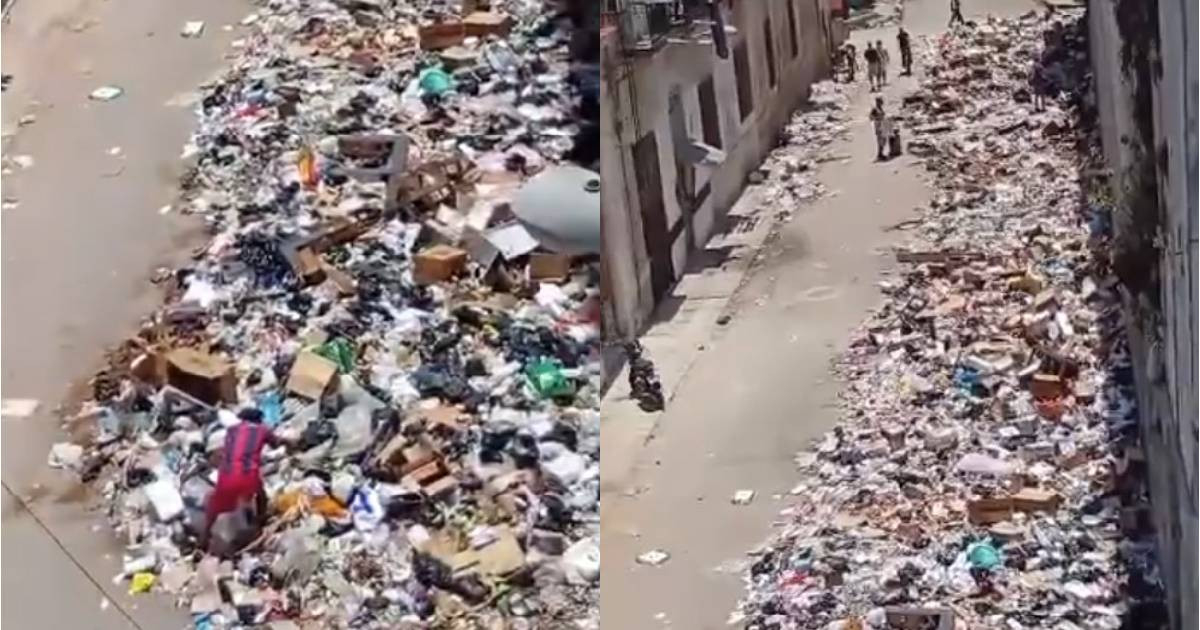
A 25-second video that went viral on social media this Friday starkly illustrates the urban decay and health hazards plaguing Cuba's capital. The footage shows a towering pile of garbage in the heart of Havana, accompanied by a sardonic question: "Which part of Havana did they clean?"
Shared on Facebook by content creator Juan Juan Almeida, the video quickly became a barometer of the Cuban people's frustration with the regime and the dire state of affairs on the island.
Viewers identified the location as the garbage dump on Virtudes Street between Consulado and Industria in Centro Habana, directly across from the former Teatro Musical de La Habana.
"That garbage dump is historic. Virtudes between Consulado and Industria," remarked user Ele Fumero.
Zulema González confirmed that the site remained unchanged at the time of her comment. "That dumpster is at the old Havana Musical Theater. I passed by yesterday and it's just like in the video," she attested.
This is neither a new nor an unfamiliar dumpsite. Back in August 2025, photographer Otmaro Rodríguez highlighted the same spot, calling it one of the capital's most shocking. Nine months later, the situation remains unchanged.
Cubans commenting on Almeida's video didn't mince words. "Cuba has hit rock bottom," stated Erick Reynaldo emphatically.
Armando Pelaez Santiesteban employed irony, saying, "This is the Prosperous and Sustainable Continuity," while Johnny Klelian Muñoz bluntly summarized, "These are the 'dictatorship's' achievements over 67 years. A picture is worth a thousand words."
The crisis is underscored by alarming statistics. Havana produces between 24,000 and 30,000 cubic meters of solid waste daily, yet only 44 out of 106 garbage trucks are operational due to a diesel shortage, leaving up to 23,814 cubic meters uncollected each day.
The city has just 10,000 containers, despite needing between 20,000 and 30,000.
Even the regime has admitted its failure to manage waste collection. In September 2025, Armando Rodríguez Batista, Minister of Science, Technology and Environment, acknowledged, "The trash isn't contained; it's scattered all over Havana."
In December, after a meeting led by President Miguel Díaz-Canel, the government conceded it couldn't clear the capital or adequately compensate street sweepers. Of 126 planned trash bins, only 31 were produced, and just 40 out of 1,000 promised carts were completed.
The video shared by Almeida is part of a series of viral complaints that week. Days earlier, comedian Rigoberto Ferrera exposed garbage burning in La Pera Park in the Plaza de la Revolución municipality at six in the evening.
Additionally, an Italian tourist labeled Cuba as "the dirtiest country" she had ever visited, sparking an international debate.
Meanwhile, photographer Alina Sardiñas shared a chilling account of Cuban streets' deterioration, describing a walk filled with "a mix of terror and awe."
Despite a government plan announced in February with 49 measures, including the importation of 15,000 containers and the deployment of 450 brigades, the trash continues to pile up at the usual corners.
Understanding Havana's Waste Crisis
Why is Havana struggling with waste management?
Havana faces a waste management crisis due to a shortage of operational garbage trucks and insufficient containers. The city produces more waste than it can handle, exacerbated by a lack of resources and government inefficiency.
What measures has the Cuban government taken to address the trash issue?
In February, the government announced a plan with 49 measures, including importing 15,000 containers and deploying 450 brigades. However, these efforts have not yet resolved the persistent waste accumulation problems.
What impact has the waste crisis had on Havana's residents?
The waste crisis has led to public outrage and frustration among Havana's residents, who are vocal about the city’s deteriorating conditions. The issue is also affecting Havana's image internationally, as highlighted by recent viral videos and comments.