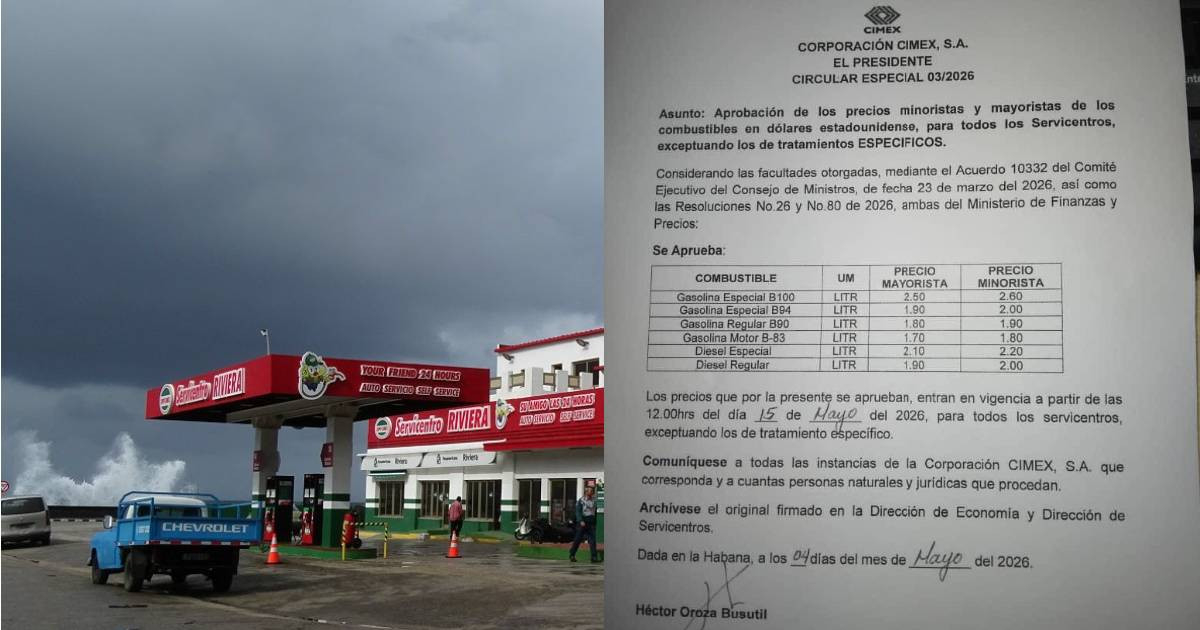
This Friday, the state-run corporation Cimex, S.A. implemented a significant price hike on fuel in Cuba, setting the cost of special gasoline B100 at $2.60 per liter—almost double its previous price in dollarized markets.
Officially documented in Special Circular 03/2026 and signed by the corporation's president, Héctor Oroza Busutil, this change took effect at 12:00 PM this Friday.
The document, which has been circulating on social media and whose authenticity was confirmed by CiberCuba through multiple knowledgeable sources on the island, also introduces a new retail price scale for all fuels sold in foreign currencies.
New Fuel Prices Announced
The price for special gasoline B94 is now set at $2.00 per liter; regular B90 at $1.90; motor B-83 at $1.80; special diesel at $2.20; and regular diesel at $2.00.
Previously, special gasoline was officially priced at about $1.30 per liter at dollarized service stations, with a cap of 20 liters per person. This latest increase effectively represents a nearly 100% surge.
Economic Implications of Fuel Price Liberalization
This adjustment forms part of the fuel price liberalization announced by the Ministry of Finance and Prices, allowing importers to set their prices based on actual operational costs starting today.
The ministry acknowledged that maintaining a single price is "economically unsustainable under current conditions."
Public Outcry and Economic Strain
The price surge arrives at a time of great hardship for the populace. On Wednesday, Minister of Energy and Mines Vicente de La O Levy admitted that Cuba "has absolutely no fuel, diesel, only accompanying gas" to generate electricity, with the power generation deficit exceeding 2,113 MW on Tuesday.
The public reacted with widespread outrage on social media. "Seven dollars and change for a gallon of regular gasoline; it must be the most expensive in the world, or close to it," commented Oscar Rodríguez.
Luis Emilio Rico Díaz was more forthright: "In dollars? Is the Cuban people's salary in dollars? Four times more expensive than any other country in America!"
Some Cubans suggested a deliberate strategy by the regime. "The Squid Game: I make the product disappear from state units, see what price the average Cuban is willing to pay, and then hit you without lubricant. That's how it is with everything," accused Yanaylet Oggunsita Jiménez.
Meanwhile, Ubilquis Ramos Agüero expressed a common sentiment: "I hope there's gasoline available at least to start the cars before they completely break down."
Potential Beneficiaries of the Price Increase
Economist Elías Amor recently warned that the liberalization might benefit small and medium-sized enterprises connected to the Grupo de Administración Empresarial S.A. (Gaesa), the military elite's business conglomerate that controls about 60% of the economy.
"There's always something fishy in the Castro regime's decisions, and this is no exception," Amor asserted.
On the black market, gasoline prices ranged from 4,000 to 6,000 Cuban pesos per liter in April and May, equivalent to seven to 12 dollars at the informal exchange rate. This makes the new official price merely a reference point for those with access to foreign currency, while most Cubans earn their wages in pesos.
FAQs about Cuba's Fuel Price Increase
Why has the price of gasoline increased in Cuba?
The increase is part of a fuel price liberalization effort by the Ministry of Finance and Prices, allowing importers to set prices based on actual operational costs.
What are the new gasoline prices in Cuba?
Special gasoline B100 is $2.60 per liter, B94 is $2.00, B90 is $1.90, B-83 is $1.80, special diesel is $2.20, and regular diesel is $2.00.
How has the public reacted to the fuel price hike?
The public has expressed widespread indignation, criticizing the regime for the high prices, especially given the economic conditions in Cuba.