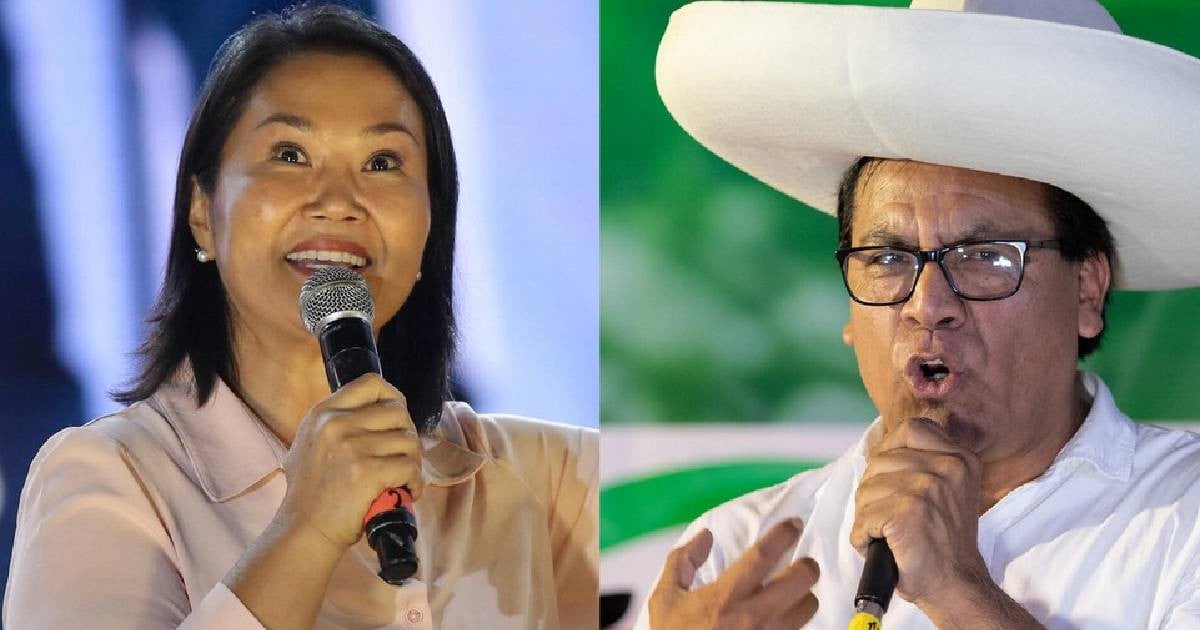
This Friday, Peru confirmed the candidates for its June 7th presidential runoff: right-wing Keiko Fujimori from Fuerza Popular will face off against leftist Roberto Sánchez of Juntos por el Perú. This comes after nearly all the votes from the first round, held on April 13th, were tallied.
According to the National Office of Electoral Processes (ONPE), with 99.998% of the ballots counted, Fujimori secured 17.18% of valid votes (2,877,678 votes), while Sánchez garnered 12.03% (2,015,114 votes), as reported by EFE news agency.
Rafael López Aliaga of Renovación Popular is notably absent from the runoff, finishing third with 11.914% (1,989,367 votes), trailing Sánchez by merely 14,000 votes in the final tally.
This outcome marks a shift from the initial projections on April 13th, when partial results with 51.6% of votes counted suggested a runoff between Fujimori and López Aliaga.
As the count progressed, Sánchez climbed in the ranks, surpassing López Aliaga to become the second-most voted candidate.
The National Jury of Elections (JNE) announced it will officially declare the results on Sunday, May 17th at noon.
For Fujimori, this represents her fourth consecutive presidential runoff, having previously lost to Ollanta Humala (2011), Pedro Pablo Kuczynski (2016), and Pedro Castillo (2021).
Fujimori, daughter of former President Alberto Fujimori who ruled Peru from 1990 to 2000 and passed away in September 2024, enters the runoff with a controversial legal history that alienates parts of the electorate.
Sánchez, a social psychologist and congressman for Juntos por el Perú, reached the runoff with leftist proposals focused on free public education, decentralization, and state reform, backed by figures such as Antauro Humala.
His candidacy surged from 3.2% in March polls to a final 12%, marking one of the campaign's most remarkable turnarounds.
The ideological divide is already shaping the runoff landscape; Sánchez challenged Fujimori to a debate in Chota, to which Fujimori countered by suggesting Huaral as the venue.
Despite missing the runoff, López Aliaga's party, Renovación Popular, acknowledged the electoral results.
Peru approaches this runoff amid significant political instability, having seen eight presidents in the last decade. The first round on April 13th was marred by logistical issues in Lima that left 52,251 citizens unable to vote due to delays of up to five hours in distributing electoral materials.
Key Questions About Peru's Presidential Runoff
What percentage of votes did Keiko Fujimori receive in the first round?
Keiko Fujimori received 17.18% of the valid votes in the first round.
Who is Roberto Sánchez and what is his political platform?
Roberto Sánchez is a social psychologist and congressman representing Juntos por el Perú. His platform focuses on free public education, decentralization, and state reform.
What challenges has Peru faced leading up to the runoff?
Peru has experienced significant political instability, with eight presidents in the last 10 years. The first round was also affected by logistical problems that prevented over 52,000 citizens in Lima from voting.