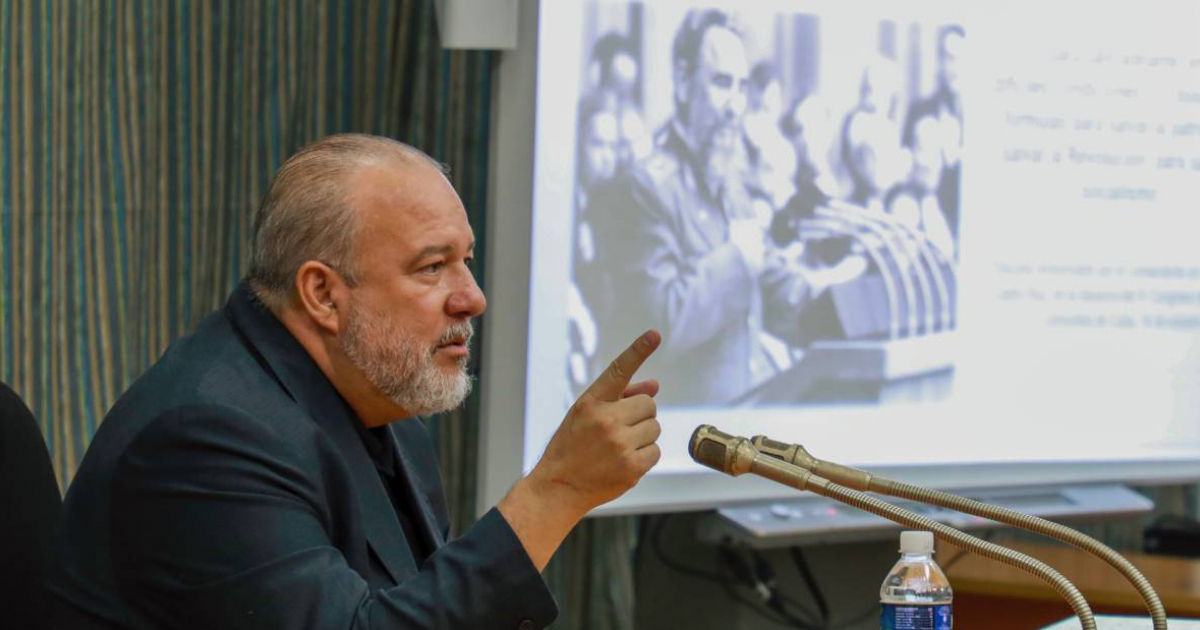
On Thursday, Prime Minister Manuel Marrero Cruz led a working session in Havana to address the city's worsening energy crisis. He concluded the meeting by urging officials to leave their desks and "be on the streets with the people," as power outages have extended beyond 20 hours a day, fueling widespread protests across the city.
The session, covered by the state-run media Cubadebate, included participation from Vicente de la O Levy, Minister of Energy and Mines; Antonio Rodríguez Rodríguez, President of the National Institute of Hydraulic Resources; Mayra Arevich Marín, Minister of Communications; and Roberto Morales Ojeda, Secretary of Organization for the Communist Party.
Minister de la O Levy attributed the service disruptions to a "combined effect of fuel shortages and unexpected shutdowns of several generating units," warning that the situation "will remain challenging."
On Wednesday, the Energy Minister acknowledged the extent of the collapse, noting, "In Havana, outages today exceed 20 to 22 hours. When power returns, it lasts for 2 hours, an hour and a half, 2 hours, sometimes 3 or 4 hours in some circuits, and then we go back to 20, 22 hours. That's the state of the capital."
On Thursday, the Antonio Guiteras thermoelectric plant—the country's most powerful—was offline for the ninth time in 2026 due to a boiler malfunction, with repairs expected to take three to four days.
The Electric Union forecasted a 1,639 MW deficit for this Friday's peak night demand, while on Tuesday, the system recorded a record shortfall of 2,113 MW at 8:40 PM, with only 1,230 MW available against a demand of 3,250 MW, leaving 61% of the country without electricity.
The President of the INRH reported that as of Thursday morning, 376,055 residents in Havana faced water supply issues: 66,961 due to breaks and the rest due to power outages.
During the session, Morales Ojeda acknowledged there are "still reserves in organizational and subjective aspects" concerning electricity, water supply, food production, and public information, calling for "sensitive, humane, and supportive actions, without neglecting discipline and demands."
Marrero Cruz ended the meeting with calls for resilience: "We can accomplish many things if we work together," he asserted, promising, "We will fight the battle and we will win."
On Thursday night, new protests erupted in Guanabacoa, featuring barricades and bonfires. Police clashed with demonstrators who retaliated by throwing stones.
In recent days, cacerolazos in the Bahía neighborhood with chants of "Down with the dictatorship!" protests in San Miguel del Padrón demanding "Electricity and food!" and a blockade of the Calzada de Concha in Luyanó marked an unprecedented escalation in the capital.
State Security deployed motorcycles and patrols, and massive internet outages were reported during the demonstrations, with at least 14 arrests in Havana linked to the cacerolazos since March 6.
The Cuban Conflict Observatory recorded 1,133 protests in April alone, a 29.5% increase over the same month in 2025, with 176 repressive acts documented.
The structural cause of the crisis is the fuel shortage: Since December 2025, Cuba has not received regular oil supplies, and in April only one of the eight monthly tankers the country claims it needs arrived. A Russian donation of 100,000 tons of crude temporarily eased the situation in April but was depleted by early May, just as temperatures began to rise with the approach of summer.
This Friday, the U.S. Embassy in Havana issued a security alert for its citizens in Cuba due to the power outages and protests, warning that the blackouts are impacting water, lighting, refrigeration, and communications.
Understanding Cuba's Energy Crisis
What is causing the massive power outages in Cuba?
The outages are primarily due to fuel shortages and the unexpected shutdown of several power generation units, as explained by the Minister of Energy and Mines.
How are the power outages affecting daily life in Havana?
The prolonged outages are disrupting water supply, refrigeration, lighting, and communication systems, leading to widespread protests and unrest across the city.
What measures are being taken to address the energy crisis in Cuba?
Prime Minister Marrero Cruz has called for officials to engage directly with the public, but long-term solutions remain uncertain as structural fuel shortages persist.