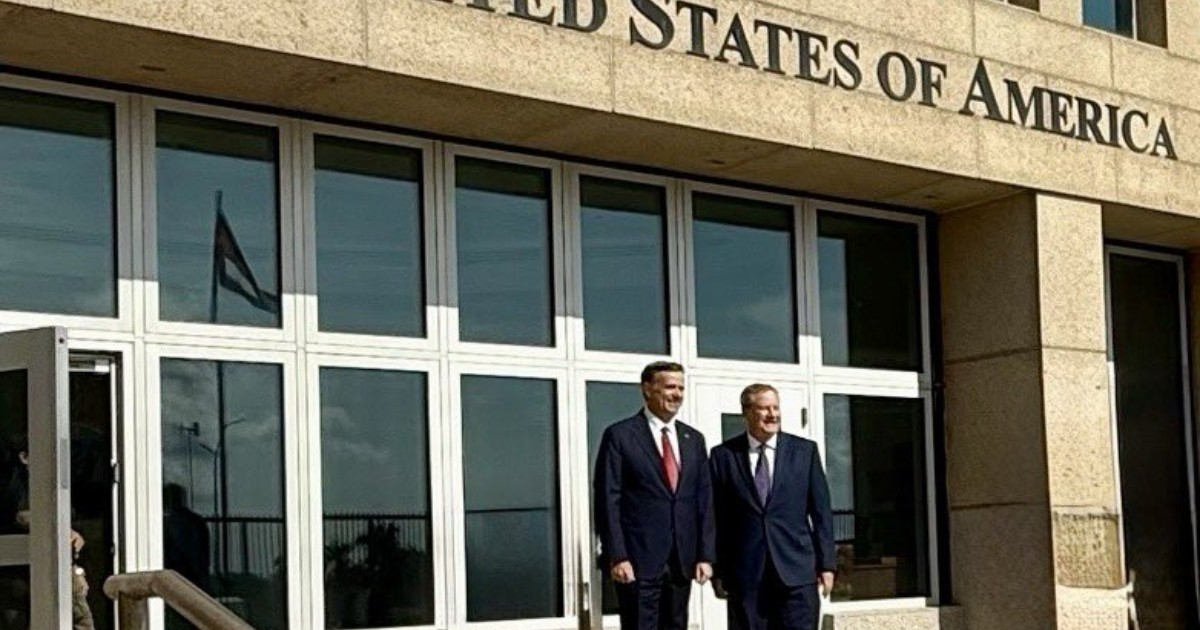
The official account of the U.S. Embassy in Cuba shared a photograph on Friday featuring Mike Hammer, the chief of the U.S. mission in Havana, alongside CIA Director John Ratcliffe. The image, taken in front of the embassy building with the inscription "THE UNITED STATES OF AMERICA" visible in the background, captures the formal reception Hammer extended to the senior intelligence official on Cuban soil.
Ratcliffe's arrival in Havana on Thursday marked a significant diplomatic event, as he traveled aboard a special mission flight from Joint Base Andrews. This visit is the second high-level interaction between Washington and Havana in under six weeks.
Meetings with Cuban Officials
During his visit, the CIA director engaged with several key Cuban figures: Interior Minister Lázaro Álvarez Casas—sanctioned by the United States under the Global Magnitsky Act since January 2021 for severe human rights violations; Raúl Guillermo Rodríguez Castro, known as "El Cangrejo" or "Raulito," the grandson of Raúl Castro and a lieutenant colonel in MININT; and Brigadier General Ramón Romero Curbelo, head of the Intelligence Directorate of Cuba's MININT.
The identity of Romero Curbelo was unveiled by exile Miguel Cossío, following the CIA's unusual decision to release photographs on their official X account with some faces intentionally blurred. "This is General Ramón Romero Curbelo, head of the Intelligence Directorate of the Cuban regime. He is the 10 of Spades in our Cuban Deck. The Cuban-American exile community knows very well who he is," Cossío posted on X.
Message from the U.S. Administration
The core message Ratcliffe conveyed to Havana was from President Donald Trump: The United States is open to engaging on economic and security matters, but only if Cuba implements "fundamental changes." CIA sources highlighted that "the dialogue offers Cuba an exceptional opportunity to stabilize its faltering economy and address the needs of its people, but this window of opportunity will not remain open indefinitely."
The Cuban regime was the first to disclose the meeting through an official statement from the Communist Party of Cuba, indicating that it was Washington that requested the encounter and that "the Directorate of the Revolution approved the visit."
Cuba's Energy Crisis and Economic Challenges
The visit occurred as Cuba faces its most severe energy crisis in decades. On Tuesday, 65% of the territory experienced simultaneous blackouts, and Energy Minister Vicente de la O Levy admitted on state television that the nation has "absolutely no fuel or diesel," with outages potentially exceeding 20 hours a day.
The Economic Commission for Latin America and the Caribbean (ECLAC) forecasts a 6.5% contraction in Cuba's GDP by 2026, the worst in Latin America. Economist Pedro Monreal warns it could reach 15%, paralleling the worst year of the Special Period.
Hammer, who participated in the Conference of Chiefs of Mission on May 6 in Doral, Florida, alongside Marco Rubio and General Francis L. Donovan of the Southern Command, strengthens his role as a pivotal figure in active U.S. diplomacy in Cuba during this era.
A senior Trump administration official bluntly summarized the regime's predicament: "They have no fuel. They have no money. They have no one coming to rescue them. The regime has been stubborn since 1959, but even they realize it's time for change."
Key Details on the CIA Director's Visit to Cuba
Who did the CIA Director meet in Havana?
In Havana, the CIA Director met with several significant Cuban officials, including Interior Minister Lázaro Álvarez Casas, Raúl Guillermo Rodríguez Castro, and Brigadier General Ramón Romero Curbelo.
What was the primary message from the U.S. during the visit?
The primary message conveyed by the CIA Director on behalf of President Donald Trump was that the U.S. is willing to engage on economic and security issues, but only if Cuba makes "fundamental changes."
What is the current economic situation in Cuba?
Cuba is experiencing a severe economic downturn, with ECLAC predicting a 6.5% GDP contraction by 2026. The country is also facing its worst energy crisis in decades, leading to extensive blackouts.