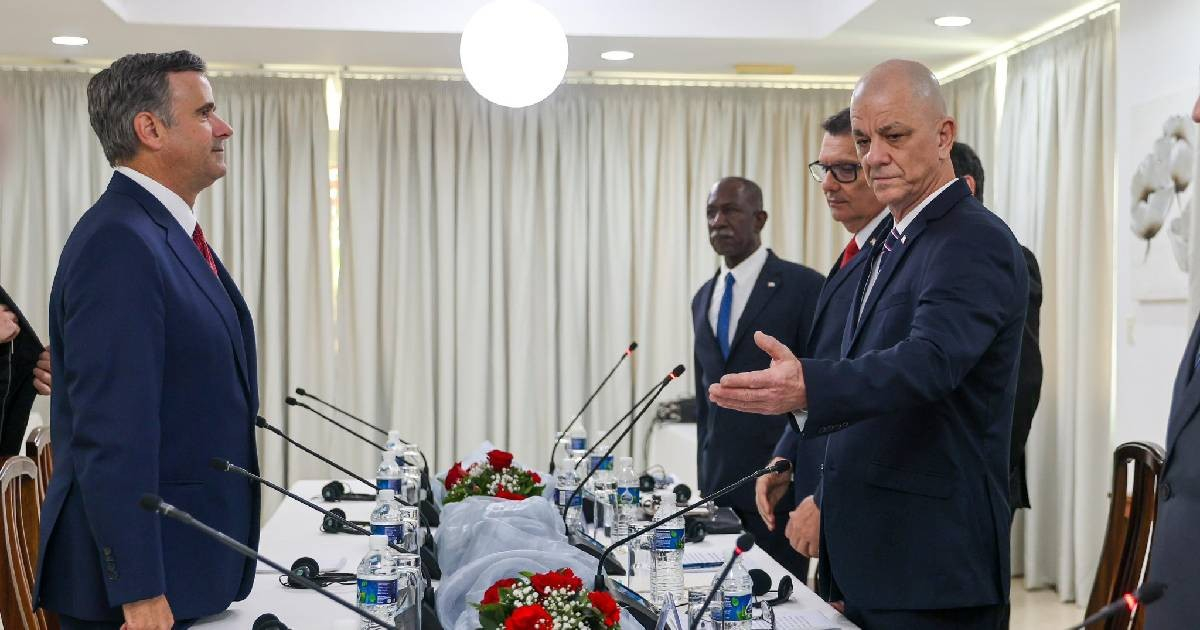
This Thursday, the Central Intelligence Agency (CIA) made an unusual move by releasing photographs on its official X account, revealing a meeting in Havana between the agency's director, John Ratcliffe, and senior officials from Cuba's Ministry of the Interior (MININT). This act is notable for an intelligence agency that rarely brings its operations into the public eye.
The images depict a formal conference room setting with an oval table, microphones, red and white floral arrangements, and attendees using translation headsets. Some individuals' faces are intentionally blurred. A third image shows the officials outside, standing in front of Havana-style buildings, accompanied by high-end white SUVs.
The Cuban government acknowledged the visit through a Communist Party statement, indicating it was requested by Washington and approved by the "Direction of the Revolution." The Cuban counterpart was led by Lázaro Alberto Álvarez Casas, the Minister of the Interior.
Among the Cuban attendees was Raúl Guillermo Rodríguez Castro, also known as "El Cangrejo," the grandson of Raúl Castro. As a lieutenant colonel in the MININT and head of the General Directorate of Personal Security, his involvement in the meeting with Ratcliffe solidifies his role as the regime's key liaison with Washington. He was reportedly also present at a secret meeting on April 10.
The flight, identified as SAM554 (Special Air Mission), is designated for high-level U.S. government missions, originating from Joint Base Andrews. Reuters captured video footage of the U.S. delegation departing Cuba this Friday.
The regime's communiqué included a particularly noteworthy claim: it explicitly denied the presence of any foreign military or intelligence facilities on the island. "Once again, it was demonstrated that the Island does not host, support, finance, or permit terrorist or extremist organizations; nor are there any foreign military or intelligence bases on its territory," the official text stated.
This assertion is at odds with documented evidence. The Center for Strategic and International Studies identified at least 12 Chinese signals intelligence facilities in Cuba, with four main sites: Bejucal, El Wajay, Calabazar, and El Salao, the latter being just 70 miles from the Guantanamo Bay Naval Base. The Biden administration confirmed their existence in June 2023, operational since at least 2019.
Defense Secretary Pete Hegseth informed Congress that Russian naval vessels, including the Kazan submarine, have repeatedly utilized Cuban ports. In late April, Marco Rubio accused Cuba of hosting Chinese intelligence, warning, "We will not allow any foreign military, intelligence, or security apparatus to operate with impunity just 90 miles from U.S. shores."
Ratcliffe's visit marks the second high-level interaction between Washington and Havana in under six weeks. The first occurred on April 10, when a State Department delegation landed in Cuba—the first official U.S. flight since 2016—to discuss the release of political prisoners, internet access via Starlink, and the presence of foreign groups on the island.
The lingering question is whether the CIA accepted the regime's narrative regarding the absence of foreign installations, or if this issue will continue to be the primary barrier to any deal that might remove Cuba from the list of state sponsors of terrorism, to which it was re-added by the Trump administration in February 2025.
Key Questions About CIA's Secret Meeting in Havana
What was the purpose of the CIA director's visit to Havana?
The visit aimed to hold discussions with Cuban officials, potentially regarding bilateral issues, security concerns, and the presence of foreign intelligence operations on the island.
How did the Cuban government respond to the visit?
The Cuban government confirmed the visit through a Communist Party statement, noting it was requested by Washington and approved by the "Direction of the Revolution."
What are the implications of the Cuban government's denial of foreign installations?
The denial contradicts reports of Chinese and Russian intelligence and military activities on the island, raising questions about Cuba's transparency and the potential impact on U.S.-Cuba relations.