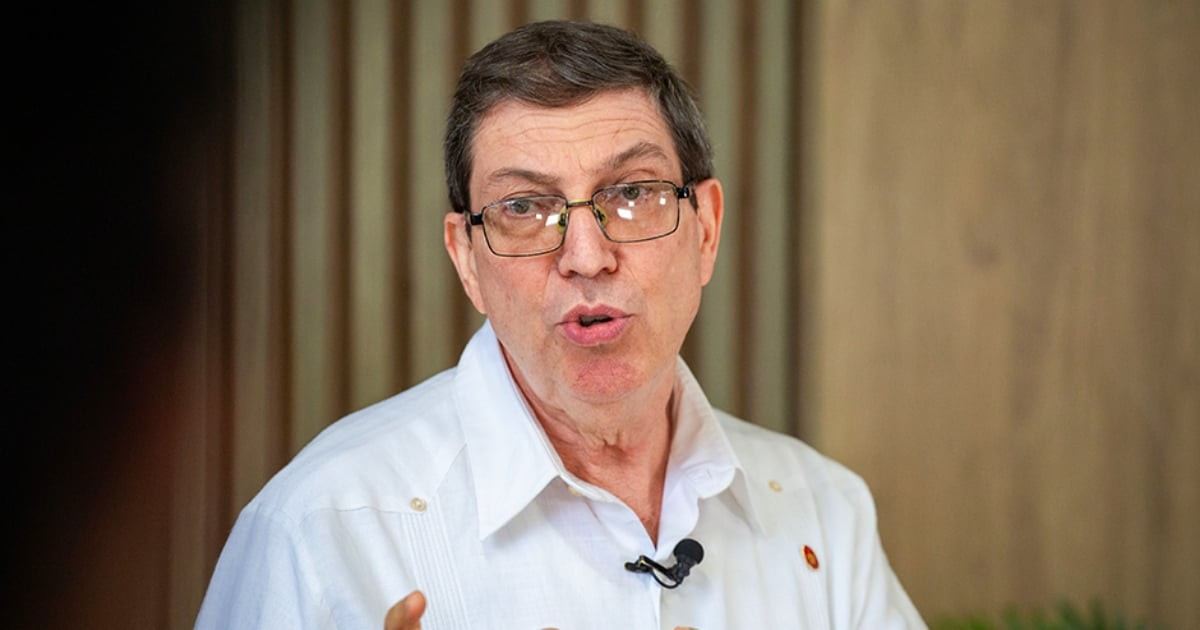
In a surprising turn of events, Cuban Foreign Minister Bruno Rodríguez Parrilla announced on Facebook this Thursday that the Cuban regime is "open to collaborating with the Catholic Church" to distribute the $100 million in humanitarian aid offered by the United States. Rodríguez emphasized that Havana is "willing to listen to the details of the offer and how it would be implemented."
This shift is noteworthy given Rodríguez's previous dismissal of the same offer as a "$100 million lie" on his X account just two days prior, where he denied receiving any formal proposal.
The change in stance comes a day after the U.S. State Department issued a formal statement reiterating the offer, explicitly conditioning the aid on its distribution through the Catholic Church and independent humanitarian organizations, without the involvement of the Cuban state.
Washington made its position clear: "It is up to the Cuban regime to accept our assistance offer or deny critical life-saving aid, ultimately being accountable to the Cuban people."
The U.S. has specific reasons for insisting on this channel. Following Hurricane Melissa, which struck eastern Cuba on October 29, 2025, as a category three storm, affecting over 2.2 million people, Washington provided $9 million distributed entirely through Caritas Cuba, ensuring the regime did not handle any funds.
As of May 8, 2026, Caritas had executed 82% of the first $3 million donation, aiding approximately 8,800 families in Santiago de Cuba, Holguín, Las Tunas, Granma, and Guantánamo.
A Model for Aid Distribution
This model—using the Church as an exclusive channel and excluding the regime—is precisely what the U.S. proposes to expand with the $100 million offer, which Senator Marco Rubio publicly disclosed on May 8 after meeting with Pope Leo XIV at the Vatican.
In his Thursday post, Rodríguez expressed the regime's skepticism, labeling the "apparent generosity" of the offer as "incongruent" given the "economic warfare" imposed on the Cuban people. He demanded the offer be "free of political maneuvering and attempts to exploit the needs and suffering of a besieged people."
Rodríguez reiterated Cuba's longstanding argument: "The best assistance the U.S. government could provide to the noble Cuban people at this and any time is to de-escalate the energy, economic, commercial, and financial blockade, which has intensified like never before in recent months."
Political Dilemma for the Regime
The regime faces a politically awkward situation: accepting the offer means acknowledging the legitimacy of an independent channel that bypasses them, while rejecting it would mean taking responsibility for denying large-scale aid to its own people amid prolonged blackouts.
Other regime officials have been more hostile: Deputy Minister Carlos Fernández de Cossío called the offer a "dirty political business," and the Cuban ambassador to Belgium dismissed it as "handouts," while Díaz-Canel accused the U.S. of wanting to take the Cuban people "hostage."
Since January 2026, the Trump administration has imposed over 240 sanctions against the regime, seized at least seven tankers, and reduced the island's energy imports by 80% to 90%, according to dossier data.
Congressman Carlos Giménez offered a blunt assessment of the situation: "The regime just wants to do what it always does: steal the aid and profit by reselling it to the people."
Questions About U.S. Aid to Cuba
Why is the U.S. insisting on the Catholic Church for aid distribution in Cuba?
The U.S. insists on using the Catholic Church to ensure that humanitarian aid reaches the Cuban people directly, without interference from the Cuban regime, based on successful past experiences like the aid distribution after Hurricane Melissa.
What are the political implications for Cuba in accepting or rejecting U.S. aid?
Accepting the aid would mean recognizing the legitimacy of an independent channel that excludes the regime, while rejecting it could lead to international criticism for denying crucial assistance to its own population.