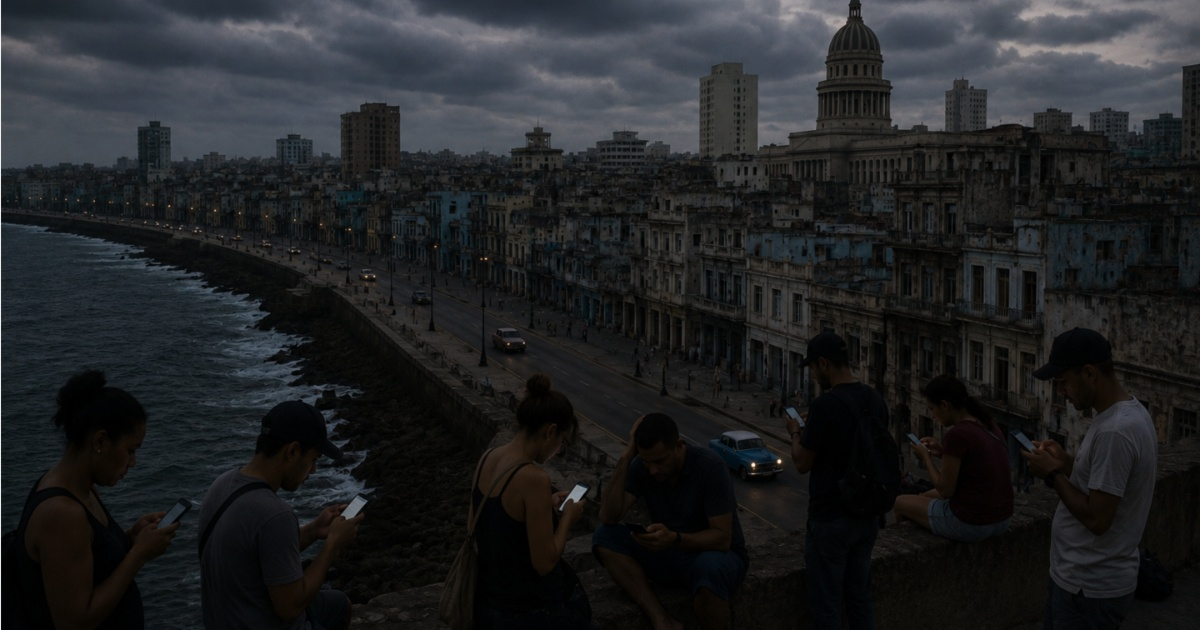
In the early hours of Thursday, reports surfaced from Cuban journalists and activists about a widespread internet blackout in Havana, coinciding with a surge of protests against the ongoing energy crisis in several neighborhoods of the capital.
Journalist Mag Jorge Castro (@MagJorgeCastro) highlighted the situation on X, writing at 2:48 a.m., "The regime cuts off communications amidst the capital's protests," noting a "massive internet outage in Havana." Fellow journalist Mario J. Pentón also shared the news across his social media platforms.
Escalating Social Tensions Erupt in Protests
This internet disruption follows two days of intense social unrest. Between May 12 and 13, residents of Luyanó blocked the Calzada de Concha during a cacerolazo protesting the power cuts, while another protest took place in Reparto Bahía under the slogan "Down with the dictatorship!"
In San Miguel del Padrón, demonstrators gathered outside the municipal government headquarters, chanting "Electricity and food!" Meanwhile, in Nuevo Vedado, residents protested after enduring 24 consecutive hours without power.
On Thursday, according to a video shared by Pentón, police violently suppressed protesters in the Playa municipality.
Energy Crisis Fuels Unrest
The underlying cause of these demonstrations is the ongoing energy crisis. This Thursday, Energy and Mines Minister Vicente de la O Levy admitted that power outages in Havana now exceed 20 to 22 hours daily, warning that the situation will worsen as the Russian oil donated in March runs out.
The state-run Unión Eléctrica reported a generation shortfall of 2,113 MW on Wednesday, with only 1,230 MW available against a demand of 3,250 MW.
Historical Precedent of Internet Outages
Cuba has a documented history of cutting internet access during protests. During the July 11, 2021 demonstrations, NetBlocks confirmed blocks on WhatsApp, Facebook, Instagram, and Telegram. On September 30, 2022, following protests after Hurricane Ian, the same organization reported an "almost total collapse of internet traffic from Cuba." In March 2026, during a nationwide blackout of the National Electroenergetic System, Cloudflare detected a 65% drop in internet traffic from the island.
The state monopoly ETECSA controls the country's entire telecommunications infrastructure, enabling centralized shutdowns whenever the regime seeks to curb the spread of protest images and testimonies.
According to Cubalex, at least 14 individuals have been arrested in Havana linked to cacerolazo protests since March 6. The Cuban Observatory of Conflicts documented 1,133 protests in April 2026, marking a 29.5% increase over the same month the previous year, reflecting a steady rise in social unrest on the island.
Understanding Cuba's Energy Crisis and Internet Blackouts
What triggered the internet blackout in Havana?
The internet blackout in Havana coincided with widespread protests against severe power outages, believed to be a tactic by the regime to suppress communication and information sharing during times of unrest.
How severe is the energy crisis in Havana?
The energy crisis in Havana is dire, with power outages exceeding 20 hours daily as reported by the Minister of Energy and Mines. The situation is expected to deteriorate further.
What historical patterns exist regarding internet shutdowns in Cuba?
Cuba has a history of internet shutdowns during protest periods, as seen during the July 11, 2021 demonstrations and after Hurricane Ian in September 2022. These shutdowns are often used to limit the spread of protest-related content.